SaaS Link Building
Toxic Backlinks: How to Spot Them and When to Disavow
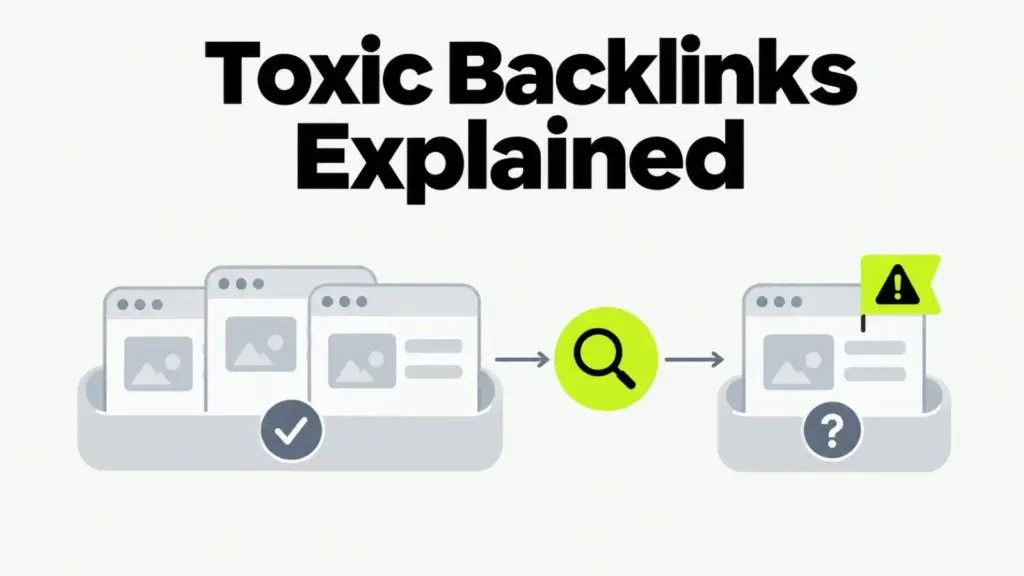
Toxic backlinks are links that violate Google's link spam policy, such as paid links that pass ranking credit, private blog networks and automated link schemes. A red score in an SEO tool doesn't make a link toxic. Most SaaS sites with odd-looking links need monitoring, not a disavow file.
What are toxic backlinks?
Toxic backlinks are inbound links that come from a link scheme or a spam source and put your site at risk of a penalty or lost trust. The test is Google's own definition, not a vendor's score.
Google's spam policies list the patterns: buying or selling links that pass ranking credit, excessive link exchanges, large-scale article or guest posting campaigns with keyword-rich anchors, and automated link creation. You can read them in Google's spam policies.
Two details matter. First, intent counts. A link you paid for or arranged is a problem. A scraper site copying your blog is just noise. Second, toxic describes a pattern more than a single link. One bad link rarely does harm. A cluster of exact-match anchors from a private blog network does.
Why do toxicity scores mislead SaaS teams?
Toxicity scores in third-party tools are estimates built from proxy signals like low traffic, thin content or spammy-looking neighbors. Google doesn't use them, and they flag plenty of harmless links.
SaaS sites get hit by this more than most. A product that gets scraped, listed in directories and copied by aggregator sites will always show hundreds of low-quality links that nobody built. Google has long said it is good at ignoring that kind of link.
Skip any workflow that ends with "disavow everything above 60% toxic". It costs hours and can remove links that were helping you. Use the score as a sorting aid and nothing more. For better signals, see backlink quality signals beyond domain rating.
How do you spot a toxic backlink?
A toxic backlink shows a pattern you or someone on your behalf could have created, and that matches a Google spam policy. Look for five signals together, not one alone.
- Exact-match commercial anchors repeated across unrelated sites, such as the same "best SaaS CRM" phrase on dozens of domains.
- Sites that exist only to sell links: no real audience, rotating topics, "write for us" pages with prices.
- Sudden bursts of links from unrelated languages or niches with no matching launch, press or campaign.
- Footprints of a network: shared hosting, templated design, identical author bios, links to many unrelated clients.
- Links you or a past vendor paid for without a sponsored or nofollow attribute.
A link that fails only one of these is usually fine. A group that fails three or more is worth a closer look. If you inherited a domain, run the full process in the backlink profile audit guide.
What should you do before you disavow?
Before you disavow anything, check for a manual action, group your links by pattern, and try to get the worst ones removed at the source. A disavow file is the last step, not the first.
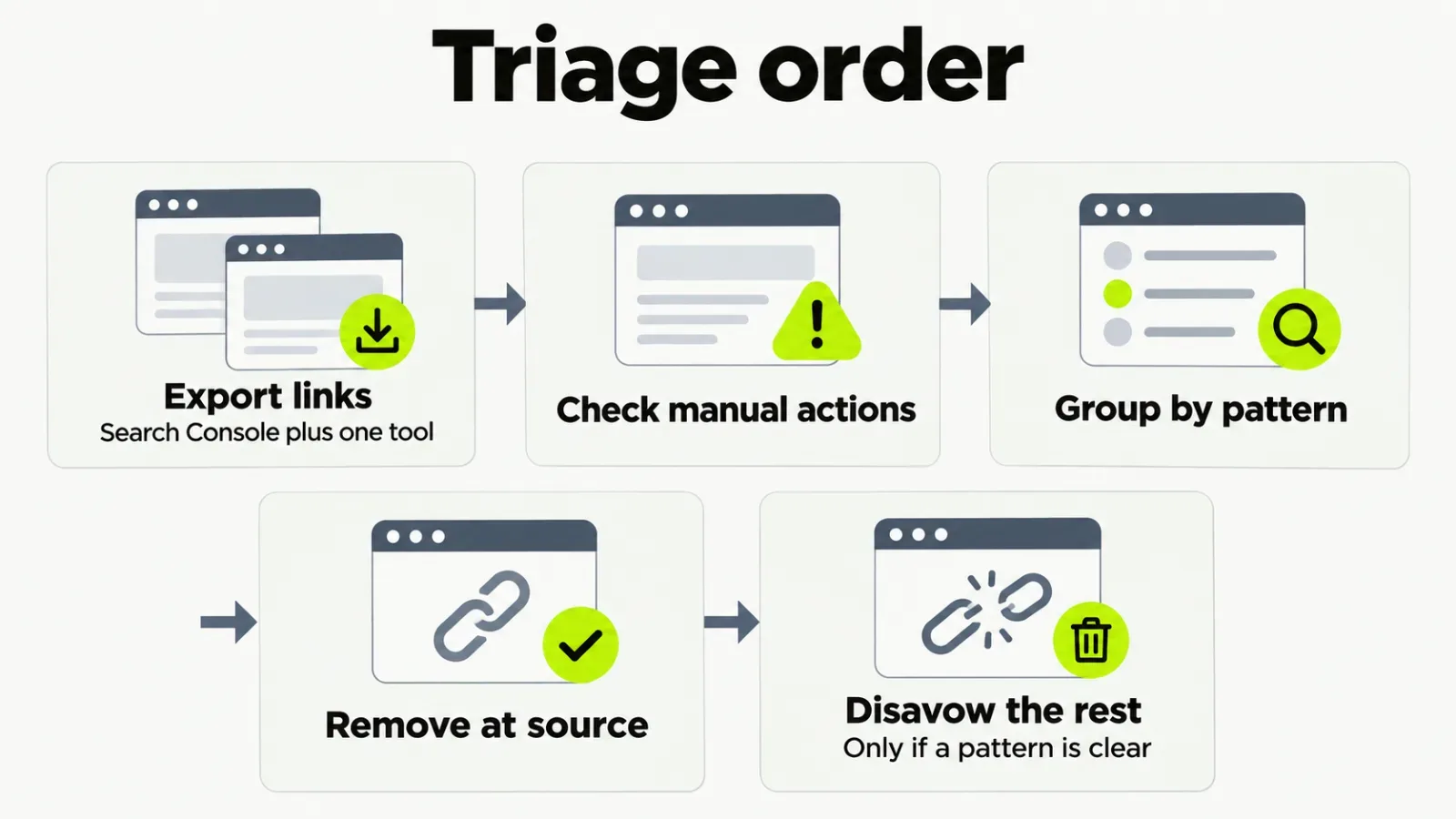
- Export links from Google Search Console and one third-party tool, since neither shows everything.
- Open the Manual Actions report in Search Console. No message means Google hasn't penalized you manually.
- Group links by pattern (network, directory, scraper, paid), not one by one.
- For paid or arranged links, ask the site owner to remove the link or add a sponsored attribute.
- Only then consider a disavow file for patterns you can't remove.
Ongoing, backlink monitoring tells you which changes deserve this effort and which are noise.
When is a disavow file worth filing?
A disavow file is worth filing when you hold a manual action for unnatural links, or when you can document a clear pattern of paid or spam links you can't remove and that you expect to hurt you. Otherwise, leave it alone.
Google's disavow documentation calls it an advanced feature and warns that using it incorrectly can hurt your site's performance. Treat that as a real warning. Disavowing is also not a repair for weak rankings. Poor content or missing links more often explain a stall than bad links do.
Here is a simple decision rule:
| Situation | Action |
|---|---|
| Manual action for unnatural links | Remove what you can, disavow the rest, file a reconsideration request |
| Past vendor built paid or network links | Document them, request removal, disavow the remaining domains |
| Scrapers, directories, random spam | Ignore |
| Tool shows a high toxicity score, nothing else | Ignore |
| Sharp link spike with no explanation | Investigate first, disavow only if a pattern is confirmed |
Disavow at the domain level when a whole site is spam. Use single URLs only when the rest of the domain is legitimate.
Run this triage this week
Export your links from Search Console, open the Manual Actions report, and sort the list by anchor text and linking domain. Mark any group that matches the five signals above. If nothing matches, write that down and move on. If something does, start with removal requests before you touch the disavow tool.
If your link count looks wrong against the sites linking to you, check referring domains before counting raw links.
Frequently asked questions
Yes, but only a pattern of spam links you built or paid for. Google says it ignores most spam links it finds on its own. The real risks are a manual action or a link scheme that Google's systems discount along with the value you hoped to gain.
It is rare, and Google says its systems are built to handle it. If you see a sudden flood of obvious spam, watch it, keep a record, and disavow only if you receive a manual action or the pattern grows.
No. A low domain rating is not a policy violation. Small, new and niche sites often link naturally and relevance counts for more than the score.
Google processes the file when it recrawls the linked pages, so the effect isn't immediate and can take weeks. Don't expect a rankings change on any fixed schedule.
No. Links with rel="nofollow" or rel="sponsored" are the correct way to mark paid or untrusted links under Google's guidance. They are not a risk in themselves.