SaaS link building
How to Calculate Link Building ROI for B2B SaaS (2026 Methodology)
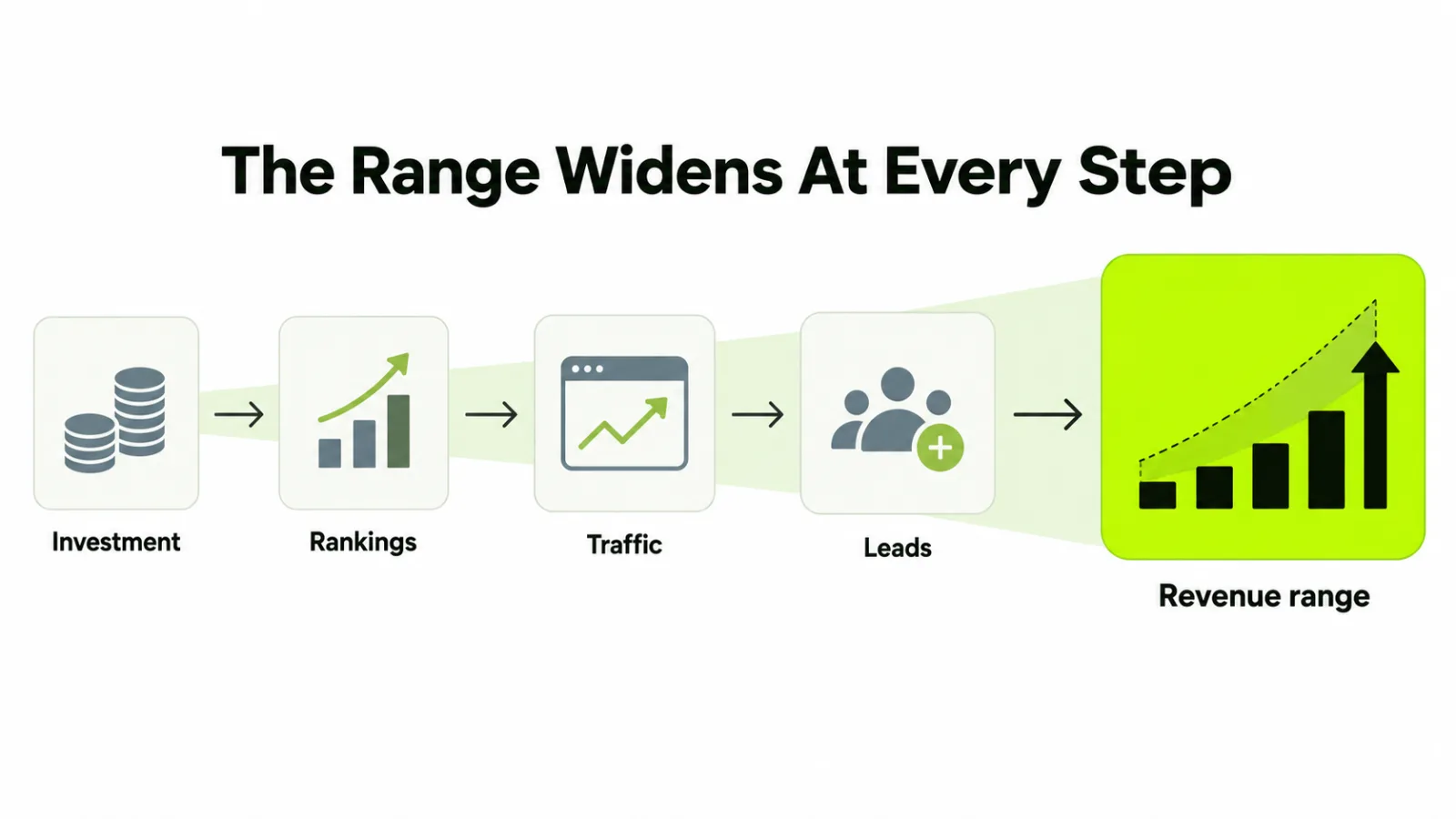
Calculating link building ROI for B2B SaaS isn’t one formula. It’s a chain of estimates connecting link investment to ranking improvements, ranking improvements to organic traffic, organic traffic to qualified leads, leads to pipeline, and pipeline to closed-won ARR. Each link in the chain has a defensible benchmark, but the chain adds uncertainty. The right approach is to model conservatively, project ranges (not single numbers), and validate assumptions quarterly against actual outcomes. This is the complete methodology behind our free ROI calculator.
The five-step ROI chain
Link building ROI for B2B SaaS follows a deterministic five-step model. Investment in link building causes ranking improvements (step 1). Ranking improvements drive organic traffic increases (step 2). Organic traffic converts to marketing-qualified leads at a stable rate (step 3). MQLs convert to opportunities and closed-won at category-typical rates (step 4). Closed-won ARR divided by the link building investment is your ROI multiple (step 5). Each step has measurable inputs and defensible benchmarks; the uncertainty grows across steps so the final ROI estimate is a range rather than a precise number.
Step 1: Link investment to ranking improvement
The hardest step to model precisely. The same dollar invested in two different agencies, two different categories, or two different time periods produces different ranking improvements. The benchmark we use is based on observed outcomes across 200+ B2B SaaS companies in our 2026 sample: a competently-executed $10,000/month engagement typically moves 5-15 commercial keywords by 3-7 ranking positions over 12 months, with significant variance by category competitiveness and starting authority position.
The variables that drive variance: starting domain authority (lower DR sites see bigger position movements per investment dollar but from lower bases), category competitiveness (high-competition categories require more investment per position), execution quality (specialist agencies typically outperform generalists by 30-50 percent at similar spend), and time (the first 6 months produce less movement than months 7-12 due to indexing and authority growth lag).
Step 2: Ranking improvement to organic traffic
This step has the cleanest math because click-through-rate distributions for SERP positions are well-studied. The 2026 CTR curves for B2B commercial intent queries, adjusted for AI Overview presence:
Position 1: 25-30 percent CTR (down from 35 percent pre-AIO). Position 2: 12-18 percent. Position 3: 8-12 percent. Position 4: 5-8 percent. Position 5-10: 2-5 percent each, declining. Below position 10: under 2 percent combined.
Apply your input keyword search volumes to these curves. A keyword with 1,000 monthly searches yields ~250-300 monthly clicks at position 1, ~80-120 at position 3, ~30-50 at position 5. Moving from position 8 to position 3 on that keyword adds ~50-90 monthly visitors; moving from position 5 to position 1 adds ~200-250.
Step 3: Organic traffic to qualified leads
This step uses your own conversion rates, not benchmarks (yours are more accurate than averages). The math: organic visitor count × visitor-to-MQL conversion rate = new MQLs. B2B SaaS organic-traffic-to-MQL rates typically cluster between 1-3 percent. Variables: content quality and intent match (a page that perfectly matches buyer intent converts higher), funnel-stage matching (top-of-funnel content converts lower than bottom-of-funnel), and CTA design (clear primary CTA vs scattered).
If you don’t have your own conversion data yet, use 1.5 percent as a starting estimate for B2B SaaS, with sensitivity testing at 1 and 2.5 percent to bracket your range.
Step 4: MQL to closed-won ARR
Two sub-conversion rates: MQL-to-SQL (or opportunity) and opportunity-to-closed-won. The combined funnel from MQL to closed-won varies enormously by category: typical B2B SaaS ranges from 3 percent (highly competitive enterprise) to 15 percent (low-friction self-serve). Multiply by your average ACV to get expected ARR per closed-won deal.
For modeling purposes, use your actual closed-won conversion rate from the last 90 days. If you don’t have stable data yet, 8 percent is a reasonable starting estimate with sensitivity bracketing at 5 and 12 percent.
Step 5: Computing the ROI multiple
Sum the projected 12-month new ARR from all targeted keywords. Divide by the total 12-month link building investment. The result is your ROI multiple. Multiples above 5x are considered strong for B2B SaaS organic investment; multiples above 10x are excellent; multiples above 20x usually indicate either underpriced market conditions in your category or unrealistic assumptions somewhere in the chain.
Adjusting for AI search traffic
The traditional ROI model captures Google organic traffic. As AI engines absorb 30-50 percent of B2B SaaS top-of-funnel buyer attention, the model under-estimates true link building ROI by missing the AI citation appearance value. The adjustment: add 15-30 percent to projected outcomes for engagements that include AEO/GEO work (this is the AI-attributed traffic that the traditional model misses). Skip the adjustment for link-only engagements without AI search optimization.
What conservative modeling looks like
For decision-making with finance or your CFO, use these conservative assumptions: middle-of-range CTR curves (not optimistic), 1.5 percent traffic-to-MQL (not 2.5 percent), your actual closed-won conversion rate, no AI search adjustment in the base case. The output will be lower than aggressive modeling but more defensible if outcomes are reviewed at month 6 or 12.
Common ROI calculation mistakes
Using aspirational conversion rates instead of actual. Modeling only the best keyword improvement scenarios. Ignoring the lag period (most movement happens in months 6-12, not months 1-6). Comparing month-3 actuals to 12-month projections. Forgetting cumulative gains: links built in month 1 still drive traffic in month 12 and beyond, so 12-month investment delivers more than 12 months of returns.
Frequently asked questions
What ROI should I expect from link building?
5-15x is typical for well-executed B2B SaaS engagements over 12 months. Higher in low-competition categories, lower in enterprise software with long sales cycles.
How long until I can validate the model against actuals?
Quarterly check-ins at months 3, 6, 9, and 12. Month 12 is the meaningful validation point because most ranking movement pays off in the second half of the engagement.
Does this model work for content marketing more broadly?
Yes. Content marketing follows the same five-step chain. The key difference is that pure content (without link building investment) typically takes longer to pay off and produces smaller ranking improvements per dollar.
Related reading and tools
- Link Building ROI Calculator
- SaaS Link Building ROI Benchmarks 2026
- State of SaaS Link Building 2026
- How SaaS Founders Should Think About SEO ROI
- How Much Should SaaS Spend on Link Building?
- How to Evaluate Backlink Quality
- ← Back to All Free Tools
Want to model ROI against your specific stage, category, and competitive position? Book a strategy call and we’ll walk through the math with your actual numbers.