Fintech SaaS
Fintech SEO Agency for B2B SaaS: Link Building and Digital PR
In fintech, trust is everything. We earn authority from the finance and tech publications buyers and search engines trust, never low-risk volume links.
Pay per delivered placement. Month to month, no lock-in.
What a placement clears before it touches a regulated fintech brand
What you get
What’s included in a fintech link building engagement
Fintech-relevant prospecting
We target the finance, payments, and risk publications your buyers and partners read.
Compliance-aware placements
Every link respects how regulated a money business is. Nothing that reads as paid, risky, or off-message for fintech.
Finance-grade content & data
Original data and explainers credible enough for finance editors and a technical, skeptical buyer.
Digital PR to finance media
Earned coverage and citations from the outlets that shape trust in fintech.
Entity & AI-search authority
The consistent, well-referenced signals AI engines need before they’ll name a fintech tool in an answer.
Reporting tied to pipeline
Rankings, AI citations, relevant referring domains, and sourced demand, in plain numbers.
A fintech SEO agency earns your product visibility with buyers who are paid to distrust vendors. We do the off-page half of that job: editorial link building, digital PR and AI-search authority for B2B fintech SaaS.
We don’t run technical audits or write your blog on retainer. If that’s the gap, hire for it separately. What we do is earn the outside evidence that makes finance buyers, Google and AI assistants treat your company as a credible source.
This page covers how that works in a regulated category. It explains where fintech authority comes from, what compliance changes about outreach, which tactics backfire, and what the first quarter of a program looks like.
What does a fintech SEO agency actually do?
SEO is three jobs that get sold under one name. It helps to separate them before you hire anyone, because most disappointment with agencies comes from buying one job and expecting another.
| Job | What it covers | Who usually owns it | Where we fit |
|---|---|---|---|
| Technical | Crawling, indexing, site speed, structured data, site architecture | Your engineers, or a technical SEO consultant | Not our work |
| Content | Product pages, comparison pages, guides, documentation | Your content team, or a content agency | We advise on which pages can earn links |
| Authority | Links, press coverage and mentions from other sites | Nobody, in most fintech teams | This is the whole of our work |
The third job is where fintech programs stall. Technical work and content can be done from inside the building. Authority can’t, because it depends on what other people publish about you.
So our scope is narrow on purpose. We run link building, digital PR, brand mention work and the entity signals that decide whether AI assistants name you. If you want one agency for all three jobs, we’re the wrong call, and our comparison of SaaS link building agencies lists firms with a wider remit.
Why is SEO harder for fintech than for other SaaS?
Fintech is harder because Google holds money topics to a stricter standard, and so do the people buying.
Google says so directly. Its guidance on creating helpful, reliable content explains that its systems give more weight to signs of experience, expertise, authoritativeness and trust for topics that could significantly affect someone’s health, financial stability or safety. Google calls these Your Money or Your Life topics.
A payments platform, a lending engine and a treasury tool all sit inside that definition. A project management app doesn’t.
The buyer is stricter too. A CFO, a controller or a head of risk doesn’t shortlist a vendor from one search result. They check who else has written about the company, whether the claims hold up, and whether a publication they already read has covered it.
The third problem is who you’re competing with. Fintech search results are full of banks, card networks, payment processors and large finance publishers. Those sites have decades of links behind them, and they rank for the definitions of your own category.
The practical result is that link count means less here than in most software categories. Where the links come from carries the weight, and our guide to evaluating backlink quality covers how to judge that.
Where does fintech authority come from?
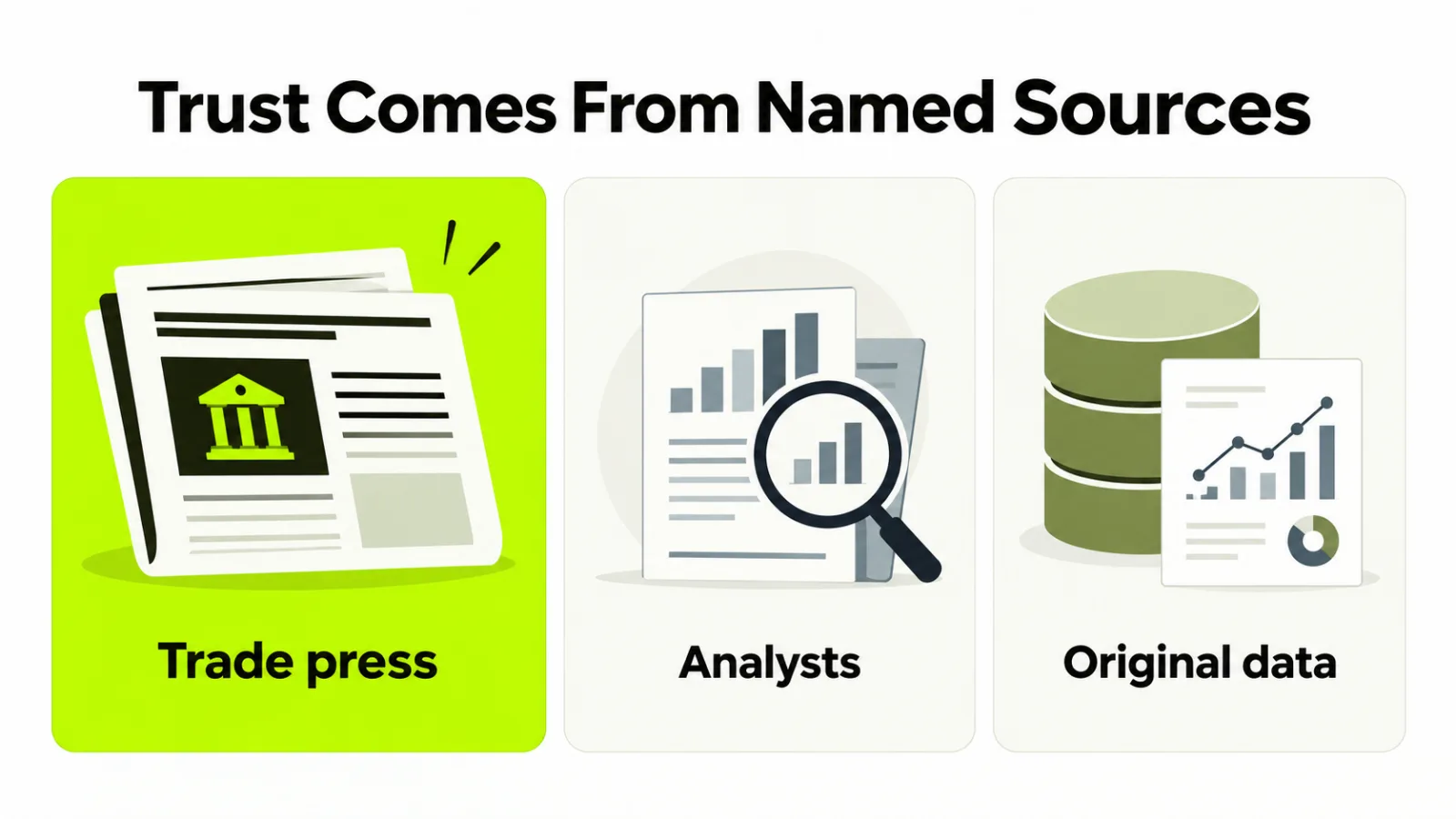
It comes from a short list of source types that finance people already trust. The same sources tend to move rankings and shape buying decisions, which is why they’re worth the effort.
| Source type | Examples | Why it carries weight | How a link is earned |
|---|---|---|---|
| Fintech trade press | Finextra, American Banker, PYMNTS, Fintech Futures, The Financial Brand | Read daily by bank and fintech operators | News, original data, expert commentary |
| Business and technology press | National business desks, technology publications, funding newsletters | Reaches founders, investors and generalist buyers | A real story: funding, data, a contrarian position |
| Analysts and research firms | Industry analysts, market-map publishers | Shapes enterprise shortlists | Briefings and inclusion in research, never purchase |
| Partner and integration ecosystems | Accounting and ERP app marketplaces, bank partner directories, payment partner programs | Shows the product works inside the buyer’s stack | Building the integration, then co-marketing it |
| Comparison and review sites | Software review platforms, independent “best software” roundups | Where shortlists get built, and where AI answers pull names | Genuine customer reviews, reviewer access |
| Your own original data | Benchmarks, indexes, annual reports | Becomes the source others cite for years | Publishing numbers nobody else has |
| Generic directories and link networks | “Finance guest post” sites, bulk directories | None. In a money category they read as manipulation | They’re bought, which is the problem |
The named publications are examples of where the category’s attention sits. They aren’t a placement list. No agency can promise an editor’s yes, and one that shows you a guaranteed list of finance outlets is showing you a rate card.
The pattern in the table is the useful part. Every row that carries weight involves someone outside your company deciding you were worth mentioning. The last row involves a payment, and it carries none.
What does compliance change about fintech link building?
It changes the timeline and the wording. In most SaaS categories a founder can approve a guest article in an afternoon. In fintech, the same article may need sign-off from compliance, legal or a partner bank.
Three sets of rules come up most often. Which ones apply depends on your licences and partners, so treat this as a map and take the detail to your own counsel.
| Rule | Who it reaches | What it changes in outreach |
|---|---|---|
| FINRA Rule 2210, Communications with the Public | Broker-dealers, and fintechs that distribute through one | Bylines, quotes and data stories may count as communications that need review before they go out |
| SEC Marketing Rule for investment advisers | Registered advisers and platforms built for them | Testimonials, endorsements and performance figures carry conditions |
| FTC Endorsement Guides | Every company, in every category | A paid or incentivised mention has to be disclosed |
FINRA’s content standard is short. Member communications must be “based on principles of fair dealing and good faith” and “must be fair and balanced”. An article that promises returns, or leaves out a material risk, fails that test whoever wrote it.
The FTC’s position applies to everyone. Its guidance says that if there’s a connection between an endorser and a marketer that consumers wouldn’t expect, and it would affect how they weigh the endorsement, “that connection should be disclosed clearly and conspicuously.”
That lines up with Google’s own rule. Google asks sites to mark paid links with a sponsored attribute, which stops them passing ranking value. A paid finance placement is either disclosed and worthless for rankings, or undisclosed and a problem with two regulators at once.
Partner banks add a fourth layer. If your product runs through a sponsor bank, your program agreement probably gives that bank approval rights over marketing copy. A guest article about your lending product can count.
Here’s how that shapes a campaign in practice.
- Approval time goes in the plan. We agree who signs off and how long it takes before the first pitch goes out. A journalist on deadline won’t wait five days for a quote.
- Experts get pre-cleared topics. Your head of compliance can comment on a rule change the same day if the boundaries were agreed in advance.
- No performance promises in bylines: Claims about returns, savings or approval rates need a source your team would defend.
- Every placement is logged. The record includes the final copy, the approval and the date, so a later exam has a paper trail.
We aren’t your compliance function and nothing here is legal advice. The point is that an agency which has never asked who approves your copy hasn’t worked in this category.
Which link building methods work for fintech SaaS?
The methods that work give a finance editor something they couldn’t get elsewhere. Seven of them carry most fintech programs.
Original data and benchmarks: Your product sees transactions, approvals, invoices or disputes that no survey can reach. Aggregated and anonymised, that becomes a benchmark journalists return to each year. Our guide to linkable assets covers what’s worth building.
Expert commentary on rule changes: Finance reporters need a named specialist every time a regulator publishes something. A head of compliance or fraud who answers quickly, in plain language, becomes a regular source. That’s the core of digital PR in this category.
Regulatory explainers: A clear, accurate page on what a rule requires gets cited by trade press, consultants and law firm blogs. It has to be right, and it has to be kept current, or it becomes a liability.
Integration and partner pages: Each accounting platform, ERP or bank you connect to has a marketplace or partner directory. Those listings are relevant links, and partners will often co-publish a launch.
Comparison content and software roundups: Finance teams build shortlists from “best accounts payable software” articles, and so do AI assistants. Getting included honestly is its own discipline, covered in our guide to listicle link building.
Unlinked mentions. Fintech companies get named in funding news and partner announcements without a link. The publication already decided you were worth naming, so asking costs one email. Our link reclamation guide covers the process.
Editorial guest contributions: An article you pitched, that an editor could have turned down, is editorial work. The same article on a site with a price list is a paid placement. Our page on white hat link building gives the test that separates them. Our post on guest posts for SaaS SEO covers when they’re worth the effort.
None of these is fast. They share one property that matters in fintech: you could describe every one of them to a regulator, an investor or an acquirer without changing the story.
How does the plan change by fintech segment?
“Fintech” covers buyers who have almost nothing in common. A payments engineer and a credit union compliance officer don’t read the same publications, so the source map has to be drawn per segment.
| Segment | Who buys | Strongest link asset | Where it gets cited |
|---|---|---|---|
| Payments and billing infrastructure | Heads of payments, finance leaders, engineers | Payments performance data, developer documentation | Payments trade press, developer communities |
| Spend management, AP and AR automation | Controllers, CFOs, finance operations | Finance-operations benchmarks, close and audit templates | Accounting press, CPA communities, ERP marketplaces |
| Lending and credit infrastructure | Credit risk and lending operations teams | Credit trend data, underwriting explainers | Lending trade press, bank and credit union publications |
| Banking-as-a-service and embedded finance | Product leaders and compliance officers | Regulatory explainers, program-management guides | Banking press, law firm and consultancy blogs |
| Regtech, KYC, AML and fraud | Compliance, risk and fraud teams | Fraud trend reports, typology explainers | Compliance and fraud publications |
| Insurtech | Carriers, MGAs, brokers | Claims and underwriting data | Insurance trade press |
| Wealth and adviser technology | Advisory firms and broker-dealers | Practice-management research | Adviser trade press, with the tightest review rules |
Two things follow from the table. A general “fintech link building package” can’t be right for all seven rows. And the asset column matters more than the outreach, because a good list of publications with nothing worth citing produces no links.
What should fintech companies avoid?
Avoid anything where payment decides the link. Google’s spam policies list buying or selling links for ranking purposes as link spam, along with excessive link exchanges and automated link creation.
In fintech the usual offers look more respectable than that description suggests. These are the ones worth recognising.
- Finance guest post packages: A list of sites, a price per site, and a guarantee. The guarantee is the giveaway, because nobody can promise editorial approval on a schedule.
- Private blog networks with finance branding. They ship with a masthead and author bios now. Every site accepts every topic, which is how you spot them. Our PBN definition covers the footprints.
- Bad neighbourhoods: A lending platform linked from pages that also link to casinos and payday offers has told Google who its neighbours are.
- Bought reviews: The FTC’s rule on fake reviews and testimonials prohibits paying for reviews that must express a particular sentiment, and undisclosed reviews by company insiders.
- Exact-match anchors at volume: Twenty links that all say “best payments API” look arranged, because they were. Our guide to anchor text penalties covers the patterns.
The cost in fintech isn’t only a ranking drop. A bought link profile turns up in diligence. An acquirer’s SEO review, or a bank partner’s vendor assessment, will find it faster than Google does.
How do AI assistants decide which fintech vendors to name?
They name vendors that already appear across sources the assistant retrieves. There’s no separate trick for it, and Google says so in plain terms.
Its documentation on AI features and your website states: “There are no additional requirements to appear in AI Overviews or AI Mode, nor other special optimizations necessary.” A page has to be indexed and eligible to show with a snippet. That’s the bar.
The same page explains why authority matters more in AI answers than in a list of ten links. AI Overviews and AI Mode may use a “query fan-out” technique, “issuing multiple related searches across subtopics and data sources” to build one response.
Think about what that means for a finance buyer’s question. “Which accounts payable platform suits a 200-person company” becomes several searches: pricing, integrations, security posture, reviews, comparisons. A vendor that appears in several of those result sets gets named. A vendor that appears in one usually doesn’t.
ChatGPT works on a similar principle with its own crawler. OpenAI’s crawler documentation separates the bot used for search results from the one used for training, so blocking the wrong one in robots.txt can remove you from ChatGPT’s answers.
For a fintech company the work comes down to four things.
- Be present in comparison content. Roundups and review pages are what fan-out searches return.
- Keep your entity facts consistent. What you are, who you serve and what you’re certified for should read the same on your site, LinkedIn, Crunchbase and review profiles. Our guide to entity authority covers this.
- Answer the question in the first paragraph. Assistants quote pages that state the answer plainly.
- Earn mentions in sources the category trusts. This is the same work as the rest of this page.
Nobody can guarantee a citation in an AI answer. We track a fixed set of buyer prompts over time and report what changes. Our guide on getting cited by AI covers the method.
Which pages on a fintech site deserve links first?
Start with the pages that can earn links on merit, then use internal links to pass that authority to the pages that sell.
Product pages rarely earn links by themselves. No journalist links to a pricing page. That’s normal, and trying to force it is where bought links come from.
| Page type | Can it earn links? | Role in the plan |
|---|---|---|
| Original data or benchmark report | Yes, repeatedly | The main link target |
| Regulatory explainer or glossary entry | Yes, slowly | Steady citations from trade press and advisers |
| Integration and partner pages | Yes, from the partner | Relevant links from inside the buyer’s stack |
| Comparison and alternative pages | Sometimes | Captures buyers near a decision |
| Security and compliance page | Rarely | Answers diligence questions; link to it internally |
| Product and pricing pages | Almost never | Receives authority through internal links |
The mistake we see most is a link budget aimed at product pages with nothing linkable on the site. Our post on SaaS backlink strategy covers how to sequence the two.
What do the first 90 days look like?
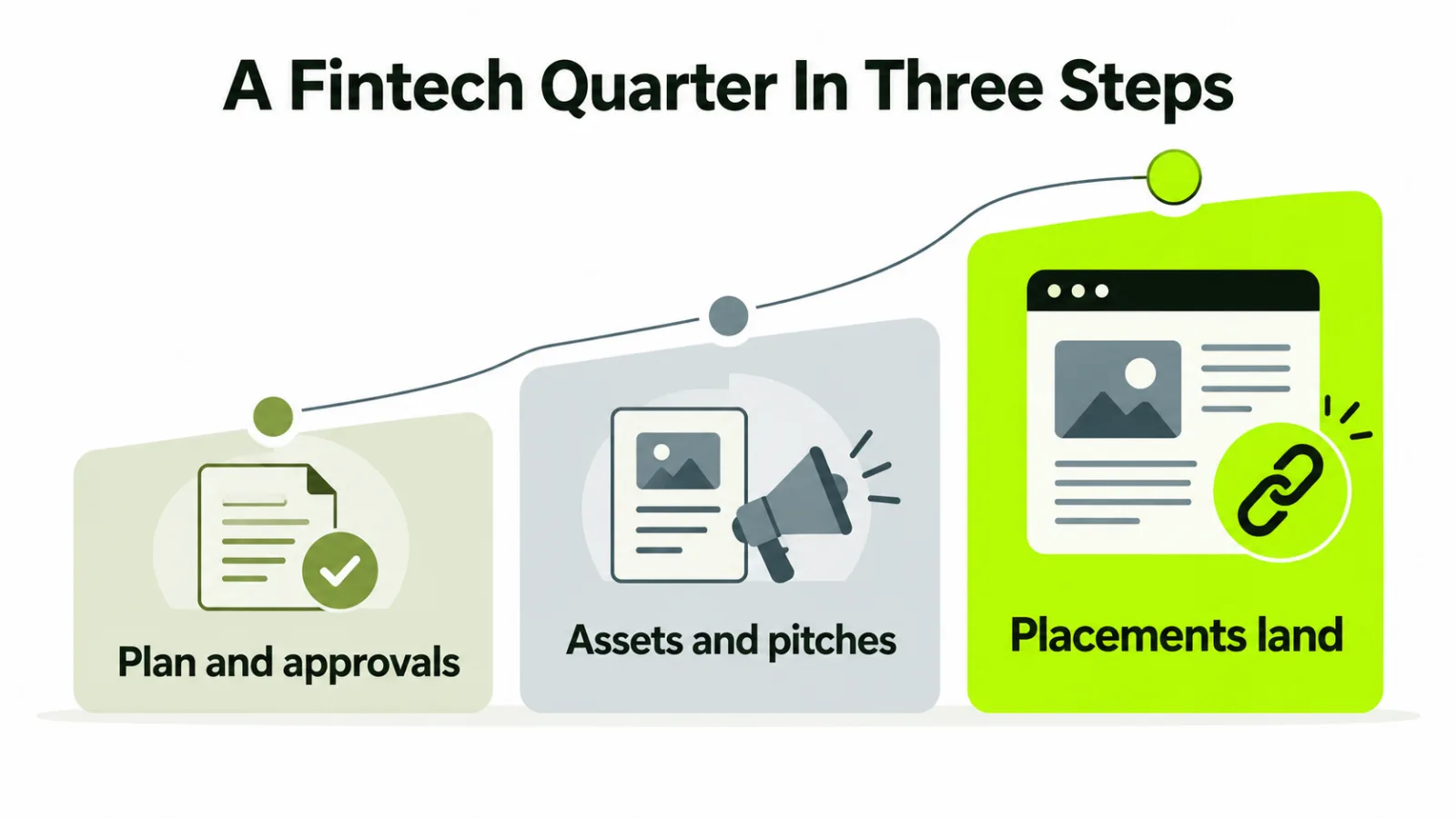
The first quarter is mostly groundwork. Links start landing in the back half, and the effect on rankings follows later still.
| Weeks | Work | What you see |
|---|---|---|
| 1 to 2 | Review of your link profile and three to five competitors. Source map by segment. Compliance workflow agreed. | A written plan: which sources, which assets, who approves |
| 3 to 6 | Asset work begins. Expert bench set up. First pitches go out. Unlinked mentions reclaimed. | Early wins from reclamation, first editor conversations |
| 7 to 12 | Placements start to land. Reporting begins. The mix is adjusted to what editors respond to. | A placement log with the reasoning behind each one |
We don’t commit to a fixed link count. A fixed count means the placements are bought. We commit to the standard each placement meets and to showing our reasoning.
Budget depends on stage more than on segment. Our pricing page publishes the monthly bands we see by funding stage, and link building budget by stage explains where they come from.
How is a fintech program measured?
It’s measured on authority and visibility first, and on pipeline once enough time has passed to see it.
- Relevant referring domains: New linking sites from finance, fintech and B2B technology sources. Irrelevant ones aren’t counted as progress.
- Rankings for commercial terms: Category, comparison and “software for” queries, tracked as a fixed set.
- Branded search. More people searching your name is the cleanest sign that coverage reached buyers.
- AI answer presence: Whether you’re named for a fixed list of buyer prompts, checked on a schedule.
- Organic pipeline: Demo requests and opportunities that started in search, reported by your CRM.
Attribution in fintech is slow because sales cycles are. A link earned in the first month can influence a deal that closes three quarters later. We report the leading indicators monthly and say plainly which ones haven’t moved. Our guide to SaaS SEO metrics covers the full set.
How do you choose a fintech SEO agency?
Ask about method before price. These seven questions separate an agency that earns links from one that resells them.
- Can I see the sites before a link goes live?
- Does money reach the publisher, in any form?
- Who on the publisher’s side approves the link?
- How do you handle our compliance review, and how long do you allow for it?
- What will you refuse to do for us?
- What happens when a link is removed six months later?
- Do you guarantee a number of placements, or a metric?
Google publishes its own advice on this. Its guide to hiring an SEO warns that no one can guarantee a number one ranking, and suggests asking a provider to explain exactly what they intend to do.
We’re the wrong fit in three cases. You need technical SEO or content production more than authority. You haven’t found product-market fit yet, so there’s nothing stable to build authority around. Or the budget sits below the level where this work pays off, which our pricing page puts at roughly $3,000 a month.
If none of those apply, book a strategy call. We’ll map where your authority gaps are and tell you whether we’re the right people to close them.
Frequently asked questions
Is a fintech SEO agency different from a SaaS SEO agency?
Yes, in two ways. Finance is a topic Google holds to a higher trust standard, so weak links do more harm. And outreach copy often needs compliance review before it goes out, which changes the timeline. A general SaaS agency can do the work if it has handled both.
Do you guarantee rankings or a number of links?
No. A guaranteed ranking isn’t something anyone can deliver, and a guaranteed link count means the links are bought. We commit to the standard every placement meets and to reporting what moved and what didn’t.
Which publications do you target for fintech clients?
The ones your buyers read, which depends on your segment. A payments API and a compliance platform have different trade press, analysts and communities. We build the source map with you in the first two weeks and never work from a fixed list of sites.
How does compliance review affect link building?
It adds approval time and limits what can be claimed. Bylines, quotes and data stories may need sign-off from compliance, legal or a partner bank. We agree the workflow before outreach starts, so experts can respond to journalists inside the deadline.
Can you work with a pre-seed or seed-stage fintech?
Usually not yet. Authority work pays off around a stable product and message. At the earliest stage, founder-led PR and a few strong partner integrations do more than a link building program. We’ll say so on the call instead of taking the engagement.
How long before a fintech program shows results?
Placements start landing in the second and third month. Ranking movement for competitive terms usually takes two to three quarters, because Google has to recrawl the linking pages and the effect builds as more arrive. Pipeline follows the sales cycle after that.
Do unlinked brand mentions help in fintech?
They do. Search engines and AI assistants read companies as entities, so a credible mention in finance media adds to how well you’re recognised even with no link attached. We reclaim the link where the publication allows it and count the mention either way.
Do you also handle technical SEO and content?
No. We do the off-page work: links, digital PR, brand mentions and AI-search authority. We’ll tell you which pages are worth building links to and which need work first, and we’re glad to work alongside your content team or another agency.
More on fintech SaaS
- Fintech SaaS SEO
- Fintech SaaS Guest Posting
- Fintech SaaS Digital PR
- Fintech SaaS Content Marketing
- Case study (composite, anonymised): Series B fintech payments platform, DR47 to DR64.
Reporting
How results are measured
We report on rankings, AI citations, referring domains and pipeline. We don’t show numbers we can’t stand behind.
Representative results
- DR38 to DR58 in 12 months, HIPAA compliance healthtech SaaS.
- Pipeline contribution 6% to 22%, mid-market customer success SaaS.
- Top-3 against Splunk and Datadog, cloud-native SIEM SaaS.
Composite, anonymized accounts based on real client engagements. Client identities and exact metrics are generalized for confidentiality.