HR-tech SaaS
HR Tech SEO Agency: Link Building for HRMS, HRIS and Payroll Software
HR buyers buy on trust. We earn authority from People publications, analysts and original workforce data that journalists cite and AI engines surface.
Pay per delivered placement. Month to month, no lock-in.
The bar a placement clears before it reaches a People audience
What you get
What’s included in an HR-tech link building engagement
HR-relevant prospecting
We target the People, HR, and future-of-work publications your buyers and analysts read.
Workforce data & studies
Original people-data and benchmarks that journalists and analysts want to cite.
Digital PR to HR media
Earned coverage and expert citations from the outlets that shape HR-tech opinion.
Practitioner-grade content
Useful, credible content for HR and People leaders.
Community & analyst presence
Authority in the communities and analyst conversations where HR-tech gets shortlisted.
Reporting tied to pipeline
Rankings, AI citations, relevant referring domains, and sourced demand, reported plainly.
An HR tech SEO agency helps HR software get found and trusted by the people who buy it. We do the off-page side for B2B HR software, including HRMS, HRIS, payroll and applicant tracking platforms: editorial link building, digital PR and AI-search authority.
We don’t audit your site’s code or write your blog. Our work is earning the outside references, from HR publications, analysts, review platforms and partners, that make a People leader put a vendor on the shortlist.
This page covers how that works for HR software. It explains which terms buyers search, where authority comes from, how the plan differs for HRMS, payroll and ATS vendors, and what to expect in the first quarter.
What does an HR tech SEO agency do?
SEO has three parts, and an agency may be selling any of them.
- Technical: Making sure search engines can crawl and index the site. This belongs to your engineers or a technical consultant.
- Content: Product pages, comparison pages, compliance guides and templates. This belongs to your content team.
- Authority: Links and mentions from other websites. This can’t be produced internally, because it depends on other people’s editorial choices.
Authority is the only part we work on. That covers link building, digital PR, brand mention recovery and the entity signals that decide whether AI assistants name your product.
If you want technical, content and links from one firm, our comparison of SaaS link building agencies includes full-service options.
HRMS, HRIS or HCM: which term should you target?
Target the one your buyers use, and check before assuming. The three terms overlap, vendors use them loosely, and the choice affects which pages you build and which publications will cover you.
| Term | What it usually means | Who tends to search it |
|---|---|---|
| HRIS, human resources information system | The core employee record: personal data, job history, documents, reporting | HR managers and operations leads replacing spreadsheets |
| HRMS, human resources management system | The core record plus payroll, time and attendance, and often recruiting | HR and finance leaders buying one system for several jobs |
| HCM, human capital management | A broad suite that adds talent, performance, learning and workforce planning | Enterprise HR and IT buying committees |
| Payroll software | Pay calculation, tax filing and payments | Payroll managers, finance leads, small business owners |
| ATS, applicant tracking system | Job posting, candidate pipelines and hiring workflows | Talent acquisition leads and recruiters |
These definitions are conventions, not standards. One vendor’s HRIS is another’s HRMS, and buyers pick up whichever word their last vendor used.
The safe approach is to let your own search data decide. Look at which term brings impressions to your site in Search Console, which one your customers use on sales calls, and which one the review platforms file you under. Then make that the primary term on one page and treat the others as close variants on the same page.
Building a separate page for each acronym usually splits the same audience across three weak pages. Our glossary entry on search intent explains how to tell whether two terms need two pages.
Why is SEO different for HR software?
Because the product holds employee data and runs payroll, the buyer is cautious and the content has legal weight.
The stakes are personal data and people’s pay. A mistake in an HR system can mean a missed paycheque or a compliance failure. Buyers respond by checking a vendor’s reputation from several directions before they’ll take a demo.
The purchase is made by a committee. HR leads it, and IT, finance and sometimes legal each have a veto. Each of them searches for something different: features, security, integrations, total cost.
Google treats the topic with care. Its guidance on helpful, reliable content says its systems give more weight to trust signals for topics that could significantly affect someone’s financial stability. Pay, tax and employment rights sit inside that.
Review platforms carry unusual weight: HR buyers lean heavily on peer reviews, and review sites tend to rank prominently for “best HR software” searches.
The combined effect is that sources matter more than volume. A reference from an HR publication or an employment law blog does more than a stack of general business links. Our guide to evaluating backlink quality explains how to judge the difference.
Where does HR tech authority come from?
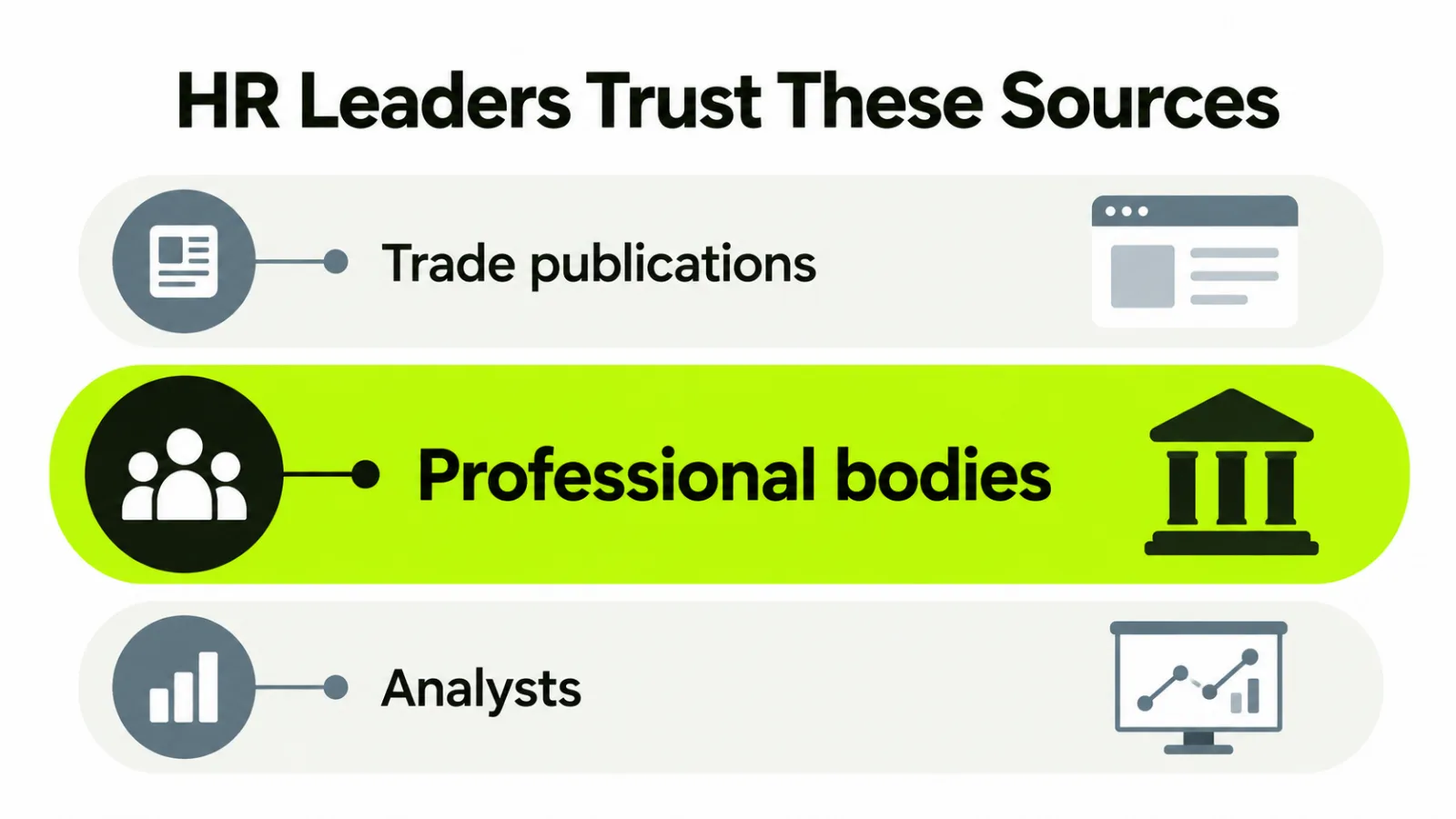
It comes from the publications, bodies and people that HR professionals already rely on to do their jobs.
| Source type | Examples | Why it carries weight | How a link is earned |
|---|---|---|---|
| HR trade publications | HR Dive, HR Executive, HR Brew, HRMorning, UNLEASH | Daily reading for People leaders | Workforce data, expert comment, contributed analysis |
| Professional bodies | SHRM and its regional chapters, payroll associations | Members treat their resources as reference material | Research partnerships, speaking, member resources |
| Analysts | Josh Bersin and other HR technology analysts | Shapes how the market is mapped and who gets shortlisted | Briefings and inclusion in research, never payment |
| Employment law and compliance blogs | Law firm blogs, compliance consultancies | They explain rule changes and cite tools and data | Accurate explainers, original data on compliance practice |
| Review and comparison platforms | Software review sites, independent roundups | Where shortlists form and AI answers find names | Genuine customer reviews, honest positioning |
| Integration marketplaces | Payroll, accounting and identity platform app directories | Shows the product fits the existing stack | Building the integration and co-marketing it |
| General business and small business media | Business publications, small business resource sites | Reaches owners and operators who buy without an HR team | Templates, calculators, plain-language guides |
| “HR write for us” sites and link networks | Sites that publish any article for a fee | None | They’re bought |
The names in the table show where the category’s attention sits. They aren’t a list of placements anyone can promise. An editor decides what runs, and that decision is what gives the link its value.
How does link building differ for HRMS, payroll and ATS vendors?
The buyer changes with the product, and so do the publications and the assets that work. Here’s the map, followed by the segments that need the most explanation.
| Segment | Who buys | Strongest link asset | Where it gets cited |
|---|---|---|---|
| HRMS and HRIS | HR directors, People operations, IT | Workforce benchmarks, HR policy templates | HR press, small business resources, implementation partners |
| Payroll | Payroll managers, controllers, owners | Tax and pay-rule explainers, calculators | Accounting press, payroll associations, bookkeeper blogs |
| ATS and recruiting | Talent acquisition leads, recruiters | Hiring data, interview and job description templates | Recruiting publications, career sites, university career centres |
| Performance and engagement | People leaders, team managers | Engagement research, manager toolkits | Leadership and management publications |
| Learning and development | L&D leads, HR business partners | Skills research, course design guides | Learning industry press, training communities |
| Benefits administration | Benefits managers, brokers | Benefits trend data, enrolment guides | Benefits trade press, broker networks |
| Time tracking and workforce management | Operations and site managers | Scheduling and overtime data | Industry-specific trade press, such as retail and hospitality |
| Global payroll and employer of record | Finance and People leaders hiring abroad | Country-by-country hiring guides | Remote work publications, startup and expansion media |
HRMS and HRIS platforms
An HRMS touches every employee record, so the vendor sees patterns no survey reaches: headcount change, time off taken, tenure, turnover by department. Aggregated and anonymised, that’s a benchmark report HR journalists will cite.
Templates are the second strong asset. An HR manager at a 60-person company needs a leave policy, an onboarding checklist and a review form. A good template library earns links from small business resource pages and gets shared between HR peers for years.
The difficulty is the breadth. An HRMS competes with payroll vendors, ATS vendors and enterprise suites at once, so the link plan has to pick the two or three use cases where the product is strongest and build depth there first.
Payroll software
Payroll content has to be correct, and it has to stay correct. Rates and thresholds change, and a page that was accurate last year can mislead this year.
That’s also the opportunity. A payroll vendor that keeps clear, current explainers earns links from accountants, bookkeepers and business writers who need something reliable to point to. The primary sources are public, such as the IRS’s guidance on employment taxes, and the value you add is making them usable.
Calculators work well here. A paycheque or overtime calculator that gives a correct answer gets bookmarked and linked. One that gives a wrong answer gets screenshots.
Applicant tracking and recruiting software
An ATS sees the hiring market in real time: how long roles stay open, how many applicants each attracts, where candidates drop out. That data is in demand from recruiting publications and from business reporters writing about the labour market.
Regulation is a live topic in this segment. New York City’s Local Law 144 prohibits employers from using an automated employment decision tool unless it “has been subject to a bias audit within one year of the use of the tool”, information about the audit is publicly available, and candidates have been given notice.
A recruiting vendor that explains rules like this accurately, and publishes its own audit results where they apply, earns references from employment lawyers and HR press. One that markets AI screening without addressing them is inviting scrutiny. The EEOC is the federal reference point for discrimination law in hiring.
Which link building methods work for HR software?
The ones that give HR professionals something they can use at work. Seven carry most programs.
Workforce data stories: A report built from your own platform data, pitched to HR and business reporters. This is the strongest method in the category, and our guide to linkable assets covers how to structure the report page.
Commentary on rule changes: Pay transparency, overtime thresholds and leave entitlements change often and by jurisdiction. A named compliance or People leader who explains a change clearly becomes a regular source. That’s what digital PR looks like in HR.
Templates and toolkits: Policies, checklists, review forms and letters. They earn links slowly and steadily, from a wide range of sites.
Calculators: Turnover cost, paycheque, overtime, time-to-hire. They need to be accurate and to show how the answer was reached.
Integration co-marketing: Each accounting, payroll and identity platform you connect with has a marketplace and a partner team. One integration can produce a directory listing, a launch post and a joint guide.
Review programs and roundups: Honest presence on review platforms, and inclusion in independent “best HR software” articles. Our guide to listicle link building covers how inclusion gets earned.
Editorial contributions: An article an editor could have declined. Our page on white hat link building gives the test that separates this from a paid placement. Our post on guest posts for SaaS SEO covers when they’re worth the effort.
How do privacy and compliance shape the plan?
They set the limits on what you can publish and how quickly. HR software holds some of the most sensitive data a company has, so every data story needs a privacy check before it becomes a pitch.
Four rules apply to almost every HR tech program.
- Aggregate, then publish: Report at a level where no employer and no employee can be identified. Set a minimum group size and hold to it.
- Check what your contracts allow: Customer agreements often limit how their data can be used, even in aggregate. Legal should confirm before the analysis starts.
- Respect data protection law: Employee records are personal data. If you serve European customers, the EU’s data protection rules govern what you can do with them.
- Date every compliance page: Show when it was last reviewed and which jurisdiction it covers. An undated explainer on overtime rules is a risk to the reader and to you.
Reviews need the same care. The FTC’s rule on fake reviews and testimonials prohibits compensation conditioned on a review expressing a particular sentiment, and reviews by company insiders who don’t disclose the connection. A review drive that offers a gift card for five stars breaks it.
None of this is legal advice, and we aren’t your privacy counsel. We build the review step into the workflow so a data story doesn’t go out before the right person has cleared it.
What should HR software companies avoid?
Avoid any tactic where a payment produces the link, and any content you couldn’t defend to an employment lawyer.
- Bought links: Google’s spam policies list buying or selling links for ranking purposes as link spam.
- Undisclosed sponsored posts. Google asks sites to mark paid links as sponsored, which stops them passing ranking value.
- Pay-to-win awards. Many “best HR tech” award programmes charge an entry or licensing fee, and a buyer can check which ones do.
- Compliance content written for keywords: A thin page on a wage rule, published to rank and never updated. It’s the fastest way to lose an HR reader’s trust.
- Templates presented as legal advice. Label them as starting points and say that local law varies.
- Identical anchors: Thirty links reading “best HRMS software” look arranged. Our guide to anchor text penalties covers the patterns that get sites demoted.
How do AI assistants decide which HR software to recommend?
They recommend products that appear across the sources they retrieve for a question. HR buyers ask very specific questions, which makes this channel well suited to the category.
Google states that nothing special is needed. Its page on AI features and your website says a page must be indexed and eligible to be shown with a snippet, and that there are “no additional requirements to appear in AI Overviews or AI Mode”.
The same page describes how answers get built. AI Overviews and AI Mode may use “query fan-out”, which means issuing several related searches across subtopics and combining the results.
Take a question like “what’s the best HRIS for a 150-person company with staff in two countries”. The related searches cover company-size fit, multi-country payroll, pricing, integrations and reviews. A product that shows up in several of those is likely to be named.
For HR software, three things have the most effect.
- State who you’re for: Company size, countries supported, industries served and integrations, on the page and in plain words. Assistants match these to the question.
- Build review depth. Enough genuine reviews, spread over time, on the platforms the category uses.
- Keep facts consistent. The same headcount range, pricing model and feature list across your site, review profiles and partner listings. Our guide to entity authority explains why mismatches cost you.
Also check robots.txt. OpenAI’s crawler documentation lists different bots for search and for training, and blocking the search bot takes you out of ChatGPT’s search answers.
We can’t promise an AI citation. We track a set of buyer prompts over time and report what changes, as described in our guide on getting cited by AI.
Which pages on an HR software site earn links?
Data, templates and tools earn them. Product pages get their authority second-hand, through internal links.
| Page type | Can it earn links? | Role in the plan |
|---|---|---|
| Workforce data and benchmark reports | Yes, strongly | The main link target and press hook |
| Template and policy libraries | Yes, steadily | Wide spread of small, relevant links |
| Calculators | Yes | Bookmarks, resource-page links |
| Compliance explainers | Yes, if current | Citations from advisers and trade press |
| Integration pages | From partners | Links from inside the buyer’s stack |
| Product and pricing pages | Rarely | Receive authority through internal links |
The usual fault is a template library that never links to the product it relates to. The authority arrives and goes nowhere. Our post on SaaS backlink strategy covers how to route it.
What do the first 90 days look like?
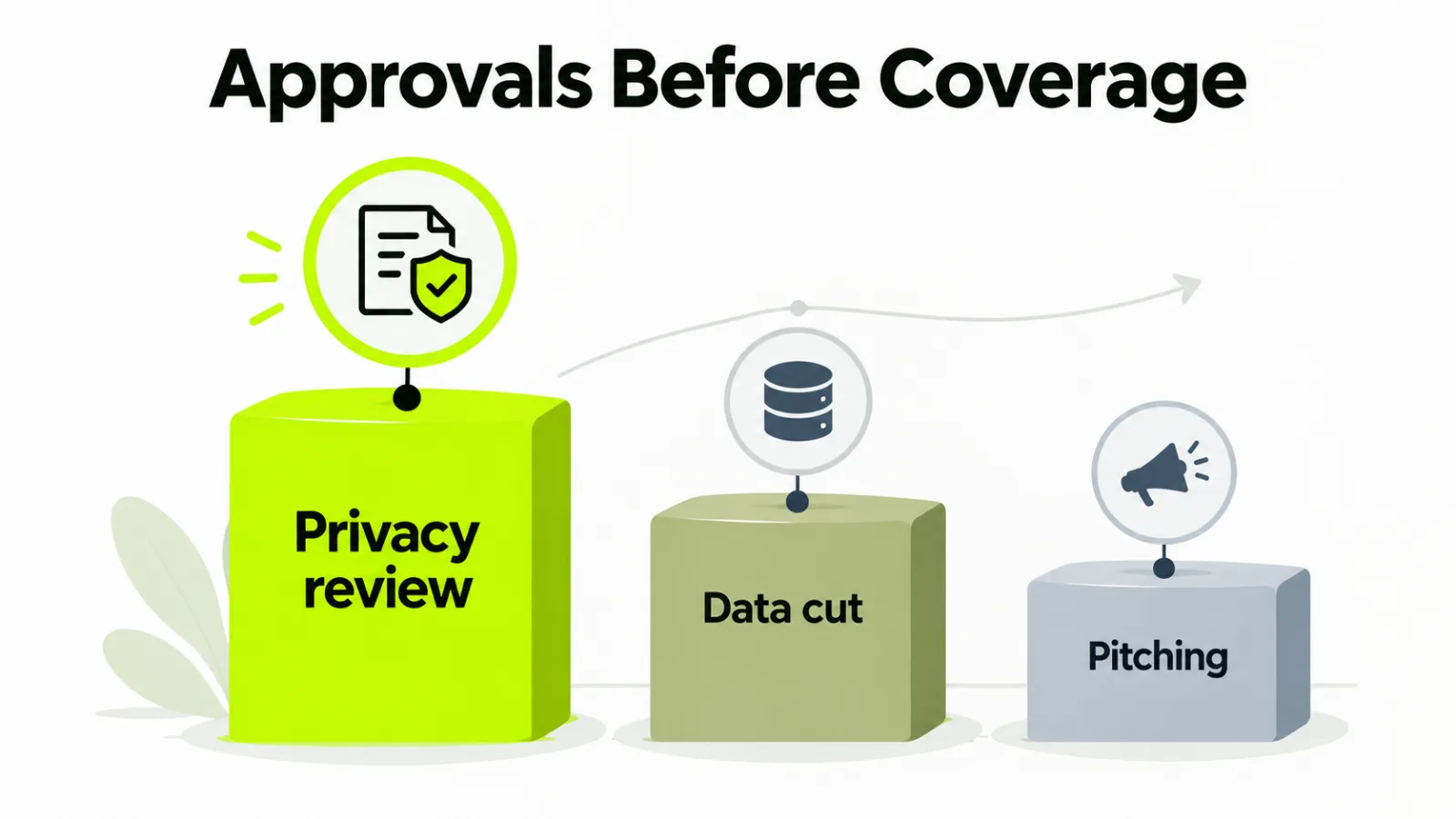
The first quarter sets up the assets and the approvals. Coverage follows in the second half.
| Weeks | Work | What you see |
|---|---|---|
| 1 to 2 | Review of your link profile and direct competitors. Source map for your segment. Privacy and legal review path agreed. | A written plan and a shortlist of assets |
| 3 to 6 | First data cut or template set prepared. Commentary bench set up. Unlinked mentions reclaimed. Marketplace listings completed. | Reclaimed links, first editor conversations |
| 7 to 12 | Data story pitched. Roundup outreach under way. Reporting begins. | Coverage starting to land, logged with reasoning |
We don’t promise a number of links per month. A fixed number means the placements are purchased. We commit to the standard each placement meets.
Budget tracks company stage. Our pricing page publishes monthly bands by funding stage, and link building budget by stage explains the reasoning.
How is an HR tech program measured?
On source quality and visibility first, then on pipeline as the sales cycle allows.
- Relevant referring domains: New links from HR, payroll, recruiting and business sources.
- Rankings for buying queries: A fixed set of category terms, comparisons and “software for” searches by company size.
- Roundup and review presence: Inclusion in the ranking “best” articles for your segment, against a baseline.
- AI answer presence: Whether you’re named for a fixed list of buyer prompts.
- Organic pipeline: Demo requests and opportunities that started in search.
HR software is often bought on an annual cycle, around budget season or contract renewal. A link earned in spring may show up as pipeline in autumn. We report leading indicators monthly and say which haven’t moved. The full list is in our guide to SaaS SEO metrics.
How do you choose an HR tech SEO agency?
Ask about method, and ask about data handling. The second is where HR tech differs from other categories.
- Can I see each site before a link goes live?
- Does money reach the publisher, in any form?
- How do you handle customer data in a report, and who signs it off?
- Who checks compliance content for accuracy and jurisdiction?
- What will you refuse to do?
- What happens when a link is removed?
- Do you guarantee a number of placements?
Google’s guide to hiring an SEO advises caution about anyone who guarantees rankings, and recommends asking a provider to explain exactly what they intend to do.
We’re the wrong fit if you need technical SEO or content production, if you have no data, templates or expertise to promote and no plan to build any, or if the budget is below the level where authority work pays off. Our pricing page puts that at around $3,000 a month.
If the fit looks right, book a strategy call. We’ll go through what your platform already knows that the HR press would want to cite.
Frequently asked questions
Do you work with HRMS and HRIS vendors specifically?
Yes. HRMS and HRIS platforms are a core part of the HR software category, alongside payroll, applicant tracking, performance, learning and benefits tools. The method is the same across them. The publications, assets and buyers differ, so each gets its own source map.
Should we build separate pages for HRMS, HRIS and HCM?
Usually not. The three terms describe overlapping products and the same buyers use them interchangeably. One strong page that leads with the term your buyers use most, and covers the others as variants, tends to do better than three thin pages competing with each other.
What earns links for HR software?
Workforce data from your own platform earns the most. Templates, policy libraries, calculators and accurate compliance explainers follow. All of them give an HR professional something to use at work, which is the reason another site links to them.
Is link building different for payroll software?
Yes. Payroll content affects people’s pay and tax, so accuracy and currency matter more than in other segments. The sources differ too: accounting press, payroll associations and bookkeeper blogs carry more weight than general HR media. Calculators and dated explainers are the strongest assets.
Can we publish customer data in a benchmark report?
Only in aggregate, and only if your customer agreements and applicable privacy law allow it. Set a minimum group size so no employer or employee can be identified, and have legal confirm before the analysis begins. We build that review into the plan.
Do you guarantee rankings or a number of links?
No. Nobody can guarantee a ranking, and a guaranteed link count means the links are bought. We commit to the quality and relevance of every placement and report what moved and what didn’t.
How long before an HR tech program shows results?
Reclaimed links and marketplace listings arrive in the first two months. Earned coverage follows each asset’s release. Rankings for competitive terms usually take two to three quarters to move, and pipeline follows the buying cycle after that.
Do you handle technical SEO or content writing?
No. We do link building, digital PR, brand mentions and AI-search authority. We’ll advise on which pages can earn links and work with your content team or another agency.
More on HR-tech SaaS
- HR-Tech SaaS SEO
- HR-Tech SaaS Guest Posting
- HR-Tech SaaS Digital PR
- HR-Tech SaaS Content Marketing
- Case study (composite, anonymised): mid-market HRIS, organic ARR 4% to 28%.
Reporting
How results are measured
We report on rankings, AI citations, referring domains and pipeline. We don’t show numbers we can’t stand behind.
Representative results
- DR38 to DR58 in 12 months, HIPAA compliance healthtech SaaS.
- Pipeline contribution 6% to 22%, mid-market customer success SaaS.
- Top-3 against Splunk and Datadog, cloud-native SIEM SaaS.
Composite, anonymized accounts based on real client engagements. Client identities and exact metrics are generalized for confidentiality.