SaaS Link Building
How to Choose a Link Building Agency: Questions to Ask
Choose a link building agency by asking how it picks sites, who approves each placement, what happens when a link drops, and how it bills. A good agency answers with specifics and says where it can’t help. Walk away from guaranteed rankings, link counts with no site names, and anything that sounds like a private blog network.
This guide is for the founder or marketing lead who has to pick one. It gives you seven questions, what a good answer sounds like, the warning signs that matter most, and the contract terms to read twice. Where Google has published advice on hiring an SEO, we link to it.
What you are paying an agency for
A link building agency sells work. The work is finding sites that fit your category, pitching or writing for them, and getting an editor to say yes. Rankings and pipeline come later and depend on things the agency doesn’t control.
Google’s own advice on hiring an SEO says as much: “No one can guarantee a #1 ranking on Google.” Its guidance on third-party SEO services adds that any prediction a provider makes is their own and may not happen.
So judge an agency on what it can show and commit to: the sites it picks, how it works with editors, how it reports, and how it bills. Those are the seven questions below.
Seven questions to ask before you sign
Ask these on a call, then ask for the answers in writing. A vague answer tells you something.
| Question | A good answer sounds like | A weak answer sounds like |
|---|---|---|
| Which sites will you approach, and how do you choose them? | Topical fit with your category, a real audience, editorial standards, and a few named examples. | A domain rating band, a traffic number, or “we have a large network.” |
| Can I see placements you’ve earned for a company like mine? | Live URLs, and a client reference you can call. | Screenshots, or “client names are confidential” for every example. |
| Who writes the content, and who at the publication approves it? | A named person at the agency, and an editor at the publication who chose to run the piece. | Bulk-written articles on sites the agency controls, or that publish anything for a fee. |
| What happens if a link is removed, changed to nofollow, or never gets indexed? | A written policy: how you’re told, whether the link is replaced, and how it changes the bill. | No policy, or “that rarely happens.” |
| How do you bill, and how long am I committed? | One clear unit (per placement or per month), a short first term, and a plain exit. | An annual contract, payment up front, or a package of links priced by domain rating. |
| What will you report, and what result do you expect in what time frame? | Named measures, an honest range, and no promise of a position. | One number such as total links, or a guaranteed ranking. |
| When would you tell me not to buy links? | Specific cases: no pages worth linking to, a site that isn’t ready, a goal links won’t reach. | “Never,” or “links always help.” |
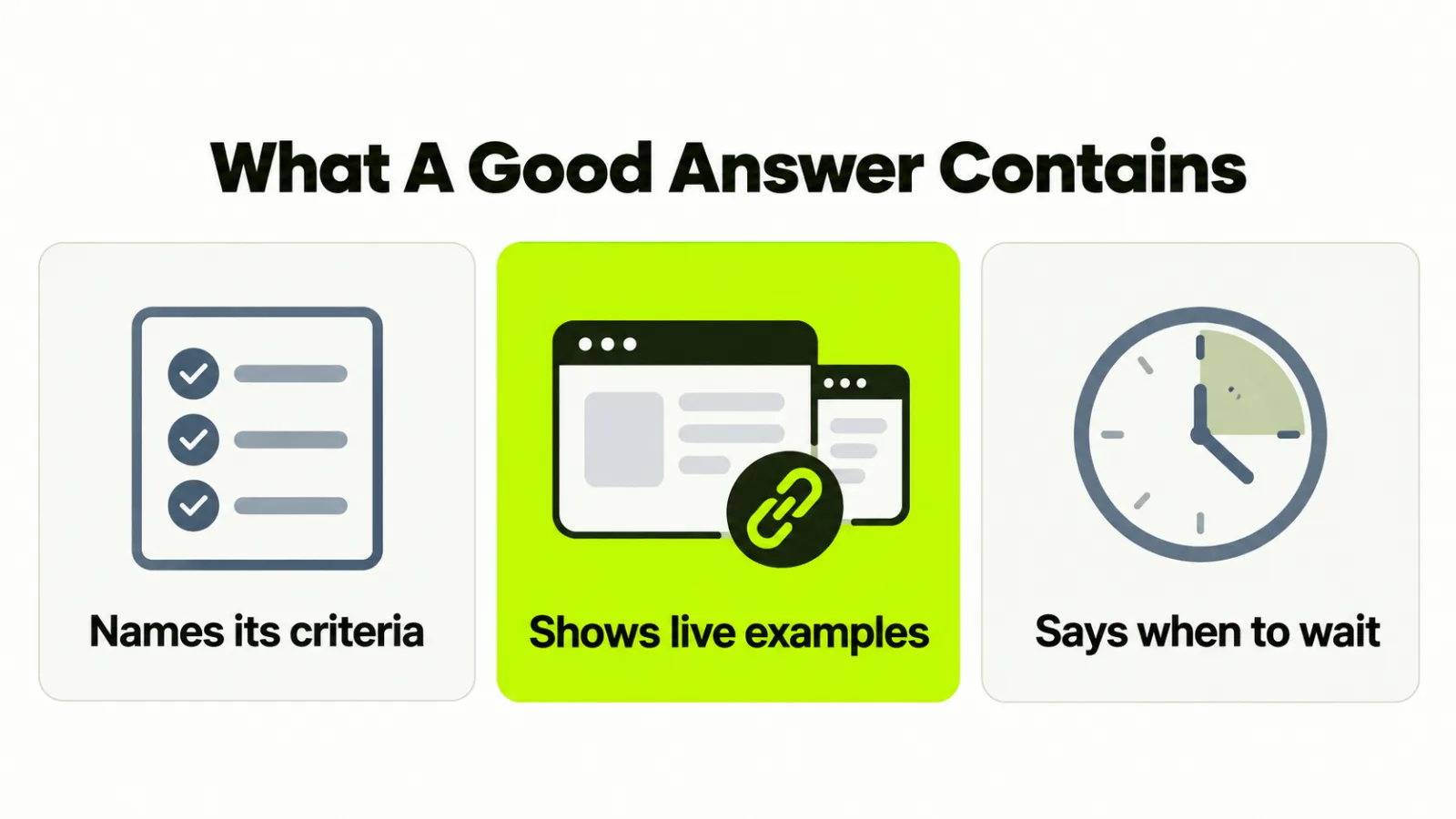
Questions 2 and 6 echo what Google suggests asking an SEO: examples of previous work, what results to expect in what time frame, and how success is measured. Google also says to check an SEO’s business references, and to be careful with a company that is secretive or won’t clearly explain what it intends to do. Both points are in its guide to hiring an SEO.
Question 4 matters more than it looks. A link can be live on a page Google hasn’t indexed, and until it is indexed the link passes nothing. Our guide to how to index backlinks explains the gap, and the agency’s policy should cover it.
Red flags that should end the conversation
Most weak agencies show themselves on the first call. These are the signs worth taking seriously.
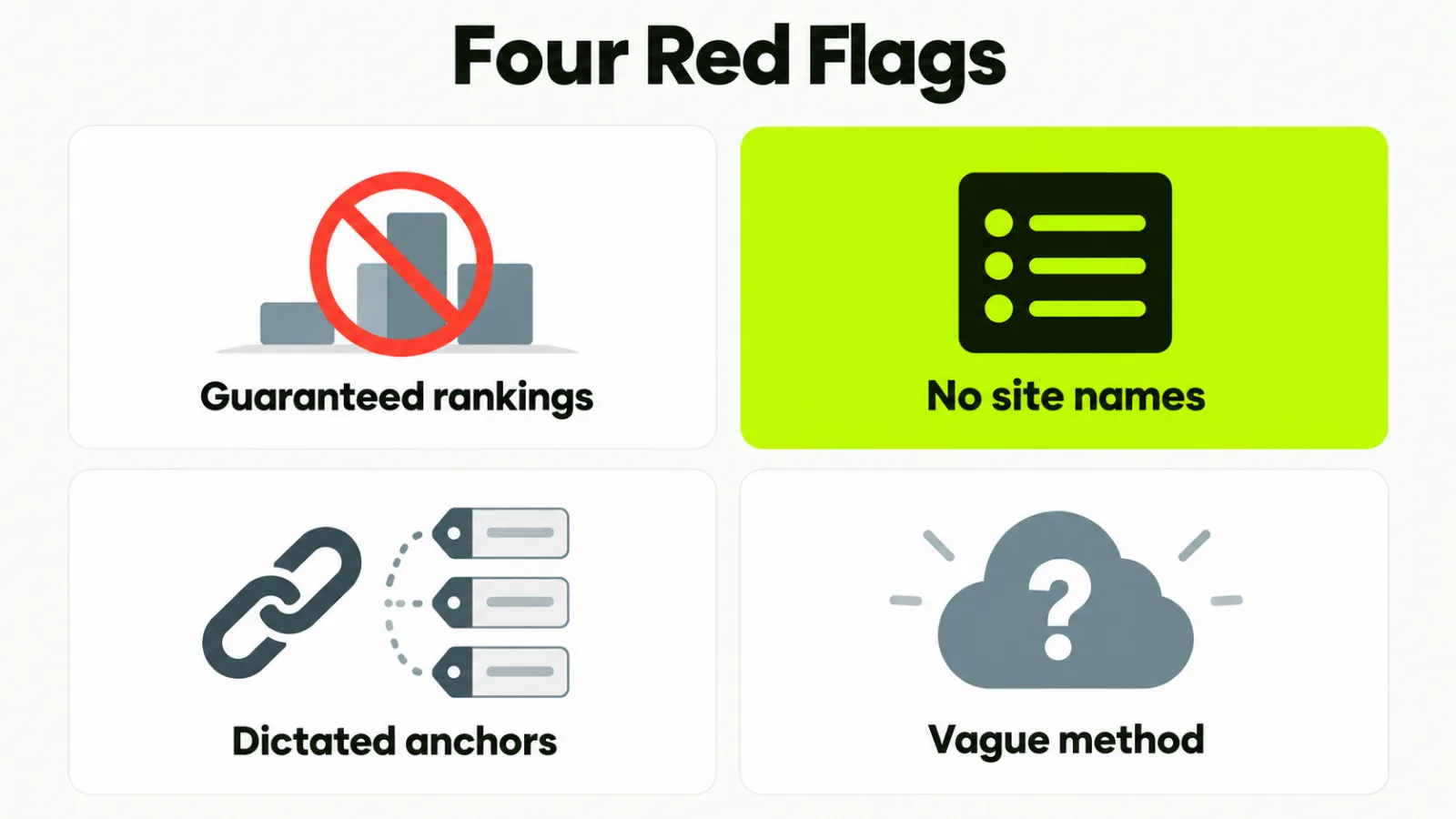
- A guaranteed ranking or position. Google lists claims of guaranteed rankings, and of a special relationship with Google, among the warning signs in its hiring guide.
- A link count or price list with no site names. If the agency won’t say where the links will go, you can’t check them.
- Network language. “Our network,” “aged domains” and “high-DR sites we own” describe links made to manipulate rankings, which is how Google defines link spam.
- Anchor text the agency dictates. Keyword-optimized anchor text in guest posts and distributed articles is one of the examples Google’s link spam policy gives. Our guide to anchor text and penalties shows the ratios to watch.
- A large batch of links in the first weeks on a young site. Real editorial placements arrive one at a time, so a burst needs an explanation.
- A vague account of the method. Google treats a company that is secretive or won’t explain what it plans to do as a warning sign.
- Unsolicited email that promises first-page rankings. Google’s hiring guide warns about SEO firms that email you out of the blue.
Paid placements and the sponsored label
Buying a link to influence rankings breaks Google’s link spam policy. Buying a placement as advertising doesn’t, as long as the link is qualified. The policy says buying and selling links is a normal part of the web for advertising and sponsorship, and that such links should carry a sponsored or nofollow value. Google’s guidance on qualifying links prefers sponsored for paid placements.
That gives you a sharp question for any agency. Is the link an editorial placement the publication chose to run, or a labelled sponsored placement? A labelled link tells Google it is an advertisement. An unlabelled paid link is what the policy targets. An agency that can’t say which it sells hasn’t thought it through, or doesn’t want to tell you.
Our test for any tactic is the same two questions: who chose the link, and what changed hands. The white hat link building guide sets it out.
How to check a sample before you commit
- Ask for three live placements for companies like yours, and one reference you can call.
- Open each page. Would the site have published this article anyway? Does the link sit in a sentence that needs it?
- Look at the site itself. Does it publish on one clear topic, with named authors and recent posts, or does it take articles on any subject?
- Search for the page’s address in quotes, then for a sentence from it, to see whether Google has indexed it. The guide to how to index backlinks explains what a missing result does and doesn’t mean.
- Compare the anchor text across the three placements. Natural ones vary. Identical anchors don’t.
Our eight-factor checklist turns the same checks into a score if you want one.
Contract and billing terms to read twice
| Term | What to look for |
|---|---|
| Minimum term | A short first term, or month to month. Be wary of an annual commitment before you’ve seen one placement. |
| What counts as delivered | A live link on an indexed page that matches the agreed target. “Link built” isn’t the same thing. |
| Replacement | What happens when a link is removed or changed, how long the window is, and who pays. |
| Content ownership | Who owns the articles written for you, and whether you can reuse them. |
| Access | Read-only Search Console access is enough for an audit. Google’s hiring advice says not to grant write access at that stage. |
| Reporting | How often, what’s in it, and a list of live URLs you can check yourself. |
| Exit | How you leave, what you keep, and what you still owe. |
The billing model matters as much as the price. A retainer pays for effort each month, and per-placement billing pays for what lands. Neither is wrong, and each suits a different situation. Our guide to how much a SaaS company should spend covers amounts by stage, and the pricing page shows typical budgets by company stage.
A 30-day test before a long commitment
Agree a small first month before you agree anything bigger. Name the pages you want links to, set the number of placements you would accept, keep a veto over the sites, and fix a reporting date.
Judge the month on what you can verify yourself: the links are live, the pages are indexed, the sites fit your category, and the anchor text varies. Don’t judge it on rankings. Links take time to show, so a month tells you how the agency works and says little about results. If you aren’t sure links are worth buying yet, read does link building still work first.
How we answer these questions
You should hear the same answers from us that you’d want from anyone, so here are the ones we publish.
- Billing: we work on a pay-per-delivery basis. You pay for the links we earn and place, with no upfront retainer and no long contract.
- Site choice: every placement is judged on topical relevance, editorial context, source trust and audience overlap before it counts. We turn down placements that would put your brand at risk, however easy they are to get. We don’t use private blog networks or paid link schemes.
- Guarantees: we don’t guarantee rankings or positions. We report rankings, AI citations, referring domains and pipeline contribution instead of raw link counts.
- Pricing: we agree per-placement pricing after a discovery conversation, before any work starts.
- Fit: we’re a poor fit if you want the lowest price per link or results in a few weeks.
Put the other questions on this page to us on a call. Our SaaS link building services page and process show how an engagement runs. Our comparison of ten SaaS link building agencies, which includes us, scores each on five dimensions and ends with a longer vetting checklist.
Frequently asked questions
What should I ask a link building agency before signing?
Ask which sites it will approach and how it picks them, to see placements it has earned for similar companies, who writes and who approves each article, what happens when a link is removed or never indexed, how it bills and for how long, what it will report and what result it expects in what time frame, and when it would tell you not to buy links.
What are the red flags of a bad link building agency?
A guaranteed ranking, a link count with no site names, talk of its own network of sites, anchor text it dictates, a burst of links in the first weeks, a vague account of its method, and unsolicited email promising first-page results. Google lists guarantees and secrecy among its warning signs when hiring an SEO.
Which link building agency focuses on relevance over domain rating for SaaS?
Look for an agency that chooses sites by topical fit and audience first, and can show you how a placement was chosen. We work that way: every placement is judged on topical relevance, editorial context, source trust and audience overlap before it counts. Ask any agency, including us, for live examples. Our comparison of ten SaaS link building agencies covers the others.
How much does a link building agency cost?
It depends on the billing model, the quality of the sites, how competitive your category is and how many placements you want. A retainer charges for effort each month, and per-placement billing charges for delivered links. Our guides to SaaS link building spend and pricing give budgets by company stage.
Is it safe to pay for links?
Paying for a link to influence rankings breaks Google’s link spam policy. Paying for an advertisement or sponsorship is a normal part of the web, as long as the link is labelled with rel=”sponsored” or rel=”nofollow”. Ask the agency which one it sells. Google’s guidance on qualifying links prefers sponsored for paid placements.
How long should I commit to a link building agency?
Start with a short, defined first month and avoid an annual contract before you’ve seen a placement. Judge that month on whether the links are live, indexed, relevant and varied. Rankings take longer to show.
How do I know whether an agency’s links are working?
Track referring domains from relevant sites, rankings for the pages you pointed links at, referral traffic, and the signups or demos that follow. Expect it to take months. Google says no one can guarantee a ranking, so treat any promised date with suspicion. Our ROI calculator and ROI guide show how to put numbers on it.
What access does a link building agency need?
Placements happen on other sites, so an agency doesn’t need to log in to your CMS. For an audit, read-only Search Console access is enough, and Google advises against granting write access at that stage. It also says an SEO with FTP access should explain every change it makes. See Google’s guide to hiring an SEO.