SaaS link building
SaaS Backlink Strategy: The Complete Guide
A SaaS backlink strategy is a deliberate plan for earning links from credible, relevant websites so your highest-value pages rank in search, get cited by AI engines, and convert qualified buyers rather than a volume program that buys links by the dozen. In B2B SaaS, the sales cycle runs long, your rivals are well-funded, and one customer can be worth tens of thousands over their lifetime. Links aren’t a vanity metric here. They’re how search engines and AI models decide whether your product is a credible answer to your buyer’s question. This guide covers what a SaaS backlink strategy is, how to plan one, which link types to use and when, how to handle anchor text, how to prioritise pages, and how to know if any of it is working.
What is a SaaS backlink strategy?
A SaaS backlink strategy is the system that ties your link-building work to your commercial goals: the pages you need to rank, the topics you want to own, and the buyers you’re chasing. Most agencies sell backlinks like a commodity. A set number of placements per month at a set price. A strategy runs the opposite direction. It begins with one question (“which pages, if they ranked, would move pipeline?”) and then builds the authority those pages need to compete.
That distinction matters because SaaS is a brutal place to rank. Your category pages go up against incumbents with years of domain authority and deep content budgets. Your comparison and alternative pages get fought over by every competitor you have. And more and more, buyers never reach a results page at all. They ask ChatGPT, Perplexity, or Google’s AI Overviews “what’s the best tool for X,” and the answer reflects which sources those models trust. A real backlink strategy handles all three pressures at once. Our SaaS link building hub frames the wider picture, treating link building as one input into a larger authority system rather than the goal itself.
Why does SaaS need a dedicated link strategy?
SaaS needs a dedicated link strategy because the economics, the competition, and the buyer journey all behave differently than almost any other category. Three structural realities drive it.
First, what you’re promoting is intangible. No physical product to review, no local storefront, no inventory page. Your credibility lives entirely in how the web talks about you, so earned links become a primary trust signal and not a supporting one. Second, SaaS keywords cluster around high-intent, high-competition terms: best-in-category roundups, “alternative-to-a-competitor” searches, and category-for-a-specific-industry queries. Those pages convert, which is exactly why they’re saturated and impossible to rank without real authority behind them. Third, the people you’re trying to reach (founders, CTOs, VPs of operations) are skeptical, short on time, and increasingly doing their research through AI assistants. Authority built through genuine publications, expert commentary, and community presence is what lands you in those AI answers.
A strategy gives every link a job. It’s the gap between “we got 40 links last quarter” and “we moved our integrations comparison page from position 14 to the first page, and it’s driving demo requests now.” If you’d rather a partner run the whole thing, our SaaS link building services page lays out how the work is structured.
How do you plan a SaaS backlink strategy?
You plan a SaaS backlink strategy by auditing where you stand, mapping where competitors are winning, picking the pages that matter to revenue, and naming the topics you want to be known for. Skip the planning and you get motion without direction. Links to pages that don’t convert, anchored to terms nobody searches.
Planning decides where links should go. Running the campaign that earns them is a separate discipline, and our link building checklist walks through it phase by phase.
Audit your current backlink profile
Start with an honest inventory. Which referring domains do you already have, and how relevant are they? Are there toxic or spammy links from a past vendor that need disavowing? Which of your pages already pull links on their own, and why? This baseline tells you whether the job is cleanup, scale, or both. It also surfaces your link magnets, the assets that earn links without you asking, which you should be producing more of.
When the profile came with the company rather than from your own work, our guide to an audit of an inherited profile covers the steps and their order.
Run a competitor link gap analysis
Pin down the three to five competitors outranking you for the terms you care about, then look at the referring domains they have and you don’t. That gap is your most actionable target list. When four competitors all earned a link from the same industry publication, podcast, or roundup, that source is reachable and relevant, and you’re missing from a conversation you belong in.
Choose priority pages and target topics
Decide which pages deserve authority first (more on that below) and which topics you want to own across the web. Topics carry as much weight as pages, because relevance is topical now. To rank for “workflow automation,” you need credible mentions across the subjects a buyer ties to it (integrations, security, onboarding, ROI) not one anchor on one page.
What link types should a SaaS strategy use, and when?
A strong SaaS strategy mixes several link types, each built for a different goal. There’s no single best method, only the right method for a given page and stage. Leaning on one tactic is the most common reason link programs stall. The table below maps the core methods to the moments where each one earns its keep.
| Link type | What it is | Best used when | Primary benefit |
|---|---|---|---|
| Guest posting | Original articles published on relevant industry sites with a contextual link back | Building topical authority and ranking power for category and blog pages | You control the context and the anchor on a relevant page |
| Niche edits | Links added into existing, already-indexed articles that have aged and earned authority | You need a relevant link on a page that already ranks and passes equity | Speed, plus placement on established pages |
| Brand mentions | Earned references to your brand, often unlinked, across the web | Building entity recognition and trust signals for search and AI engines | Credibility and citation strength beyond raw link equity |
| Digital PR | Newsworthy stories, data studies, and expert commentary placed in publications | You want high-authority links, brand reach, and AI-citable sources in one move | Authority, reach, and links that are hard to copy |
| Forum and community | Genuine participation and references in communities where buyers gather | Reaching buyers directly and building presence in spaces AI models read | Relevance, referral traffic, and conversational visibility |
In practice these run as a portfolio. Digital PR and guest posting lay the durable authority foundation. Niche edits push specific pages that need a nudge. Brand mentions and community presence grow your entity strength, which increasingly decides whether an AI engine names you when a buyer asks for a recommendation. The mix shifts with maturity: early on, weight toward foundational authority; later, weight toward targeted page-level links and entity reinforcement.
How should you approach anchor text?
Your anchor text should look the way natural links look: mostly branded and contextual, with exact-match commercial anchors used sparingly and only where they read naturally. Over-optimised anchors are one of the fastest ways to signal manipulation, and one of the most common habits SaaS teams inherit from cheap link vendors.
A healthy profile leans on your brand name, your URL, and natural phrases (“this onboarding platform,” “their guide to SOC 2 readiness”) far more than on the exact keyword you’re chasing. Exact-match and partial-match anchors do have a role, they help search engines read a page’s focus, but they’re the exception, spread across many domains, never the default. The test is simple: if a real editor linked to your page in a real article, what would they write? Anchor text that fails that test is anchor text that builds risk. Diversity across branded, naked-URL, generic, and topical anchors is the signature of a profile you earned.
How do you prioritise which pages to build links to?
Prioritise pages by commercial value and competitive winnability: build links first to the pages that convert and sit just outside striking distance of ranking. Spread authority evenly across your whole site and you waste it. Concentration wins.
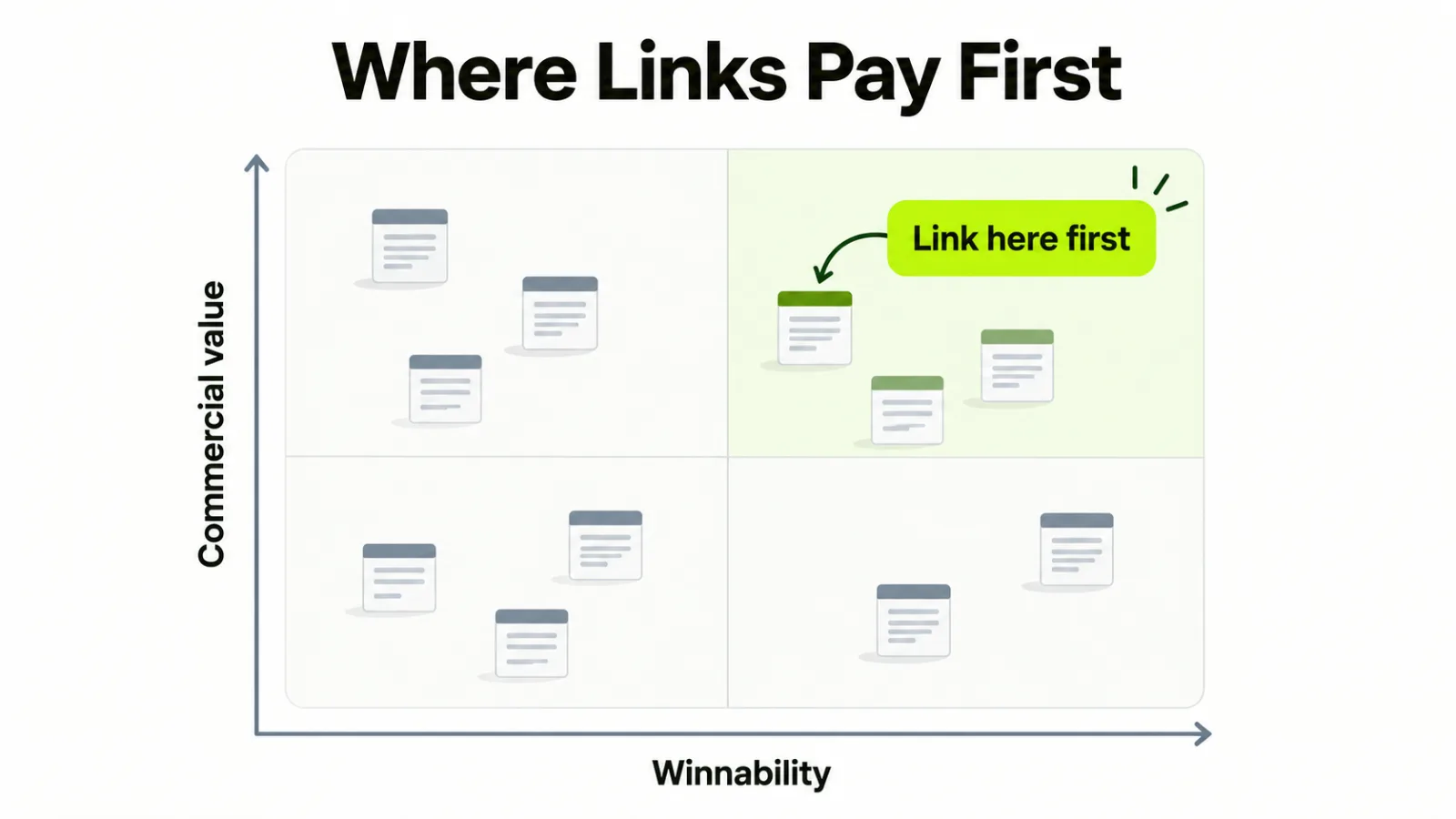
- Map pages to revenue: Rank your pages by how directly they drive pipeline: pricing, product, high-intent comparison, and best-in-category pages usually top the list; broad blog content sits lower.
- Find the striking-distance pages: Pages ranking around positions 5 to 20 often need only a modest authority boost to reach the first page. These are your fastest wins.
- Weigh the competition: A page that converts but faces entrenched, heavily-linked incumbents needs more sustained investment than one in a softer SERP. Sequence accordingly.
- Build supporting depth. Strengthen the cluster around a money page, its supporting posts and resources, so authority flows internally toward the page that converts.
- Reassess quarterly: As pages move, priorities shift. A page that reached the first page may now need defending; a new page may have entered striking distance.
This is where strategy beats volume most clearly. Ten well-placed links pointed at three winnable, high-intent pages will almost always outperform fifty links scattered across your site.
How do you measure a SaaS backlink strategy?
You measure a SaaS backlink strategy across four layers (rankings, referring domains, AI citations, and pipeline) because no single metric tells you whether the work is creating commercial value. Link counts on their own are the easiest number to report and the least meaningful.
Rankings and visibility
Track movement on your priority pages and target keywords rather than site-wide averages. What you want to see: your money pages climbing into the first page and holding there, and your topical cluster gaining ground together.
Referring domains and quality
Count unique referring domains and not total links, and weight them by relevance and authority. Ten new links from one domain matter far less than ten links from ten relevant, credible domains you didn’t have before.
AI citations and brand mentions
This one’s climbing fast: are AI engines like ChatGPT, Perplexity, and Google’s AI Overviews naming your brand when buyers ask for recommendations in your category? It’s downstream of entity strength, earned mentions, and presence in the sources those models trust, and it’s becoming a leading indicator of demand.
Pipeline contribution
The metric that matters most. Are the pages you invested in driving demo requests, trials, and qualified pipeline? Connect ranking and referral data to your CRM so link building gets judged the way every other growth investment does, by what it returns.
What are the most common SaaS backlink mistakes?
The most common SaaS backlink mistakes come from treating links as a volume game instead of an authority system. Each one caps results or builds risk.
- Buying links by the number: Volume-first programs produce irrelevant, low-quality placements that do little for rankings and can invite penalties.
- Ignoring relevance: A link from an unrelated site carries a fraction of the value of one from a publication your buyers read.
- Over-optimising anchors: Stuffing exact-match keywords into anchor text is a classic manipulation signal and a common inherited liability.
- Pointing links at the wrong pages. Sending authority to the homepage or low-intent posts instead of winnable, high-converting pages wastes the investment.
- Neglecting brand and entity signals: Chasing only links while ignoring mentions and community presence leaves you invisible to AI engines.
- No measurement beyond link counts: Without tying activity to rankings and pipeline, you can’t tell what’s working, or defend the spend.
- Inconsistency: Link building pays off; stop-start campaigns reset the momentum every time.
What does a SaaS backlink roadmap look like?
A practical SaaS backlink roadmap moves in phases (foundation, targeted acquisition, authority building, and growth) each one building on the last. The timing flexes with your starting authority and competition, but the sequence holds.
- Phase one: audit and foundation. Inventory your current profile, clean up toxic links, run the competitor gap analysis, and lock in priority pages and target topics. Define how you’ll measure success before you start.
- Phase two: targeted acquisition. Aim your first links at striking-distance, high-intent pages using niche edits and guest posts for speed and relevance. Go for early, visible ranking movement on pages that convert.
- Phase three: authority building. Layer in digital PR and data-driven stories to earn high-authority links and brand reach, while reinforcing entity signals through earned mentions and genuine community presence.
- Phase four: growth and defence. Hold a consistent cadence, expand into adjacent topic clusters, defend the pages that reached the first page, and keep feeding the assets that earn links on their own. Reassess priorities each quarter against the four measurement layers.
The throughline is consistency with intent. Authority grows when every link, mention, and placement points back to a deliberate plan. If you’d like a roadmap built around your specific category, pages, and competitors, you can talk to our team.
Frequently asked questions
How many backlinks does a SaaS company need?
There’s no fixed number. The right amount depends on your competition, your starting authority, and the pages you want to rank. A sharper question than “how many” is “from where, to which pages, and how relevant.” A handful of links from credible, relevant domains pointed at winnable pages will usually beat a large pile of low-quality placements.
How long does a SaaS backlink strategy take to show results?
Link building builds over time; it doesn’t deliver overnight wins. Striking-distance pages can move within a few months, while competitive category terms take longer and demand sustained investment. Anyone who guarantees specific rankings on a specific date is overpromising. Search outcomes ride on too many factors no one controls.
What’s the difference between buying backlinks and a backlink strategy?
Buying backlinks means purchasing a quantity of placements as a commodity. A backlink strategy starts from your commercial goals, which pages and topics matter, and builds the relevant authority those pages need. One reports link counts; the other reports rankings, citations, and pipeline.
Do backlinks still matter for SaaS with AI search rising?
They matter more. AI engines decide which brands to cite partly by which sources they trust, and earned links and mentions are core trust signals. A strong backlink and brand-mention profile is one of the clearest paths to becoming a brand AI assistants recommend in your category.
Which backlink method is best for SaaS?
No single method wins. The strongest results come from a portfolio. Digital PR and guest posting build durable authority, niche edits accelerate specific pages, and brand mentions plus community presence strengthen the entity signals that drive AI visibility. The right mix depends on your stage and goals.
Are niche edits safe for SaaS sites?
Niche edits are safe when they’re relevant. A link placed in a real, established article on a topic close to yours, with natural anchor text. They turn risky when they’re bulk-bought on irrelevant pages with over-optimised anchors. Relevance and editorial quality are what separate a safe niche edit from a liability.
Should SaaS backlinks point to the homepage or inner pages?
Most should point to the inner pages that convert (high-intent product, comparison, and category pages) rather than defaulting to the homepage. Concentrating authority on winnable, commercially valuable pages beats spreading it thin across the site.
How do I measure backlink ROI for a SaaS business?
Measure across four layers: rankings on priority pages, growth in relevant referring domains, AI citations and brand mentions, and, above all, pipeline contribution. Connect your ranking and referral data to your CRM so link building gets judged by the qualified demand it helps create, the same way you’d assess any growth channel.