SaaS Link Building
Link Building for CRM Software Companies
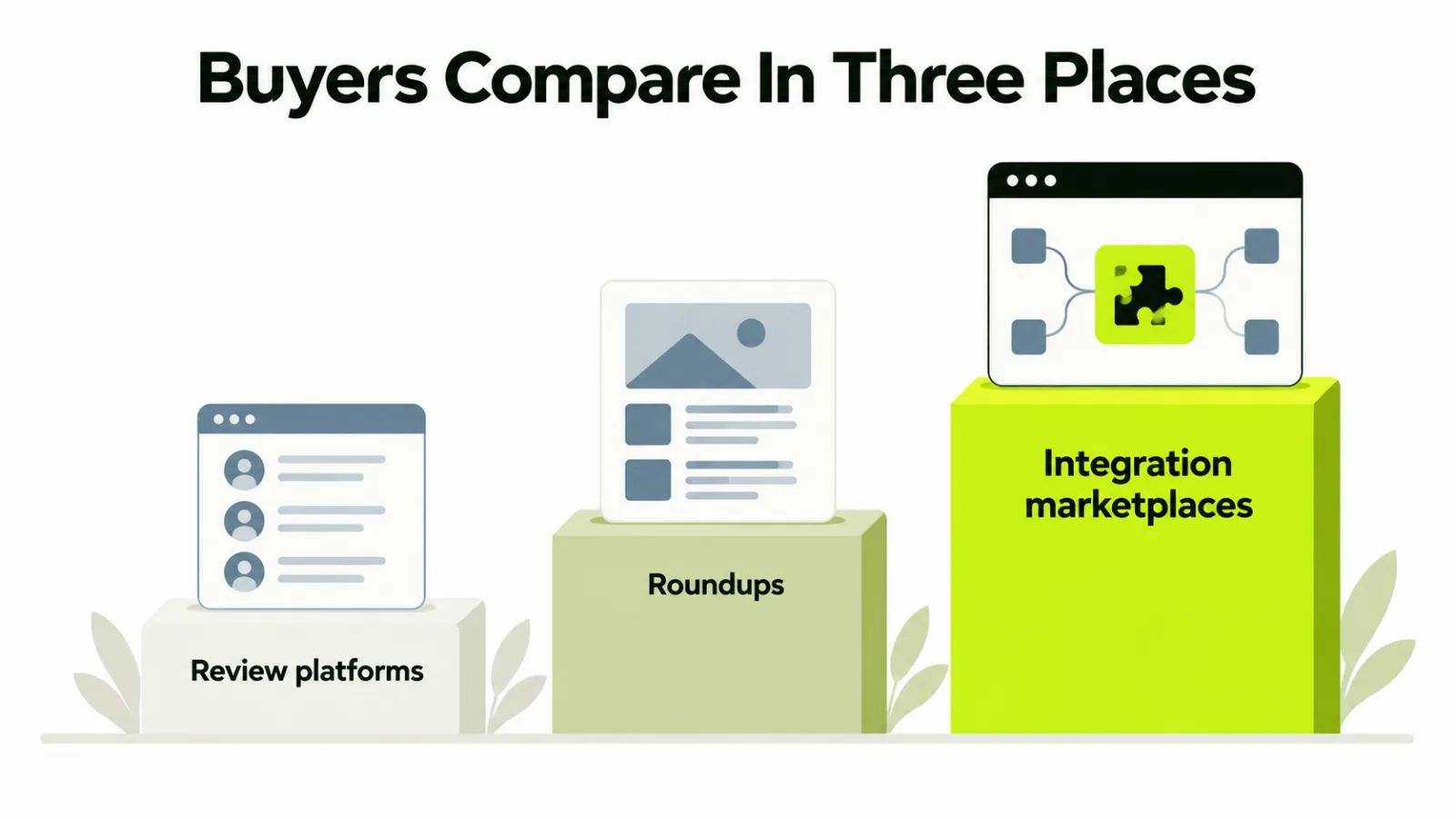
Link building for CRM software companies means earning references from the places buyers compare tools: review platforms, independent roundups, integration marketplaces and the publications sales teams read. In a category led by a few very large vendors, those references decide whether a smaller CRM gets considered at all.
A quick note on the phrase. If you’re looking for a CRM to manage your own link building outreach, this isn’t that page. Our guide to outreach link building covers the process side.
This guide is for companies that sell CRM and sales software. It covers why the category is hard, how to compete on a niche, where authority comes from, how reviews and integrations earn links, and what to avoid.
Who is this guide for?
Any B2B software company whose product sits in the sales and customer stack. The category is wider than the three letters suggest.
- General CRMs for small and mid-sized businesses.
- Vertical CRMs built for one industry, such as real estate, legal, construction or nonprofits.
- Sales engagement tools for outreach sequences, calling and scheduling.
- Revenue intelligence products for forecasting, call analysis and pipeline inspection.
- Customer success platforms for onboarding, health scoring and renewals.
- Quoting, proposal and partner tools that plug into a CRM.
They share a buyer, a sales or revenue leader, and they share a problem. The search results they want are held by companies many times their size.
Why is link building hard for CRM companies?
Because the head terms are out of reach, the comparison pages are commercial, and the buyer takes a long time to decide.
The largest vendors own the category terms. Search for “CRM software” and the first page is mostly a handful of global vendors and the biggest review platforms. Those domains have been earning links for many years. A newer vendor won’t displace them with any link budget.
Comparison content is a business in its own right. Many “best CRM” articles earn money when a reader clicks through and buys. That affects who gets included and in what order. It doesn’t make the format useless, and it does mean you need to know which lists are editorial and which are sold.
Switching is expensive, so buyers research for longer. Moving a sales team to a new CRM means migrating data and retraining people. Buyers read reviews, ask peers and compare several options before they’ll take a demo. A vendor needs to be visible across that whole process rather than on one page.
The conclusion is that a CRM company can’t win by pointing links at its homepage and hoping to rank for the category. It has to pick ground it can hold.
How does a smaller CRM compete in search?
By being specific. Narrow searches have fewer strong competitors, clearer intent and buyers who are closer to a decision.
| Angle | Example search | Why it’s winnable |
|---|---|---|
| By industry | “CRM for commercial real estate brokers” | The large vendors have a generic page. You can have the definitive one. |
| By company size | “CRM for a five-person sales team” | Enterprise suites don’t fit, and buyers know it |
| By workflow | “CRM with built-in quoting” | The buyer already knows what they need |
| By integration | “CRM that works with” a named accounting tool | Few pages answer it well, and the partner may link to yours |
| By migration | “alternative to” a named competitor | Captures buyers who have already decided to leave |
Link building follows the same choice. A vertical CRM for law firms should be earning references from legal technology publications and bar association resources rather than from general software blogs.
This is also how AI assistants work. When someone asks for a CRM suited to a specific situation, the assistant looks for sources that match the situation. A vendor with a clear, well-referenced specialism gets named. A vendor that describes itself as “the all-in-one platform” gets passed over.
Our post on SaaS backlink strategy covers how to choose which terms to build toward.
Where does authority come from for CRM companies?
From the places buyers go to compare, and from the ecosystem your product plugs into.
| Source type | Examples | Why it carries weight | How a reference is earned |
|---|---|---|---|
| Software review platforms | The major B2B software review sites | They rank for comparison searches and feed AI answers | Genuine customer reviews, a complete profile |
| Independent roundups | “Best CRM for” articles on industry and business sites | Where shortlists get built | Reviewer access, a clear niche, an honest pitch |
| Integration marketplaces | HubSpot Marketplace, Salesforce’s marketplace, Zapier’s app directory | Proves the product works inside the buyer’s stack | Building the integration and keeping it current |
| Sales and revenue publications | Sales leadership media, revenue operations communities and newsletters | Read by the people who sign the contract | Sales data, practical frameworks, expert comment |
| Industry trade press | The publications of the vertical you serve | For a vertical CRM, more relevant than any software site | Industry-specific data and guidance |
| Consultants and implementers | Agencies and freelancers who set up CRMs for clients | They recommend tools and write about them | A partner programme worth joining |
| Small business media | Business advice sites and resource libraries | Reaches owners buying their first CRM | Templates, calculators, plain-language guides |
| Paid list positions and link networks | Sold slots in roundups, “write for us” sites | None, and a risk on top | They’re bought |
The examples show where attention sits. They aren’t a list of placements anyone can promise. The decision to include or cover a product belongs to the publisher.
How do review platforms fit into link building?
They’re the first thing a CRM buyer checks, and they’re a source that both search engines and AI assistants read. A thin review profile is a visibility problem.
Three things make a review presence work.
- A complete profile: Category, features, pricing, integrations and screenshots, filled in and kept current. Assistants pull these fields when comparing tools.
- A steady flow of real reviews. Recent reviews, spread over time, from customers of the size and type you want more of.
- Replies: A vendor that answers critical reviews with specifics reads as one that’s paying attention.
The rules on how reviews are collected are strict now. The FTC’s rule on fake reviews and testimonials prohibits several practices that used to be common in software marketing.
| Practice | Status under the FTC rule |
|---|---|
| Reviews from people who never used the product | Prohibited |
| Compensation conditioned on a review being positive | Prohibited |
| Reviews by officers or employees without disclosing the connection | Prohibited |
| A company-controlled site presented as independent reviews | Prohibited |
| Suppressing negative reviews through threats or intimidation | Prohibited |
| Asking every customer for an honest review | Not restricted by the rule |
The safe programme is the simple one. Ask all customers, at a consistent point in their lifecycle, for an honest review. Don’t tie any reward to the rating. Each review platform also has its own rules on incentives, so check them before offering anything.
Why are integrations the strongest link source for CRM companies?
Because a CRM is the centre of a stack. Every tool that connects to it is a potential partner, and every partner has a reason to mention you.
This works in two directions.
If you sell a tool that plugs into a larger CRM, that CRM’s marketplace is your most relevant listing. The largest ecosystems run public directories with a page per app. A listing there is a link, a source of customers, and a signal to assistants that your product works with the platform a buyer already owns.
If you sell the CRM itself, build your own directory. Every integration partner listed on it has a reason to list you back, announce the integration and write a setup guide. A CRM with fifty real integrations has fifty partners who can each be asked for a link.
One integration, handled properly, tends to produce four or five references.
- The marketplace or directory listing.
- A launch post on the partner’s blog or changelog.
- A setup guide on the partner’s help centre.
- A joint webinar or case study write-up.
- Mentions from consultants who implement both tools.
Most CRM companies stop at the first. The rest take a few emails and a shared document.
How does sales data earn links?
It earns them because a CRM sees what no survey can: what salespeople did, and what happened next.
The questions sales leaders ask have answers sitting in your product. How long do deals of a given size take to close? How many touches before a reply? What share of pipeline slips each quarter? Aggregated and anonymised, each of those is a report a sales publication would cover.
Three conditions make it work.
- Enough volume to be credible. State how many accounts and what time period. Readers check.
- Segments that match how buyers think. By company size, industry and deal size, so a reader can find the row that describes them.
- Permission: Customer agreements often limit how data can be used, even in aggregate. Legal should confirm before the analysis starts.
A report like this is worth repeating each year. The second edition is easier to pitch than the first, because reporters can write about what changed. Our guide to linkable assets covers how to build the page so it keeps earning.
Which free resources earn links for CRM companies?
Things a salesperson or a small business owner can use today, without signing up.
Spreadsheet CRM templates: Plenty of people searching for a CRM aren’t ready for one. A good free template serves them now, earns links from small business resource pages, and introduces your product for when they outgrow it.
Sales email and call templates: Follow-up emails, discovery call outlines, proposal structures. They get bookmarked and shared inside sales teams.
Calculators: Commission, quota, pipeline coverage, sales cycle length. Each one answers a question someone has typed into a search box.
Migration guides: A clear, step-by-step guide to moving data out of a named competitor. It serves the buyer who has already decided to switch, and it gets linked from forums where people ask how.
If your product sends email on behalf of customers, the guidance in your templates should be consistent with the FTC’s CAN-SPAM compliance guide. Outreach advice that ignores it won’t be linked by anyone who knows the subject.
How should a CRM company handle comparison content?
Fairly on its own site, and carefully on other people’s.
On your own site, comparison and alternative pages capture buyers near a decision. They work when they’re honest. A page that says where the competitor is the better choice gets read to the end. A page that claims you win on every line gets closed.
On other sites, being included in an independent roundup is one of the most valuable references in this category. Our guide to listicle link building covers how to earn it.
Paying for a position is the shortcut on offer, and it fails on two counts. Google’s spam policies list buying links for ranking purposes as link spam. And the FTC’s Endorsement Guides say a material connection between an endorser and a marketer “should be disclosed clearly and conspicuously”.
Affiliate and referral programmes are legitimate when they’re disclosed. Google asks for those links to be marked as sponsored, which means they don’t pass ranking value. That’s fine. They can still send buyers. They just aren’t link building.
How does the plan change by product type?
The buyer and the ecosystem differ, so the source map does too.
| Product type | Who buys | Strongest link asset | Where it gets cited |
|---|---|---|---|
| General CRM for small business | Owners, first sales hires | Templates, calculators, plain guides | Small business media, resource libraries, review platforms |
| Vertical CRM | Operators in one industry | Industry data and workflows | That industry’s trade press and associations |
| Sales engagement | Sales development leaders | Outreach performance data, templates | Sales publications, revenue operations communities |
| Revenue intelligence | Revenue leaders, sales operations | Forecasting and pipeline research | Revenue leadership media, analyst coverage |
| Customer success platforms | Customer success and account leaders | Retention and expansion benchmarks | Customer success communities and publications |
| Quoting, proposal and partner tools | Sales operations, channel managers | Integration guides, process templates | The marketplaces of the CRMs they plug into |
Vertical CRMs have the clearest path. Their trade press is small, relevant and rarely pitched by software vendors with real data. We’ve written composite case studies on a sales technology platform and a customer success platform that show how the approach is sequenced. Both are anonymised and say so.
What should CRM companies avoid?
The tactics the category is saturated with. Most of them are visible to buyers and to Google.
- Buying roundup positions: Covered above. It’s link spam if it passes ranking value and a disclosure problem if it doesn’t say it’s paid.
- Review gating: Asking happy customers for public reviews and steering unhappy ones to a private form. It distorts the record buyers rely on, and it can breach the platform’s own rules.
- Gift cards for five stars: Compensation tied to a positive rating is prohibited under the FTC rule.
- Mass outreach from your own tool. Using your sales engagement product to send thousands of link requests. The recipients are your market, and they’ll remember the brand.
- Link exchanges at scale: Google lists excessive link exchanges as link spam. One genuine partner link is fine. A spreadsheet of forty swaps isn’t.
- Bought guest posts: An article on a site with a price list. Our page on white hat link building gives the test that separates this from editorial work.
- Repeated anchors. Dozens of links reading “best CRM software”. Our guide to anchor text penalties covers the patterns.
How do AI assistants decide which CRM to recommend?
They recommend products that appear across the sources retrieved for the question. “Which CRM should I use for” a given situation is a natural thing to ask an assistant, so the channel matters here.
Google’s page on AI features and your website says there are “no additional requirements to appear in AI Overviews or AI Mode, nor other special optimizations necessary.” A page has to be indexed and eligible to appear with a snippet.
The mechanism is what rewards breadth. Google describes “query fan-out”, in which one question becomes “multiple related searches across subtopics and data sources”.
For “best CRM for a ten-person consultancy”, those searches cover pricing at that size, ease of setup, integrations, reviews from similar companies and comparisons. Products that appear in several of them get named.
Four things matter most for a CRM vendor.
- Say who it’s for, plainly: Team size, industries, use cases. Assistants match these against the question.
- Publish pricing: A product with public pricing can be recommended for a budget. One that says “contact sales” often can’t.
- List integrations as text: A logo wall is invisible to a crawler. A page naming each integration isn’t.
- Keep profiles consistent. The same category, pricing model and feature list on your site, review platforms and marketplace listings. Our guide to entity authority explains why.
Check robots.txt too. OpenAI’s crawler documentation lists separate bots for search and for training, and blocking the search one removes you from ChatGPT’s search answers.
Nobody can guarantee an AI recommendation. We track a fixed list of buyer prompts and report what changes, using the method in our guide on getting cited by AI.
Which pages on a CRM vendor’s site earn links?
Resources and data earn them. Product pages are supported by internal links from those.
| Page type | Can it earn links? | Role in the plan |
|---|---|---|
| Sales data and benchmark reports | Yes, strongly | The main press hook |
| Templates and calculators | Yes, steadily | A wide base of small, relevant links |
| Integration pages | From partners | Links from inside the buyer’s stack |
| Migration guides | Yes, from forums and communities | Captures switchers |
| Industry-specific landing pages | Sometimes, from trade press | The pages you most want to rank |
| Comparison pages | Occasionally | Rank through internal links |
| Features and pricing pages | Rarely | Receive authority through internal links |
The usual gap is internal. A template library earns links steadily, and none of its pages link to the product for the industry they serve.
What do the first 90 days look like?
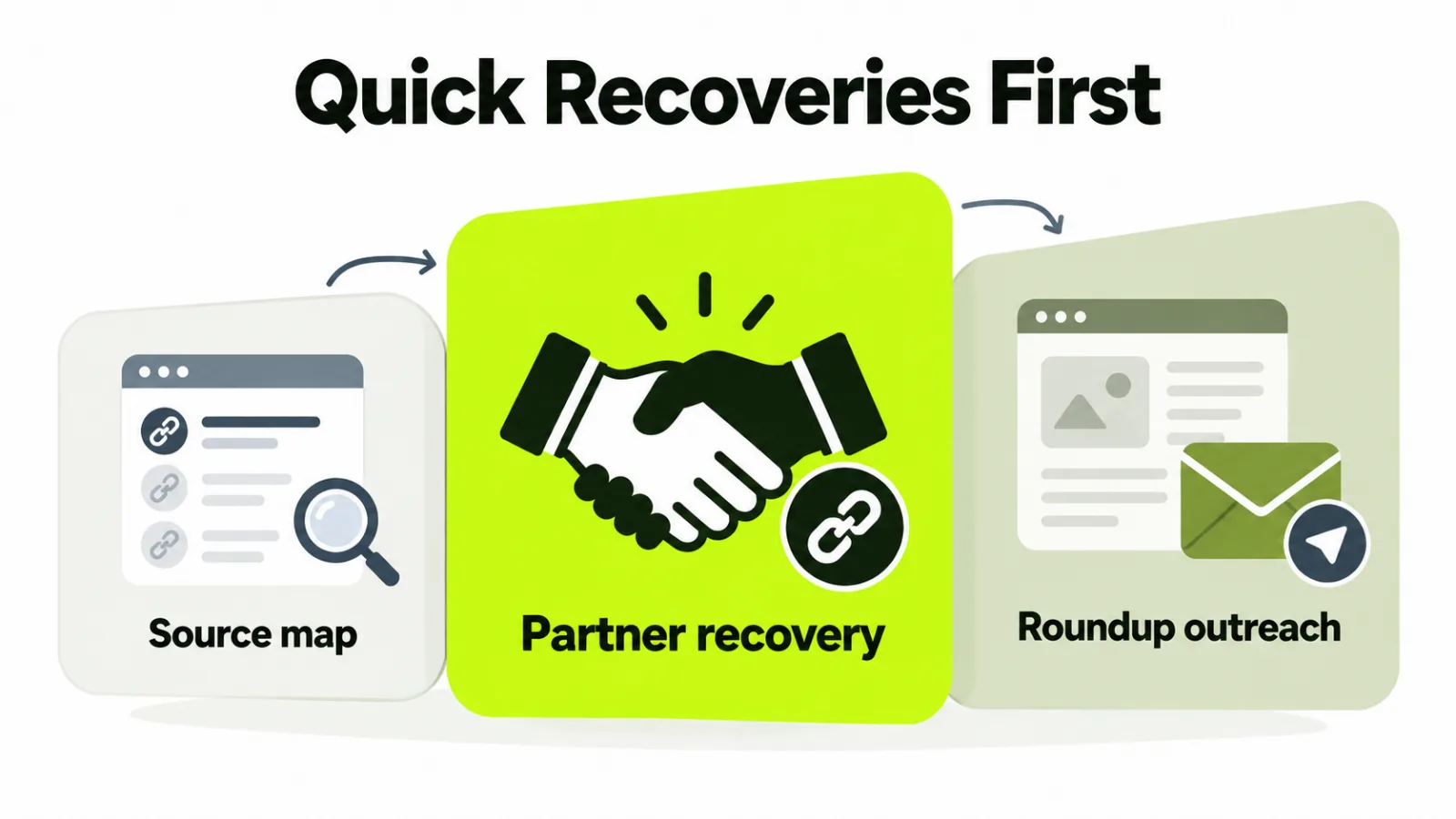
Mostly setup and quick recoveries, with earned coverage arriving in the third month.
| Weeks | Work | What you see |
|---|---|---|
| 1 to 2 | Review of your link profile and direct competitors. Roundup audit for your niche. Integration and partner inventory. | A written plan and a source map |
| 3 to 6 | Partner link recovery. Marketplace listings completed. Unlinked mentions reclaimed. First asset chosen. | Links from partners you already had |
| 7 to 12 | Roundup outreach. First data or template asset promoted. Reporting begins. | First inclusions and coverage, each logged with reasoning |
We don’t commit to a number of links per month. A fixed number means the placements are purchased. We commit to the standard each one meets.
Budget follows company stage. Our pricing page publishes the monthly bands, and early-stage teams should read our guide to link building for SaaS startups first.
How is a CRM company’s program measured?
On relevance and presence first, pipeline second.
- Relevant referring domains: New links from sales, industry and business sources.
- Roundup presence: How many ranking “best CRM for” pages in your niche include you, against a baseline.
- Partner coverage: How many integration partners link to you, out of the total.
- Rankings for niche terms: A fixed set of industry, size and comparison searches.
- Assistant presence: Whether you’re named for a fixed list of buyer prompts.
- Organic trials and pipeline: Signups and opportunities that started in search.
You have a CRM, so the last one should be easy to verify. We report monthly and say which measures haven’t moved. Our guide to calculating link building ROI sets out the arithmetic.
When should a CRM company hire a link building agency?
When the niche is chosen, there’s at least one asset or a real integration network to work with, and the budget is above the level where this pays off. Our pricing page puts that at about $3,000 a month.
Ask any provider these.
- Can I see every site before a link goes live?
- Does money reach the publisher, in any form?
- How do you approach roundups that charge for inclusion?
- Can I read the outreach before it’s sent under our name?
- What will you refuse to do?
- Do you guarantee a number of placements?
Google’s guide to hiring an SEO advises caution about anyone who guarantees rankings, and recommends asking for a clear explanation of what the provider will do.
If the timing is right, book a strategy call. We’ll look at which partners, roundups and publications already matter in your niche, and where you’re missing from them.
Frequently asked questions
Is this guide about CRM software for managing link building?
No. It’s for companies that sell CRM and sales software and want to earn links to their own sites. If you need a system to track link building outreach, that’s a different product category.
Can a small CRM company rank against the largest vendors?
Not for the category term. It can rank for specific searches by industry, team size, workflow or integration, where the large vendors have only generic pages. Those narrower searches also tend to come from buyers closer to a decision.
What earns links for CRM and sales software?
Integration partnerships earn the most relevant ones. Original sales data earns press coverage. Templates, calculators and migration guides earn a steady base from business and community sites. Product pages rarely earn links and rely on internal links from those assets.
Should we pay to be included in “best CRM” lists?
No. A paid position that passes ranking value is link spam under Google’s policies, and an undisclosed paid endorsement conflicts with FTC guidance. Disclosed affiliate arrangements are legitimate marketing, though their links don’t pass ranking value.
Can we offer customers a reward for leaving a review?
Not one that depends on the review being positive. The FTC’s rule prohibits compensation conditioned on a particular sentiment. Asking every customer for an honest review is fine. Check each review platform’s own incentive rules before offering anything.
How do integrations help SEO?
Each integration gives a partner a reason to link to you: a marketplace listing, a launch post, a setup guide. Those links are highly relevant, because they come from tools your buyers already use. They also tell AI assistants which stacks your product fits.
Do you guarantee links or rankings?
No. Nobody can guarantee a ranking, and a guaranteed link count means the links are bought. We commit to the quality and relevance of each placement and report what moved and what didn’t.
How long before a CRM link building program shows results?
Partner and reclaimed links arrive in the first two months. Roundup inclusions and coverage follow. Rankings for niche terms usually take three to six months to move, and competitive ones take longer.
Related reading
- Listicle link building
- Link building for SaaS startups
- Martech SEO agency
- Sales technology case study (composite, anonymised)
- Customer success case study (composite, anonymised)
- What is SaaS link building?