Martech SaaS
Martech SEO Agency for B2B SaaS: Link Building and Digital PR
Your buyers are marketers who run SEO themselves. We earn authority through original data and digital PR that stands out in a saturated category, not generic guest posts.
Pay per delivered placement. Month to month, no lock-in.
What earns a link in a category run by people who do SEO
What you get
What’s included in a martech link building engagement
Martech-relevant prospecting
We target the marketing media, analyst sites, and practitioner newsletters your buyers live in.
Original data & research
Studies and benchmarks worth citing. The strongest link magnet in a category that loves data.
Digital PR to marketing media
Earned coverage and expert citations from the outlets marketers actually read and share.
Expert-led content
Sharp, opinionated content that stands out to an audience that publishes for a living.
Entity & AI-search authority
The consistent signals AI engines use to name a martech tool in an answer.
Reporting tied to pipeline
Rankings, AI citations, relevant referring domains, and sourced demand. No vanity metrics.
A martech SEO agency sells search visibility to people who sell search visibility. We take the off-page side for B2B marketing software: editorial link building, digital PR and the authority that gets a martech product onto shortlists in Google and in AI answers.
Your buyers run SEO programs of their own. They can spot a paid guest post from its URL, and they’ve sent the same outreach templates your last agency used. That changes what works.
This page explains how authority gets built in the most crowded category in software. It covers what marketers link to, why comparison content decides so much, which tactics your buyers will recognise and resent, and how the first quarter runs.
What does a martech SEO agency do?
The label covers three different services. Most martech teams already do two of them well.
| Part of SEO | In a martech company | Our role |
|---|---|---|
| Technical | Usually strong. The team knows its own tooling. | None |
| Content | Usually strong, often the best-resourced function | We point out which pieces can earn links |
| Authority | Usually the gap, because it can’t be produced in-house | All of our work |
That third row is what we do: link building, digital PR, brand mentions and AI-search authority. A martech company rarely needs help writing. It needs other sites to reference what it wrote.
If you’re looking for a single firm to cover technical, content and links together, our comparison of SaaS link building agencies includes several.
Why is SEO harder in martech than in other SaaS categories?
Three reasons: the category is enormous, every competitor is good at marketing, and the buyer knows the tricks.
The category is the most crowded in software. Scott Brinker’s 2025 marketing technology landscape counted 15,384 solutions across 49 categories, up 9% from 14,106 the year before. The first edition in 2011 listed about 150.
Every one of those companies is competing for the same finite set of marketing publications, newsletters and roundup slots.
Your competitors are marketers. In most B2B categories a decent content program stands out. In martech it’s the entry fee. The companies above you have been publishing for years and run their own digital PR.
Your buyer does this for a living. A head of growth knows what a link insertion looks like. A content lead has received your agency’s outreach email, word for word, from four other vendors. Tactics that pass unnoticed elsewhere get recognised here, and the recognition attaches to your brand.
We call that last one the meta-credibility problem. How you market is itself evidence of whether your marketing product is any good.
What do marketers actually link to?
They link to things that make their own work easier or their own arguments stronger. That’s a short list, and it’s the same list they’d give you if you asked.
| Asset | Why a marketer cites it | What it takes |
|---|---|---|
| Original data from product usage | They need a number for a deck, a post or a budget request | Aggregated, anonymised data and a clear method |
| Benchmarks by industry or channel | They want to know whether their own results are normal | Enough volume to segment honestly |
| Free tools and calculators | They use it, then recommend it | A tool that works without a sales call |
| Templates and frameworks | It saves an afternoon | Something better than the first page of results |
| A well-argued contrarian position | It gives them something to agree or argue with | A real view, held by a named person |
| Generic “ultimate guides” | They don’t | Nothing. The category has thousands already. |
Product data is the strongest asset in the table. An email platform knows real open rates by industry. An attribution tool knows how many touches precede a deal. A survey can’t reproduce either, and that’s why journalists come back for the update each year.
Our guide to linkable assets goes through what SaaS companies can publish that content sites can’t.
One caution on data. Marketers read methodology sections. A benchmark built on a small sample, or one that hides its sample size, gets taken apart in public. State what you measured, how many accounts, and over what period.
Where does martech authority come from?
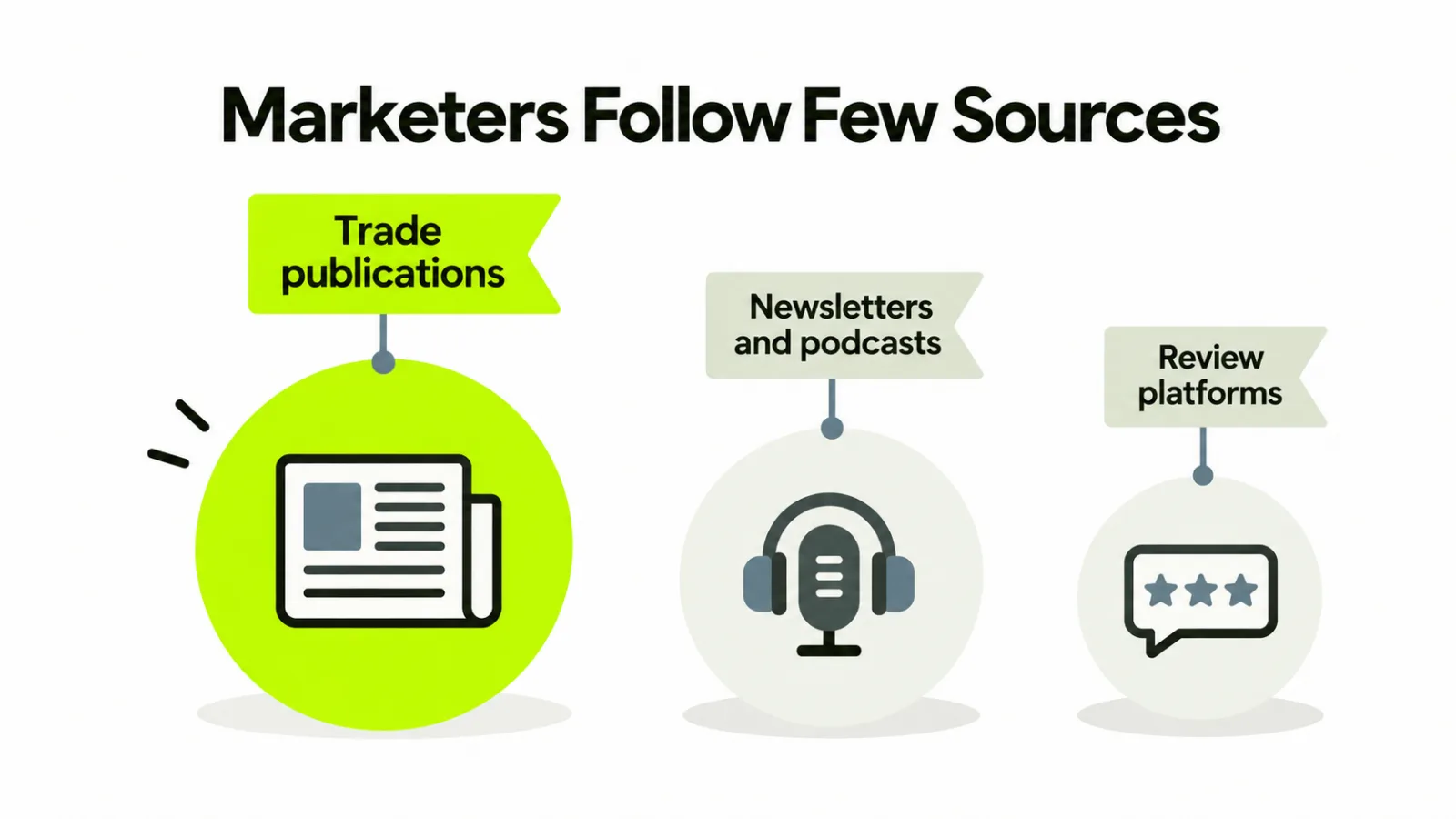
It comes from the publications and people marketers already follow, and there are fewer of those than the size of the category suggests.
| Source type | Examples | Why it carries weight | How a link is earned |
|---|---|---|---|
| Marketing trade publications | MarTech, Search Engine Land, Adweek, Digiday, Marketing Brew | Daily reading for the people who buy | Data, news and contributed analysis that passes an editor |
| Research and industry bodies | Content Marketing Institute, IAB, analyst firms | Sets benchmarks and vocabulary | Research partnerships, contributed data |
| Practitioner newsletters and podcasts | Independent operators with loyal audiences | Peer recommendation at scale | Being worth interviewing, or worth citing |
| Review and comparison platforms | Software review sites, independent roundups | Where shortlists form and AI answers draw names | Real reviews, reviewer access, honest positioning |
| Integration marketplaces | HubSpot Marketplace, Zapier’s app directory, CRM and ecommerce app stores | Proves the product fits an existing stack | Building and maintaining the integration |
| Agency and consultant blogs | Specialist agencies in your channel | They recommend tools to clients | Partner programs, co-authored research |
| Link marketplaces and “write for us” sites | Sites that publish anything for a fee | None, and your buyer recognises them | They’re bought |
The named outlets show where attention sits. They aren’t a list of placements we can promise. Editors at marketing publications are pitched by vendors constantly, and they turn most of it down.
How should a martech company run a benchmark report?
Start from one question your buyers argue about, and answer it with your own data. A report that tries to cover everything gives a reporter nothing to lead with.
The reports that earn links tend to follow the same six steps.
- Pick the question: “What’s a normal reply rate for cold outreach in B2B software?” is a story. “The state of email” isn’t.
- Define the sample before you look. Which accounts, which period, which exclusions. Decide these first, so the method can’t be bent to fit a headline.
- Segment the way readers think: By industry, company size or channel, so each reader can find the row that describes them.
- Write the method section for a sceptic. Sample size, date range, definitions and known limits. Marketers will read it, and some will try to pick it apart.
- Publish it as a page, not only a PDF. A page can be linked, quoted and updated. A gated PDF can’t be cited by someone who hasn’t filled in your form.
- Brief reporters before launch: A few days under embargo gives a journalist time to write something considered.
Then repeat it. The second edition is easier to pitch than the first, because there’s a trend to report. By the third, other writers are waiting for it.
Check your right to use the data first. Customer agreements often restrict how account data can be used, even aggregated. Have legal confirm before the analysis starts, and set a minimum group size so no customer can be identified.
Why do comparison pages matter so much in martech?
They matter because a marketer rarely buys a tool without comparing it to two others, and the comparison happens in search.
“Alternative to”, “versus” and “best tool for” queries carry more buying intent than any category term. They’re also the pages AI assistants lean on when someone asks for a recommendation.
There are two sides to this. One is your own comparison pages. The other is other people’s roundups.
Your own pages need to be fair to be believed. A comparison that claims you win on every row gets closed. One that says where the competitor is the better choice gets read to the end, and occasionally linked.
Other people’s roundups are a link building target in their own right. An independent “best email platforms for ecommerce” article that includes you sends buyers, passes authority and feeds AI answers at once. Our guide to listicle link building covers how to earn inclusion without paying for it.
Paying is common, and it’s a mistake for two reasons. Google’s spam policies treat buying links for ranking purposes as link spam. And the FTC’s Endorsement Guides say a material connection between an endorser and a marketer “should be disclosed clearly and conspicuously”. A paid ranking position presented as editorial fails both.
Which link building methods work for marketing software?
The ones that would still make sense if your buyer could watch you do them. Six carry most martech programs.
Data-led digital PR: A benchmark report, pitched to reporters who cover the channel. This is the method with the longest tail, because a good number keeps getting cited. See our digital PR definition for how it differs from link outreach.
Named expert commentary. Platform changes and privacy shifts are frequent in marketing, and every one needs a quote. A product lead who explains what changed, without pitching, becomes a regular source.
Free tools: A subject line tester, a UTM builder, a sample size calculator. Marketers bookmark them and link to them from their own resource pages for years.
Integration co-marketing: Each platform you connect with has a marketplace and a partner team. A launch post, a joint webinar write-up and a directory listing are three relevant links from one integration.
Agency partnerships: Agencies write about the tools they use for clients. A partner program that gives them early access and real data produces case studies you didn’t write.
Editorial contributions: An article pitched to a publication that could have said no. Our page on white hat link building gives the test that separates this from a paid placement.
We’d add one method to avoid by default: mass outreach. Your buyers are the recipients. A templated email asking for a link, sent to four hundred marketers, is four hundred small pieces of evidence about your brand.
How does the plan change by martech segment?
The category is 49 sub-categories on the landscape map, and they don’t share an audience. A plan has to start from who the buyer is.
| Segment | Who buys | Strongest link asset | Where it gets cited |
|---|---|---|---|
| Email and SMS marketing | Lifecycle and retention marketers, ecommerce owners | Send and engagement benchmarks, deliverability guides | Ecommerce and email publications, agency blogs |
| Marketing automation and CRM-adjacent tools | Demand generation and marketing operations | Funnel benchmarks, workflow templates | B2B marketing publications, operations communities |
| Attribution and analytics | Marketing operations, growth leads, finance partners | Channel-mix data, measurement methodology | Analytics blogs, performance marketing press |
| SEO and content tools | SEO leads, content managers | Search studies, free tools | Search publications, practitioner newsletters |
| Social and creator tools | Social managers, brand teams, agencies | Platform trend data, posting benchmarks | Social media and creator-economy publications |
| Customer data platforms | Data and marketing technology leaders | Architecture guides, privacy explainers | Data engineering and martech publications |
| Account-based marketing and sales intelligence | Revenue and marketing leadership | Buying-group research, intent data studies | B2B revenue publications and communities |
Email and SMS tools have a compliance layer the others mostly don’t. Anything you publish about sending practice should be consistent with the FTC’s CAN-SPAM compliance guide, because deliverability advice that ignores it won’t survive an editor who knows the subject.
CRM and sales tools sit next to this category and behave differently. Our guide to link building for CRM software companies covers them.
What should martech companies avoid?
Anything your buyer would recognise from the inside. Marketers know these tactics because they’ve been offered them.
- Link insertions bought in bulk: A sentence and a link added to an old post on a site that sells them. Our niche edits definition explains when an insertion is legitimate and when it’s a rate card.
- Paid roundup positions: A fee for the number one slot. It breaks Google’s rules, usually breaks disclosure rules, and the author’s readers can tell.
- Reciprocal link rings: “We’ll link to you if you link to us”, organised in a shared spreadsheet or a private group. Google lists excessive link exchanges as link spam.
- Undisclosed sponsored content. Google asks for paid links to be marked as sponsored. Marked properly, they pass no ranking value.
- Incentivised reviews. The FTC’s rule on fake reviews and testimonials prohibits compensation conditioned on a review expressing a particular sentiment.
- Scaled AI content for links. Publishing hundreds of thin pages to attract links. Google’s spam policies cover scaled content abuse directly.
The cost in martech is reputational before it’s algorithmic. A marketing tool caught using link schemes has demonstrated, to an audience of marketers, how it thinks marketing should be done.
How does AI search shortlist martech tools?
It names the tools that keep appearing across the sources it retrieves. When a marketer asks an assistant for a shortlist, the answer is assembled from pages that already rank.
Google is direct that there’s no separate optimisation for it. Its page on AI features and your website says: “There are no additional requirements to appear in AI Overviews or AI Mode, nor other special optimizations necessary.”
The mechanism is what makes authority matter. Google describes a “query fan-out” technique, in which one question triggers “multiple related searches across subtopics and data sources”.
Ask an assistant for the best email platform for a mid-sized ecommerce brand and it will look at pricing, integrations, deliverability, reviews and comparisons. A tool that shows up in three of those result sets has a strong chance of being named. A tool that shows up only on its own website doesn’t.
Four things move this.
- Inclusion in independent roundups: These are the pages fan-out searches return most.
- Review presence: Enough genuine reviews on the main platforms to be considered at all.
- Clear positioning on your own site. Who it’s for, what it costs, what it connects to, stated in the first screen.
- Consistent entity facts: Category, pricing model and integrations matching across your site and every profile. Our guide to entity authority explains why inconsistency costs citations.
Check your robots.txt as well. OpenAI’s crawler documentation separates its search crawler from its training crawler, and blocking the first removes you from ChatGPT search results.
Nobody can guarantee an AI citation. We track a fixed set of buyer prompts and report movement, using the approach in our guide on getting cited by AI.
Which pages on a martech site earn links?
Data, tools and templates earn them. Product pages rank on the authority those pages pass along through internal links.
| Page type | Can it earn links? | Role in the plan |
|---|---|---|
| Benchmark and data reports | Yes, strongly | The main press hook, repeated each year |
| Free tools and calculators | Yes, steadily | Resource-page links and bookmarks |
| Templates and frameworks | Yes | A wide base of small, relevant links |
| Integration pages | From partners | Links from inside the buyer’s stack |
| Comparison and alternative pages | Occasionally | Capture buyers near a decision |
| Feature and pricing pages | Rarely | Receive authority through internal links |
Martech blogs are often the strongest part of the site and the least connected to it. A post that earns plenty of references and links to no product page has done half its job. Our post on SaaS backlink strategy covers how to route that authority.
What do the first 90 days look like?
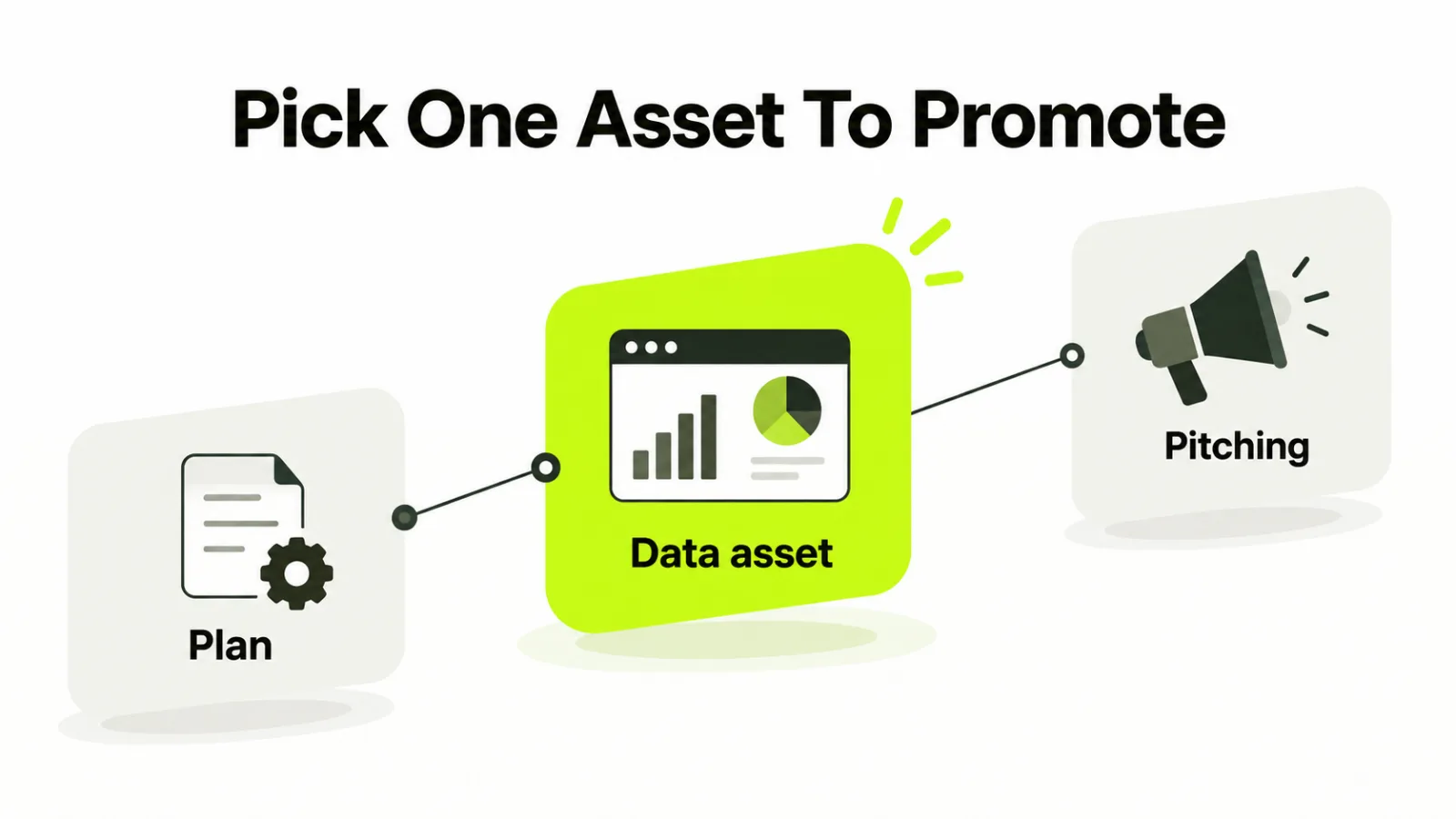
The first quarter is about choosing one asset worth promoting and building the relationships to promote it.
| Weeks | Work | What you see |
|---|---|---|
| 1 to 2 | Review of your link profile and three to five direct competitors. Roundup and comparison audit. Data inventory. | A written plan, a source map and a shortlist of assets |
| 3 to 6 | First data asset shaped. Roundup outreach begins. Unlinked mentions reclaimed. Integration listings completed. | Reclaimed links, first inclusions, editor conversations |
| 7 to 12 | Data story pitched. Commentary bench active. Reporting begins. | Coverage starting to land, with a log explaining each placement |
There’s no fixed monthly link count. A fixed count is a sign the placements are bought. We commit to the standard each one meets and to showing our reasoning.
Budget follows company stage. Our pricing page publishes the monthly bands, and how much SaaS should spend on link building explains how to size one.
How is a martech program measured?
The way you’d want a vendor to measure it: against outcomes, with the method stated.
- Relevant referring domains: New links from marketing, ecommerce and B2B technology sources.
- Roundup and comparison presence: How many of the ranking “best” and “alternative” pages in your category include you, tracked against a baseline.
- Rankings for commercial terms: A fixed set of category, comparison and use-case queries.
- AI answer presence: Whether you’re named for a fixed prompt list.
- Organic signups and pipeline: Trials, demos and revenue that began in search.
You’ll want to check our numbers against your own analytics, and you should. We report monthly, including the indicators that haven’t moved. Our guide to calculating link building ROI sets out the arithmetic.
How do you choose a martech SEO agency?
You’re better placed than most buyers to judge this, so use what you know. Ask to see the work the way you’d inspect your own.
- Show me three recent placements and the outreach that earned each one.
- Does money reach the publisher, in any form?
- Can I approve every site before a link goes live?
- How many people receive each outreach email, and can I read it first?
- What will you refuse to do for us?
- What happens when a link is removed?
- Do you guarantee a number of placements?
The fourth question matters more in martech than anywhere. Your prospects are on the receiving end, so you should read what goes out under your name.
Google’s own guide to hiring an SEO warns against anyone who guarantees rankings, and suggests asking a provider to explain exactly what they’ll do.
We’re the wrong fit when the need is technical SEO or content production, when there’s no data, tool or point of view to promote and no plan to create one, or when the budget is under the level where authority work pays off. Our pricing page puts that near $3,000 a month.
Otherwise, book a strategy call. We’ll show you where competitors are earning references you aren’t, and what you already own that could close the gap.
Frequently asked questions
Why is link building harder for martech companies?
The category has more vendors than any other in software, every competitor runs a strong content program, and the buyers are marketers who recognise link schemes. Standard tactics get little attention and can damage the brand with the exact audience it’s selling to.
What earns links for marketing software?
Original data from product usage earns the most, followed by free tools, benchmarks and well-argued positions from named people. Generic long-form guides earn very little, because the category already has thousands of them competing for the same references.
Should we pay to be included in “best tools” articles?
No. A paid position that passes ranking value is link spam under Google’s policies, and an undisclosed one conflicts with FTC guidance on endorsements. Disclosed and marked sponsored, it passes no ranking value. Inclusion earned on merit is slower and it lasts.
Do you guarantee a number of links per month?
No. Editors decide what gets published, so a guaranteed number means the placements are purchased. We commit to the quality and relevance of each placement and report what moved and what didn’t.
We already have a strong content team. What do you add?
Distribution to the sites that matter. A strong content team produces assets worth citing. We work on getting them cited: reporter relationships, roundup inclusion, unlinked mention recovery and partner co-marketing. Most martech content underperforms on links because nobody is assigned to that job.
How long before results show?
Reclaimed links and marketplace listings arrive in the first month or two. Earned coverage follows each asset’s release. Ranking movement on competitive terms usually takes two to three quarters, since the effect builds as more linking pages get crawled.
Does AI search change how martech buyers find tools?
Yes. Marketers ask assistants for shortlists and comparisons, and the answers draw on roundups, reviews and documentation. The work that earns search authority also earns AI mentions, because both depend on being referenced by independent sources.
Do you handle technical SEO or content writing?
No. We do link building, digital PR, brand mentions and AI-search authority. We’ll advise on which pages can earn links and work alongside your in-house team or another agency.
More on martech SaaS
- Martech SaaS SEO
- Martech SaaS Guest Posting
- Martech SaaS Digital PR
- Martech SaaS Content Marketing
- Case study (composite, anonymised): Series C martech attribution, ranking against Salesforce.
Reporting
How results are measured
We report on rankings, AI citations, referring domains and pipeline. We don’t show numbers we can’t stand behind.
Representative results
- DR38 to DR58 in 12 months, HIPAA compliance healthtech SaaS.
- Pipeline contribution 6% to 22%, mid-market customer success SaaS.
- Top-3 against Splunk and Datadog, cloud-native SIEM SaaS.
Composite, anonymized accounts based on real client engagements. Client identities and exact metrics are generalized for confidentiality.