SaaS Link Building
Link Building for AI Companies: Earning Trust in a Noisy Market
Link building for AI companies means earning references from the sources technical buyers and enterprise risk teams already trust: research, developer ecosystems, independent evaluations and credible press. In a market full of unverified claims, those references are what separate a real product from a demo.
This guide is about AI companies as the ones doing the link building. If you’re after how links affect visibility inside AI search, that’s a different question, and our guide on getting cited by AI covers it.
Here we cover what’s different about the category, who the buyers are and what they check, where authority comes from, how research and open source earn links, and what to avoid.
What’s different about link building for an AI company?
Four things: the volume of noise, the scrutiny on claims, the speed of change, and who holds the search results.
The noise is extreme. New AI products launch every day, and most describe themselves in the same words. Editors and newsletter writers have learned to ignore launch announcements, so the usual startup playbook earns less here than it does elsewhere.
Claims get checked. Regulators are watching how AI products are marketed. When the FTC announced its Operation AI Comply enforcement sweep, the agency’s chair said there is “no AI exemption from the laws on the books”. Journalists apply the same test, and a performance claim with no method behind it won’t be printed.
Everything dates quickly: A comparison written six months ago may describe models that have since been replaced. Content has to be maintained, and assets that stay accurate over time are worth more than ones that capture a moment.
The big terms are taken. Category searches are held by the largest labs, cloud providers and major publications. A young company competes on specific use cases and technical depth rather than on the head terms.
The result is that credibility has to be shown, not asserted. The links worth having come from people who looked at the work and found it sound.
Who buys AI software, and what do they check?
Usually four different people inside one deal, and each of them looks for evidence in a different place.
| Buyer | What they check | Where they look | What earns their trust |
|---|---|---|---|
| Developer or ML engineer | Does it work, and can I build on it? | Documentation, code repositories, forums | Working examples, honest limits, active maintenance |
| Technical leader | Will it hold up in production? | Engineering blogs, benchmarks, architecture write-ups | Reproducible evaluations, credible peers using it |
| Business buyer | Does it solve my problem and what does it return? | Review platforms, case studies, comparison articles | Named customers, measured outcomes |
| Risk, legal and procurement | Is it safe to adopt? | Security pages, policy documentation, governance frameworks | Clear data handling, alignment with recognised frameworks |
A link building plan for an AI company has to reach all four. Developer references won’t convince procurement, and a business-press feature won’t convince an engineer who can’t find the docs.
The fourth row is new for most software categories. Enterprise buyers increasingly ask how a vendor manages AI risk, and they use published frameworks to frame the question. NIST’s AI Risk Management Framework is the common US reference. In Europe, the AI Act sets obligations that vary with the risk level of the system.
Where does authority come from for AI companies?
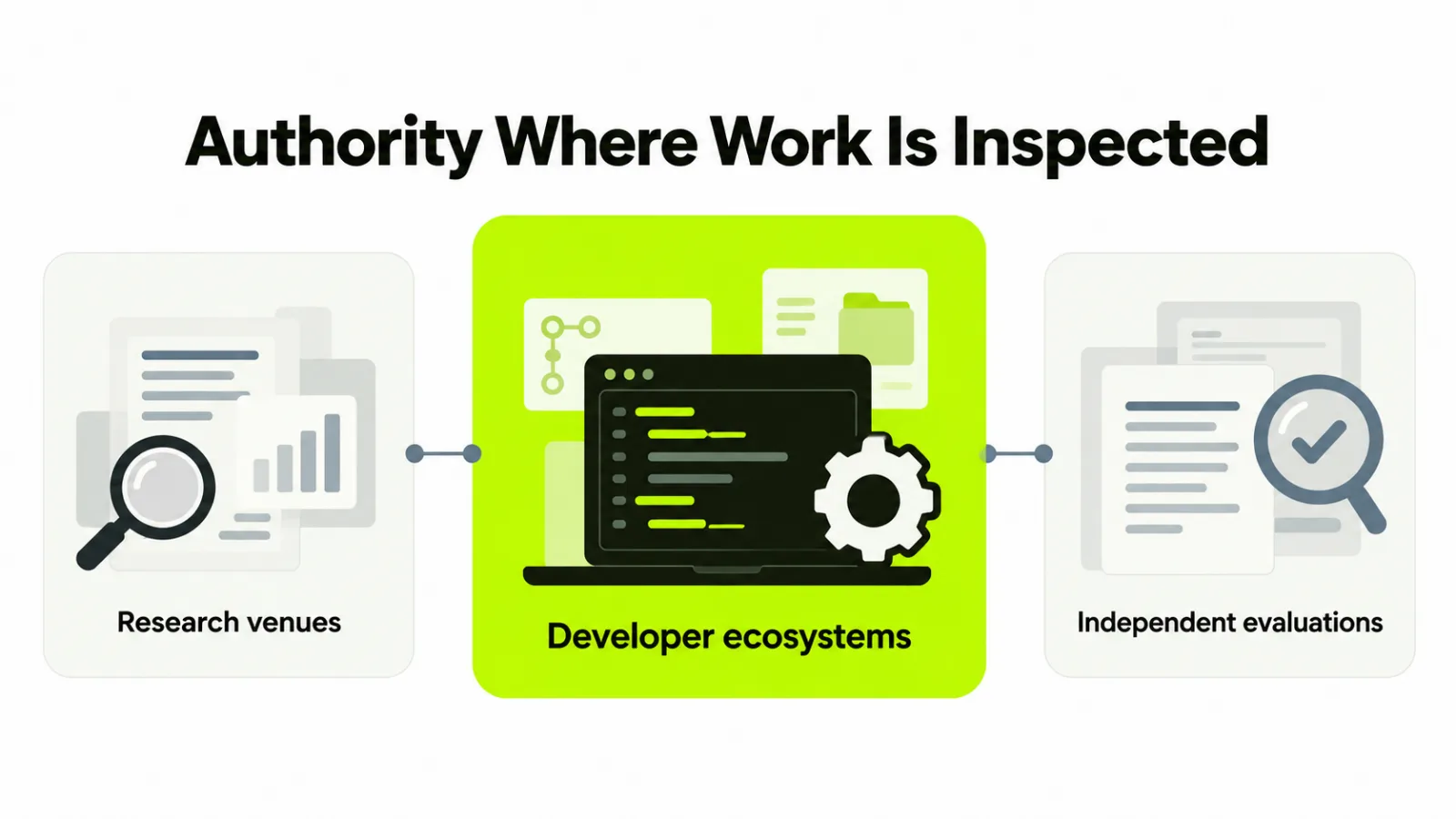
It comes from places where the work can be inspected. That’s the common thread across every source that carries weight in this category.
| Source type | Examples | Why it carries weight | How a reference is earned |
|---|---|---|---|
| Research venues | arXiv preprints, conference papers, workshop talks | Other researchers and engineers cite them | Publishing work that’s reproducible |
| Developer ecosystems | GitHub repositories, Hugging Face models and datasets | Where engineers find and judge tools | Releasing something useful and maintaining it |
| Technology press | Technology news sites, AI-focused publications, business technology desks | Reaches technical leaders and buyers | News with substance: research, data, a notable customer |
| Practitioner newsletters and podcasts | Independent writers covering AI engineering and applied AI | Trusted filters in a noisy market | Being worth explaining to their readers |
| Independent evaluations | Third-party benchmarks, leaderboards, academic comparisons | Evidence nobody on your payroll produced | Submitting to evaluation, and reporting the results as they are |
| Annual industry reports | Reports such as the Stanford AI Index | Referenced all year by press and analysts | Contributing data, or being notable enough to be included |
| Integration and cloud marketplaces | Cloud provider marketplaces, automation platforms, tool directories for agents | Shows the product fits real stacks | Building and listing the integration |
| Mass “AI tools” directories | Sites listing thousands of tools, often for a fee | Very little | Paying, in many cases |
The examples show where attention sits. They aren’t a list of placements we can promise. Coverage in this category is decided by people who are pitched constantly and have become hard to impress.
The last row is worth a word. Submitting to a few well-run directories is reasonable. Paying a service to submit you to two hundred of them produces a pile of low-value links that all look alike.
How do research and open source earn links?
They earn links because other people build on them. A paper gets cited by the work that follows it. A library gets referenced by every project that depends on it.
Four kinds of technical output do most of the work.
Papers and technical reports: A preprint on arXiv puts your method where researchers look. arXiv is a preprint server, so posting there isn’t peer review, and readers know that. What earns citations is whether the result can be reproduced.
Open-source code: A library, an evaluation harness, a small tool that solves one annoying problem. Engineers link to code they use, from documentation, blog posts and their own repositories.
Models and datasets: Releasing a model or dataset with a proper model card gives the community something to test. Each project that uses it has a reason to reference you.
Honest evaluations: A benchmark that includes the cases where your product loses is far more citable than one where it wins everything. People link to evaluations they believe.
There’s a catch that most AI companies miss. Links to your repository, your model page or your paper don’t build authority for your own domain. They build it for the platform hosting them.
The fix is simple.
- Publish a full write-up on your own site for every paper, release and benchmark.
- Link to that page from the repository README, the model card and the paper itself.
- Give journalists and bloggers that page as the reference rather than the repository.
That way the technical community can cite the artefact, and everyone else cites you. Our guide to linkable assets covers how to structure the page.
Why does claims discipline matter for links?
Because an overstated claim costs you the exact coverage you were trying to earn. Technology reporters are wary of AI announcements, and the careful ones ask for the method first.
Five rules keep a pitch credible.
- State the evaluation: Which dataset, which baseline, which date. A number without those is unusable to a careful writer.
- Say what it doesn’t do. Known limits make the rest believable.
- Don’t call it AI if it isn’t. Overstated capability is the kind of claim regulators have acted on.
- Name the customer, or say it’s anonymised. A case study with no company attached reads as invented.
- Disclose paid relationships: The FTC’s Endorsement Guides say a connection between an endorser and a marketer “should be disclosed clearly and conspicuously”. That covers sponsored newsletter features and paid creator reviews.
This is partly about regulation and mostly about reputation. The AI engineering community is small and talks. A vendor caught inflating a benchmark is remembered for it.
Which link building methods work for AI companies?
The ones that hand a technical audience something to verify. Eight carry most programs.
Technical writing with original evaluations: A post that tests something and reports what happened. It’s the most reliable link earner in the category, because engineers share results they can check.
Open-source releases: Covered above. Even a small utility earns references for years if it’s maintained.
Documentation and tutorials: Good docs get linked from forums, answers and other people’s tutorials. They’re also what AI assistants quote when a developer asks how to do something with your product.
Usage data studies: What your platform sees: which tasks people run, how usage changes, what fails. Aggregated and anonymised, it’s the kind of data business and technology reporters need.
Fast expert commentary: A major model release or a policy change needs informed reaction within hours. A technical founder who can explain what it means, accurately, becomes a regular source. That’s digital PR in this market.
Integrations: Each platform you connect to has a directory and usually a partner team. One integration can produce a listing, a launch mention and a joint tutorial.
Comparison articles and roundups: Buyers and assistants both rely on them. Our guide to listicle link building covers earning inclusion without paying.
Customer stories with numbers: A named customer with a measured outcome is uncommon enough in AI to be newsworthy when you have one.
Standard guest posting has a narrower role. Technical publications accept contributed pieces when they teach something. A product pitch in article form gets declined.
How should an AI company announce a release?
With evidence attached. A release is the one moment the press is predisposed to cover you, and most AI companies spend it on adjectives.
An announcement that earns coverage and links has five parts.
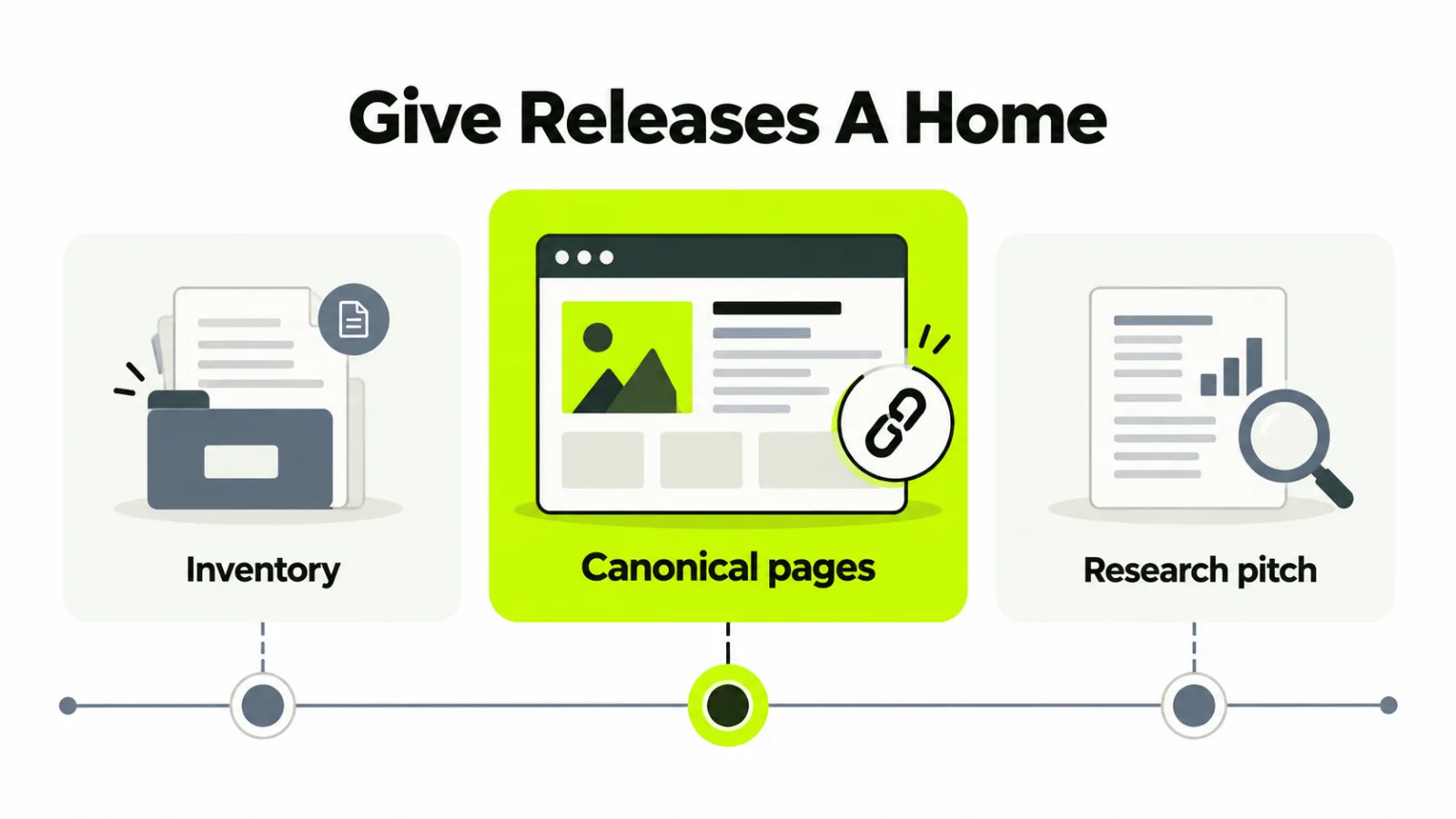
- A canonical page on your own domain. Not only a social post or a repository. This is the page everyone should link to.
- The evaluation, in full: What was tested, against what, on which date, with the cases where it underperforms.
- Something to try: A demo, a notebook or a free tier. Writers trust what they can run.
- What changed and what it costs. Pricing, limits and availability stated plainly, so a reporter doesn’t have to ask.
- A briefing before launch: A few days under embargo for the reporters and newsletter writers who cover your niche.
Keep a public changelog as well. It’s a low-effort page that developers link to, and it gives assistants a dated record of what your product can do now.
Reserve announcements for real changes: A company that announces every minor update finds that nobody opens the email when something important ships.
How does the plan change by type of AI company?
“AI company” covers businesses with very different buyers. The plan follows the buyer.
| Type | Primary buyer | Strongest link asset | Where it gets cited |
|---|---|---|---|
| Model and infrastructure providers | ML engineers, platform teams | Benchmarks, technical reports, open-source tooling | Research community, engineering blogs, developer forums |
| AI developer tools | Software engineers, engineering managers | Documentation, tutorials, open-source components | Developer publications, code repositories, community sites |
| Applied AI for a regulated industry | Domain leaders plus risk and compliance | Validation studies, compliance documentation | Industry trade press, professional bodies |
| AI features inside business software | Functional leaders in sales, support, marketing | Usage data, outcome benchmarks, customer stories | Functional trade press, review platforms, roundups |
| AI security and governance | Security leaders, risk officers | Research on AI-specific risks, framework guides | Security press, policy and governance publications |
The third row inherits the rules of its industry. An AI product for finance works under the same trust standard as any fintech, covered on our fintech page. One for clinical use works under healthcare’s, covered on our healthtech page. The AI part doesn’t lower the bar.
The fifth row overlaps with security. Our cybersecurity page covers how research credibility works with that audience.
What should AI companies avoid?
Avoid the shortcuts the category is full of. Most of them are obvious to the people you’re trying to reach.
- Directory submission blasts: A paid service that lists you on hundreds of “AI tools” sites. The links are near-identical and near-worthless.
- Paid positions in “top AI tools” lists. Google’s spam policies treat buying links for ranking purposes as link spam.
- Undisclosed sponsored coverage. Google asks for paid links to be marked as sponsored, and a marked link passes no ranking value.
- Generated content at scale. Using your own product to publish thousands of pages for search. Google’s spam policies name scaled content abuse specifically, and an AI company doing it makes an easy story.
- Manufactured reviews. The FTC’s rule on fake reviews and testimonials prohibits reviews by people with no real experience of the product, including ones that are generated.
- Benchmarks without a method: “Outperforms the leading model” with no dataset, no date and no baseline.
- Launch-only PR: A press release for every minor feature trains reporters to skip your emails.
Our page on white hat link building gives the test we use for any tactic: would the link still be there if nothing had been exchanged for it?
How do AI companies get recommended by AI assistants?
The same way any other company does, which surprises some founders. Building AI doesn’t give a company an advantage in being cited by it.
Google’s guidance on AI features and your website is plain about this: “You don’t need to create new machine readable files, AI text files, or markup to appear in these features.” A page needs to be indexed and eligible to appear with a snippet.
What decides the outcome is how widely you’re referenced. Google describes a “query fan-out” technique, where one question becomes “multiple related searches across subtopics and data sources”. The products named in the answer tend to be the ones found across several of those searches.
Three issues come up for AI companies more than for others.
Names that are ordinary words. Many AI products are named after common words or short invented terms shared with other things. An assistant has to work out which entity is meant. Use a consistent descriptor everywhere, such as “Acme, the document-processing API”, until the name can stand alone. Our guide to entity authority covers disambiguation.
Documentation is the most quoted asset. When a developer asks an assistant how to do something with a tool, the answer comes from the docs. Clear, current, well-structured documentation is authority work.
Crawler settings: AI companies sometimes block AI crawlers on principle. OpenAI’s crawler documentation lists separate bots for search and for training. Blocking the search bot removes you from ChatGPT’s search answers, which is rarely what the company intended.
Nobody can promise a citation. We track a fixed set of buyer and developer prompts and report what changes over time.
Which pages on an AI company’s site earn links?
The ones with something to verify. Product pages earn few, and they get their authority through internal links from the pages that do.
| Page type | Can it earn links? | Role in the plan |
|---|---|---|
| Research write-ups and benchmarks | Yes, strongly | The main link target |
| Documentation and tutorials | Yes, steadily | Forum and assistant citations |
| Open-source project pages on your domain | Yes | Captures links that would otherwise go to the host platform |
| Usage data reports | Yes, on a cycle | A press moment each release |
| Customer stories with outcomes | Sometimes | Evidence for business buyers and press |
| Trust, security and governance pages | Rarely | Answers procurement; link to it internally |
| Product and pricing pages | Almost never | Receive authority through internal links |
The common fault is a strong engineering blog on a separate subdomain or platform, with no links back to the product. The authority is real and it isn’t helping the pages that sell. Our post on SaaS backlink strategy covers how to route it.
What do the first 90 days look like?
The first quarter is about finding what’s already citable and giving it a home on your own domain.
| Weeks | Work | What you see |
|---|---|---|
| 1 to 2 | Review of your link profile and close competitors. Inventory of research, code, data and documentation. Entity and naming check. | A written plan and a list of citable assets |
| 3 to 6 | Canonical pages built for existing releases. READMEs and model cards linked back. Unlinked mentions reclaimed. Integration listings completed. | Reclaimed links, corrected references, first reporter conversations |
| 7 to 12 | First research or data story pitched. Commentary bench active. Reporting begins. | Coverage starting to land, with the reasoning logged |
Technical review is built in. Nothing goes to a reporter until someone on your engineering or research team has checked it. An error in a technical pitch does lasting damage with this audience.
Many AI companies are early-stage, and for them a paid program may be premature. Our guide to link building for SaaS startups covers what to do before hiring anyone.
How is an AI company’s program measured?
By the quality of who’s referencing you, then by visibility, then by pipeline.
- Relevant referring domains: New links from research, engineering, technology press and your target industry.
- Citations of your work. How many independent sites reference each paper, release or benchmark, and whether they link to your domain or to the host platform.
- Rankings for specific terms: Use cases, comparisons and “how to” queries, tracked as a fixed set.
- Assistant presence: Whether you’re named for a fixed list of buyer and developer prompts.
- Signups and pipeline from search. Developer signups, trials and enterprise opportunities that started in organic search.
We report monthly and say which measures haven’t moved. Our guide to SaaS SEO metrics has the full list.
When should an AI company hire a link building agency?
When there’s real work to promote, a message that isn’t changing every month, and a budget above the level where the effort pays off. Our pricing page puts that level at about $3,000 a month.
These questions are worth asking any provider.
- Who checks technical accuracy before anything is pitched?
- Can I see every site before a link goes live?
- Does money reach the publisher, in any form?
- How do you handle claims we can’t yet substantiate?
- What will you refuse to do?
- Do you guarantee a number of placements?
The right answer to the fourth question is that they won’t pitch them. The right answer to the last is no, because a guaranteed count means the placements are bought.
Google’s guide to hiring an SEO makes the same point about guarantees.
If the timing looks right, book a strategy call. We’ll go through what you’ve already built that deserves to be cited, and whether a program makes sense yet.
Frequently asked questions
Is link building different for AI companies?
Yes. The market is noisier, claims are scrutinised more closely, and the audience is technical. Launch announcements and generic content earn very little. Reproducible research, open-source work, documentation and honest evaluations earn the references that matter.
Do links to our GitHub or Hugging Face pages help our website?
Not directly. Those links build authority for the platform hosting the page. Publish a full write-up on your own domain for each release, and link to it from the README, model card and paper, so that references have somewhere on your site to point.
Should we submit to AI tool directories?
A few well-run ones, yes. Mass submission to hundreds of directories, especially paid ones, produces links that look alike and carry little value. The time is better spent on one integration listing or one piece of work worth citing.
Can we use our own AI product to generate content for links?
Not at scale. Google’s spam policies name scaled content abuse, which covers large volumes of pages produced mainly to manipulate rankings, however they’re made. Using AI to help write a useful, reviewed article is a different thing.
How do we get covered by technology press?
Give reporters something that stands up: a result with a method, usage data nobody else has, or a notable customer with a measured outcome. Launch announcements alone rarely get covered now. Respond quickly and accurately when reporters need expert comment on industry news.
Do you guarantee links or rankings?
No. Nobody can guarantee a ranking, and a guaranteed link count means the links are purchased. We commit to the quality and relevance of each placement and report what moved and what didn’t.
Our AI product serves a regulated industry. Does that change the plan?
Yes. The plan inherits that industry’s rules. A product for finance or healthcare is judged on the same trust standard as any other vendor in the sector, and outreach copy often needs compliance review before it goes out.
Is this the same as optimising for AI search?
No. This guide is about AI companies earning links and authority. Optimising any company to be cited in AI answers is a separate topic, though the two overlap, because assistants favour sources that are widely and credibly referenced.