SaaS Link Building
How AI Search Changes SaaS SEO
AI search changes SaaS SEO by replacing the ranked list of ten blue links with one synthesized answer that names a handful of trusted sources. The pages that rank highest no longer win by default. The brands that win are the ones AI engines treat as the most authoritative, well-corroborated entity for a topic. For B2B SaaS founders, the job moved from “earn the top spot” to “become the source the model recommends.” The levers that get you there are entity authority, citations, structure, and topical depth.
Here’s what changed, how AI engines pick who to cite, why trusted mentions beat tactical link schemes, what your team should do about it, and how to measure visibility when the answer shows up before the click.
What actually changed: discovery is now an answer rather than a list
AI search collapses research, comparison, and recommendation into one generated response. Users get a decision and not a directory. Google AI Overviews, ChatGPT, Perplexity, Gemini, and Claude read across many sources, summarize them, and surface a short list of cited references, compressing a buyer’s journey that used to span several searches and a dozen page visits.
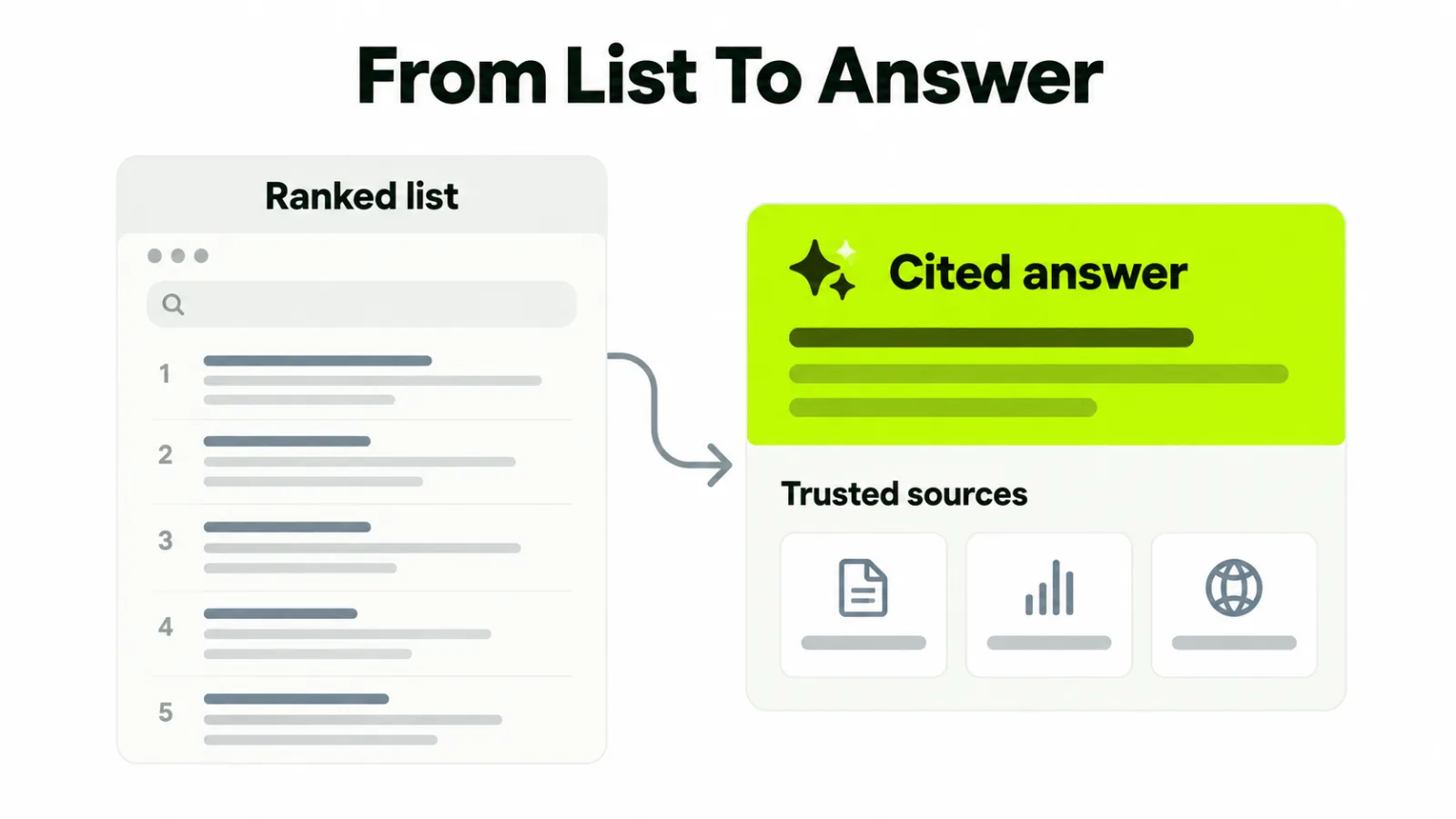
Three structural shifts matter most for SaaS:
Zero-click answers are now the default surface
When an AI Overview or assistant answers directly, the user may never land on a website. Your content can shape what the buyer believes while earning fewer raw sessions. So your presence inside the answer becomes the thing worth measuring, more than clicks to your page.
The funnel collapsed
A prospect asks for the best tool in your category for their specific use case, gets a reasoned shortlist, and forms a preference in a single prompt. Education and comparison now happen in the same exchange. Miss that shortlist and you’ve missed the consideration set entirely.
Retrieval sits between you and the user
Generative engines retrieve and rank passages before they write a word. Your content competes to rank and to be the cleanest, most quotable, most corroborated passage a model can lift straight into its answer.
None of this kills classic SEO. Crawlable, fast, well-linked pages are still the foundation, because most AI engines lean on the same search index and quality signals. The prize changed and the groundwork didn’t: be retrievable and citable as well as rankable.
Classic SEO vs. AI-search optimization
AI-search optimization keeps the SEO fundamentals but tunes them for extraction and citation rather than ranking position alone. Here’s where the emphasis shifts.
| Dimension | Classic SEO | AI-search optimization (GEO/AEO) |
|---|---|---|
| Primary goal | Rank in the top spots for a keyword | Get cited and recommended inside the generated answer |
| Unit of competition | The page (URL) | The passage, and the entity behind it |
| Success signal | Position, clicks, organic sessions | Citation share, mentions, presence in AI answers |
| What wins | Relevance, links, on-page work | Entity authority, corroboration, clean structure, topical depth |
| Content shape | Long-form pages built for a query | Self-contained, extractable claims and definitions |
| Role of links | Ranking signal via PageRank-style authority | Authority, plus proof you’re a trusted source |
| Buyer journey | Many searches across the funnel | Squeezed into one or two prompts |
How AI engines decide what to cite
AI engines cite sources that are easy to retrieve, easy to extract, and independently corroborated as authoritative on the topic. No public ranking formula exists, but the patterns you can watch across AI Overviews, Perplexity, and assistant-style search point to four factors that reinforce each other.
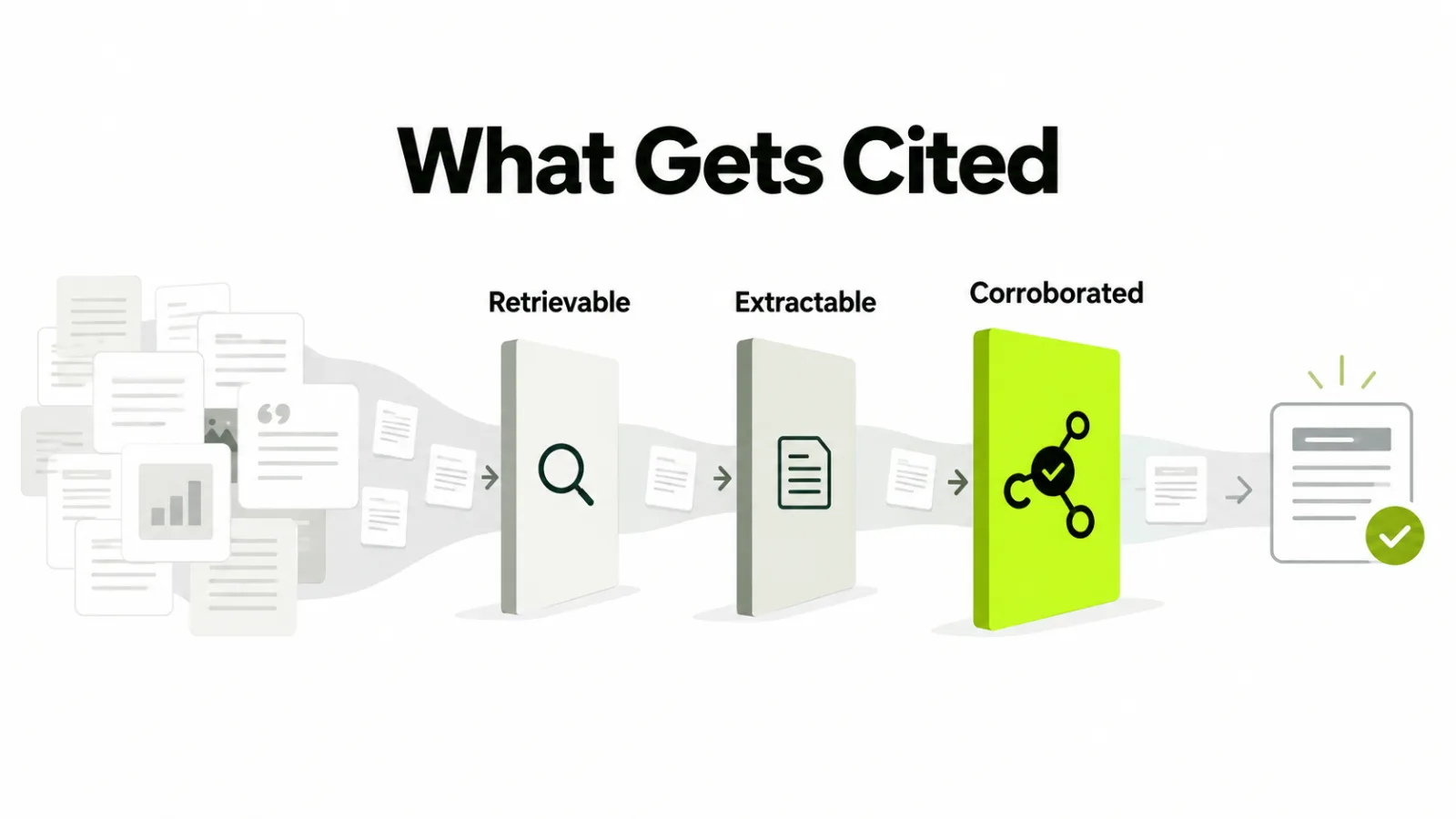
Entity authority
Engines reason about brands, people, and products as entities instead of strings of text. When your company is tied to a topic across the web, your own depth plus references from others, the model is far likelier to treat you as a credible answer. That’s why building a SaaS SEO authority strategy around one clear topical domain beats chasing scattered keywords.
Corroboration
Models trust claims that multiple independent sources agree on. A statistic, definition, or recommendation that lives only on your site is weaker than one echoed across respected publications, communities, and peers. Earned mentions count alongside dofollow links when an engine decides whether you’re a real reference or a self-promoter.
Structure and extractability
A claim stated plainly, near the top, in one self-contained sentence is much easier for a model to lift than the same idea buried three paragraphs deep. Clear headings, direct answers, definition blocks, comparison tables, and valid schema all make your passages cheaper to retrieve and safer to quote.
Retrieval fit
Before it generates anything, an engine retrieves candidate passages that semantically match the prompt. Pages that cover the full question, including the next questions a buyer would ask, hand the model more relevant passages to pick from, which raises the odds your brand lands in the answer.
Why entity authority and trusted mentions now matter more
Entity authority and trusted mentions matter more because AI engines reward sources they trust at the brand level and not pages that happened to win a keyword. In a ranked-link world, one well-optimized page could outrank a stronger competitor for a query. In an answer world, the model is asking a different question: “who is the credible source on this topic?” And it answers that from the full footprint of references to your brand across the web.
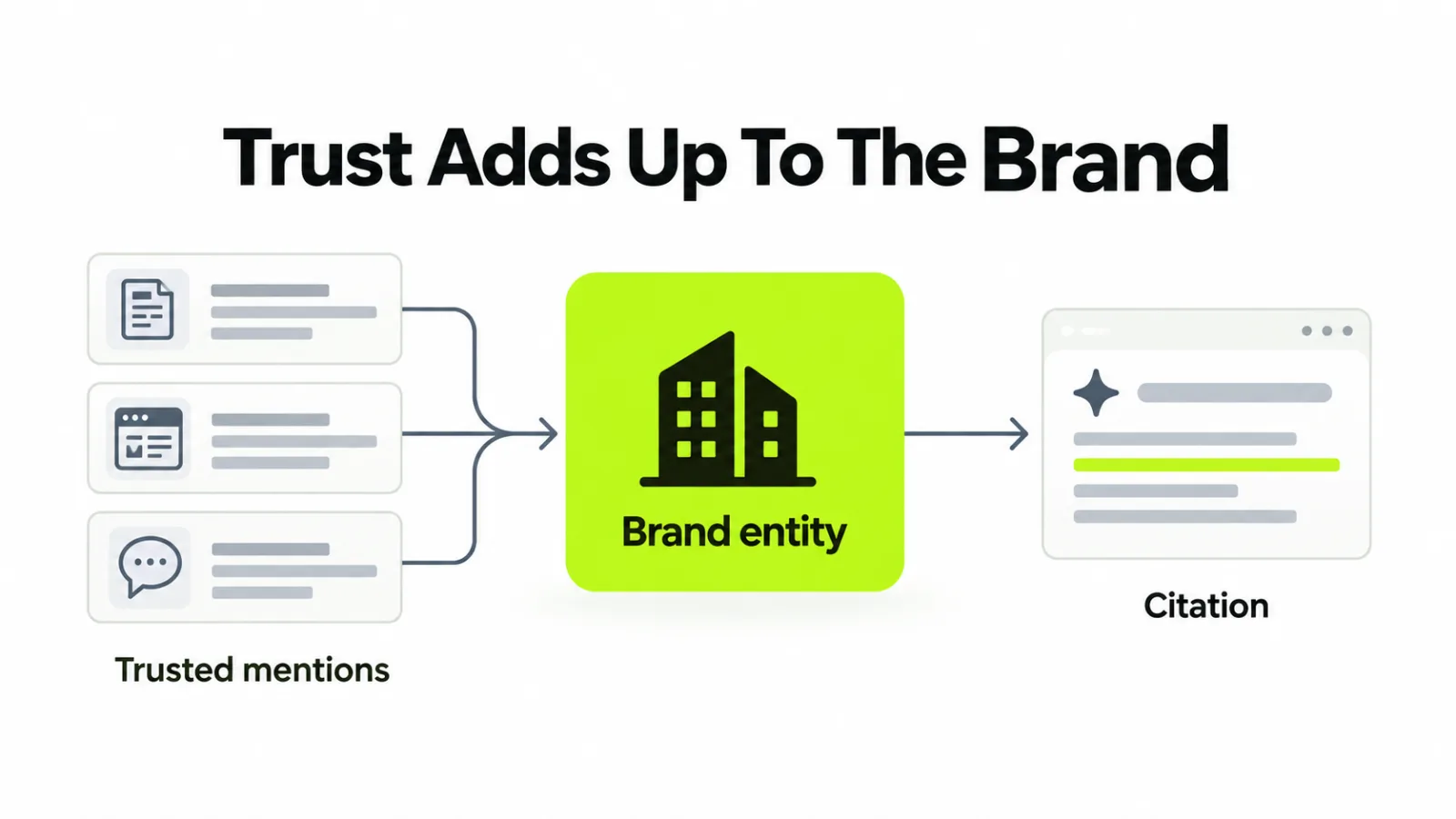
This rewrites the rules of link building. Volume-based, low-context links were always fragile, and they’re weaker now, because they do almost nothing to establish you as a corroborated entity. What makes a difference is earning mentions in places that already carry topical trust: the publications, roundups, expert content, and communities your buyers and the models both read. That’s the gap between renting links and building authority you keep, and it’s exactly why generic link building fails SaaS companies that need to be recommended.
For SaaS, the most defensible authority comes from being useful: original frameworks, real product data, customer outcomes, category-defining definitions. A content-led link building approach earns mentions because the asset deserves them: the same signal AI engines use to tell trusted sources from noise. Pair that with deliberate SaaS link building aimed at topical relevance over raw domain count, and you become the entity the model reaches for.
What SaaS teams should do
The playbook is simple to state and hard to fake: become the most extractable, most corroborated, most authoritative source for the topics you want to own. Work these in order.
1. Structure content for extraction
Open every key page and every H2 with a direct, self-contained answer in the first sentence or two. Add clear headings, tight definition paragraphs, lists, and a comparison table where it fits, so a model can lift a clean passage without guessing your point.
2. Build topical authority, not scattered posts
Pick a few topics you can credibly own and cover them in depth with interlinked pillar and supporting pages. Depth across a coherent domain is what makes engines treat you as the entity for that subject.
3. Earn citations and trusted mentions
Chase references from sources that already carry topical authority with your buyers: expert publications, comparison and roundup content, podcasts, active communities. Weight relevance and credibility over volume. One corroborating mention from a trusted source beats a hundred generic links.
4. Publish comparison and definition content
Best-in-category-for-a-use-case pages, head-to-head “your tool vs. the alternative” comparisons, and “what is” definition pages map straight onto the prompts buyers type into AI engines. Write them honestly and specifically, and the model can cite you as a fair, useful reference.
5. Implement schema and clean technical foundations
Add Organization, Product, FAQ, and Article schema where it applies, keep pages fast and crawlable, and put your most important claims in plain HTML text and not locked inside images, scripts, or interactions a crawler skips.
6. Be the original source
Publish proprietary data, benchmarks, and frameworks the rest of your category has to cite. Original, checkable information is the most durable way to earn both links and AI citations, because nobody can replicate it by paraphrasing you.
7. Strengthen entity signals everywhere
Keep your name, category, and positioning consistent across your site, your profiles, and third-party references, so engines resolve who you are and what you do without hesitating.
How to measure AI-search visibility
Measuring AI-search visibility means tracking whether your brand gets mentioned and cited inside AI answers as well as whether you rank, and making peace with the fact that some of the impact is brand lift you can’t attribute click-for-click. A practical measurement stack includes:
Citation and mention tracking
Prompt the major engines: AI Overviews, ChatGPT, Perplexity, Gemini, and Claude. Ask them the questions your buyers ask, and log whether you’re cited, mentioned, or absent. Run it on a fixed cadence so you watch the trend move as your authority builds, instead of reading one snapshot.
Share of model voice
For your priority topics, track how often you show up versus named competitors in generated answers. It’s the AI-era version of share of search.
Referral signals from AI surfaces
Watch analytics for sessions and assisted conversions coming from AI engines and assistants, knowing the numbers undercount your real influence because so many answers are zero-click.
Branded demand
Monitor branded search volume and direct traffic over time. When a buyer forms a preference inside an AI answer, they often come back later by name, which makes branded demand a leading indicator of AI-driven influence.
Underlying SEO health
Keep tracking rankings, indexation, and organic visibility. Strong classic SEO is still the price of admission for being retrievable and citable at all.
Frequently asked questions
Does AI search make SEO obsolete for SaaS?
No. AI search changes the goal of SEO, it doesn’t end it. Engines still depend on crawlable, fast, well-structured, well-referenced pages to retrieve and cite, so the fundamentals stay essential. The difference is that ranking is no longer the finish line. Being the corroborated, extractable source a model cites is the new objective.
What is generative engine optimization (GEO) for SaaS?
Generative engine optimization is the work of structuring content and building authority so AI engines cite and recommend your SaaS brand inside generated answers. For SaaS, that means owning specific topics in depth, writing self-contained extractable claims, earning trusted mentions, and publishing comparison and definition content that matches the prompts buyers use.
How is GEO different from AEO?
Generative engine optimization (GEO) and answer engine optimization (AEO) are close cousins, often used interchangeably. Both chase visibility inside AI-generated and answer-style results instead of classic ranked links. In practice the same work serves both: extractable structure, entity authority, corroboration, and schema, so most SaaS teams can treat them as one discipline and move on.
Do backlinks still matter in AI search?
Yes, but their job gets bigger. Links still build authority, and they now double as corroboration that you’re a trusted source on a topic. The shift is away from volume and toward relevance and credibility. A mention or link from a source your buyers and the models already trust is worth more than a pile of low-context links.
Why do AI engines cite some SaaS brands and not others?
Engines lean toward brands that are easy to retrieve, easy to extract, and corroborated as authoritative on the topic. If a competitor gets cited and you don’t, it usually means their content states the answer more plainly, covers the topic more deeply, or is backed by more trusted third-party sources: the signals that make a model confident enough to quote them.
How long does it take to build AI-search authority?
Durable entity authority is a multi-quarter build, because it relies on stacking depth and trusted references over time. Expect early movement within a few months and meaningful citation share to take two or more quarters. No honest partner will promise specific rankings or citation outcomes, since the engines decide how and when sources surface.
What is the single most valuable thing to start with?
Become the clearest, most extractable source on one topic you can own. Pick a focused topic, cover it in depth with direct front-loaded answers and clean structure, then earn trusted mentions that back up your expertise. Depth, clarity, and corroboration together are what get a SaaS brand cited instead of skipped.