SaaS link building
Referring Domains: Definition and Why Count Matters More Than Backlinks
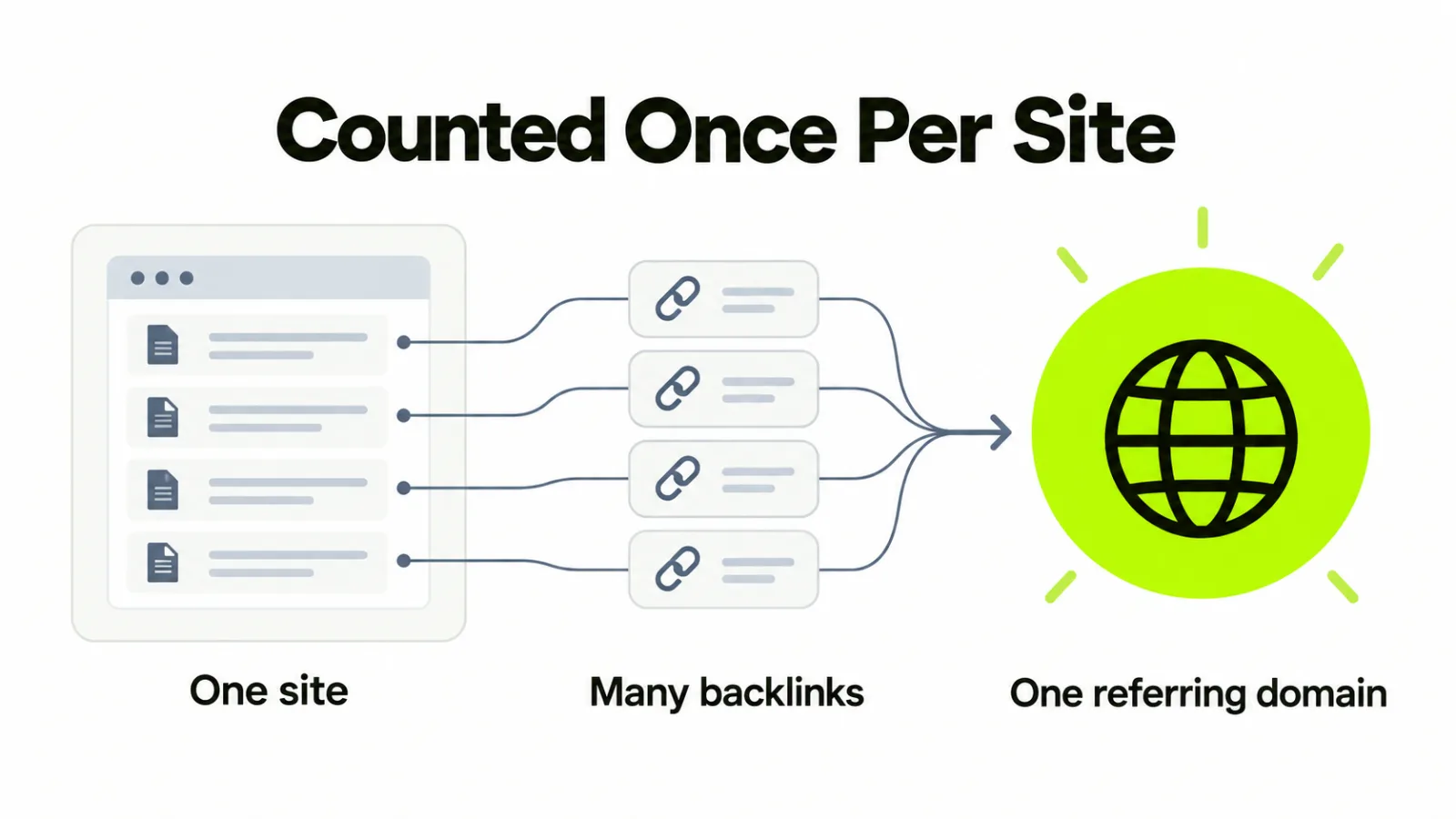
Referring domains is the count of unique websites that link to your site. Unlike total backlink count (which can be inflated by sitewide links), referring domain count more accurately reflects your authority breadth.
What it means
A single source domain can give you many backlinks. A sitewide footer link multiplies into a backlink per page on the source site. But all those backlinks count as one referring domain. The referring domain metric strips away that inflation and gives a cleaner authority signal.
Most SaaS SEO tools (Ahrefs, Semrush, Moz) report both metrics. Referring domains is the better headline number to track.
How it works
Tools count the unique root domains in your backlink profile, with optional segmentation by quality (DR40+, DR60+, DR80+). Growth in high-quality referring domains is the cleanest indicator of an authority program working.
Track three numbers: total referring domains, new referring domains per month (link velocity), and the DR distribution of the referring domain set.
Why it matters for SaaS
For SaaS, referring domain growth velocity is a primary KPI for authority programs. A working SaaS link building program adds 8-25 new referring domains per month at Series A-B, scaling to 25-40 per month at Series C+.
The DR distribution matters as much as the count. Adding 20 new referring domains per month at DR10-20 average is mostly noise; adding 10 per month at DR40+ average is a real authority program.
How to evaluate or use it
Track in Ahrefs or Semrush monthly. Set targets for both volume (new referring domains per month) and quality (share above DR40, DR60). Compare velocity to top competitors, if you’re adding 5 per month and they’re adding 20, you’re losing ground regardless of absolute counts.
The domains a competitor has and you don’t are the useful part of that comparison. Our guide to competitor backlinks covers how to turn the gap into a shortlist.
Related terms
Learn more
See the SaaS SEO metrics framework for how referring domain growth fits into a complete program measurement system.
Common patterns in referring domain profiles
The “long tail” profile: Many low-quality referring domains, few high-quality. Typical of programs that prioritized volume over quality early. Cleanup work involves disavowing the weakest sources and shifting acquisition toward higher-quality publications.
The “barbell” profile: A handful of tier-1 publications plus many tier-3 directory placements, with little in the middle. Typical of brands that earned occasional PR wins but didn’t build sustained tier-2 editorial relationships. Fix: invest in the tier-2 middle through guest posting and reactive PR.
The “pyramid” profile: Few tier-1, more tier-2, many tier-3 from legitimate sources. The healthy distribution most working programs converge toward over 18-24 months.
The “single-source-dependent” profile: A surprising share of authority concentrated in a few referring domains. Risk: if any of those sources go down, removes the link, or loses authority itself, the program’s position drops.
Frequently asked questions
How many referring domains does a SaaS need?
Stage-dependent. Series A typically 200-600, Series B 600-1,500, Series C+ 1,500-5,000. The right answer is benchmarked against your category’s top 5 ranking competitors.
What’s a healthy growth rate?
For active programs: 8-25 new referring domains per month at Series A-B, 25-40 per month at Series C+. Sustained growth above competitors’ velocity is the goal.