SaaS Link Building
Link Building for SaaS Startups: What to Do First
Link building for a SaaS startup starts with the links you can earn this month without a budget, then one asset worth citing, and only then outside help. Most early-stage startups shouldn’t pay for link building until the product and the message have stopped changing.
That order matters because a startup has one domain and can’t replace it. A cheap link package saves a few months and puts the asset at risk for years.
This guide goes through what to do first and what to leave for later. It covers the free foundation, launch platforms, a first linkable asset, founder-led PR, what to avoid, and how to tell when an agency is worth the money.
Should a SaaS startup do link building at all?
Yes, but the kind depends on the stage. Before product-market fit, the work is free and founder-led. After it, a budget starts to make sense.
| Stage | What to do | What to skip |
|---|---|---|
| Pre-seed and early seed | Foundation profiles, launch platforms, integrations, founder commentary | Paid link building of any kind |
| Seed, with early traction | One linkable asset, unlinked mention recovery, a few targeted pitches | Volume packages and fixed monthly quotas |
| Series A | A consistent program: digital PR, roundup inclusion, partner co-marketing | Anything you couldn’t describe to an investor |
We publish the monthly budget ranges we see at each stage on our pricing page. For seed-stage companies that range is $1,500 to $4,000 a month, and for Series A it’s $5,000 to $10,000. The same page says that below about $3,000 a month the work doesn’t pay off, and that we’d usually tell a pre-seed company not to buy links yet.
The reason for waiting is simple. Authority builds around a stable message. If your positioning, your category or your ideal customer is still moving, the links you earn today point at a page you’ll rewrite next quarter.
Our guide to link building budget by stage covers the reasoning in more detail.
What does a startup’s site need before link building?
A site that can make use of the links. Authority sent to a site Google can’t crawl, or that doesn’t explain the product, is wasted.
Check these six things first. None of them needs an agency.
- It can be crawled and indexed. Search your own domain in Google and confirm your main pages appear. Marketing sites built as single-page apps sometimes don’t.
- The homepage says what the product is. One sentence, in plain words, covering what it does and who it’s for.
- There’s a pricing page: Even a simple one. Writers and assistants both look for it.
- There’s an about page with real people. Founder names, backgrounds and profile links. This is how a new company becomes a recognisable entity.
- Search Console is set up. It’s free, and it’s the only way to see which searches already show your pages.
- At least one page is worth citing. If every page is a sales page, there’s nothing for another site to reference.
Google’s SEO starter guide covers the technical basics in about half an hour of reading. Get those right before spending time on links.
What links can a startup earn in the first 30 days for free?
More than most founders expect. These are the references a real company accumulates just by existing in public, and you should collect all of them before spending anything.
| Source | What it gives you | Effort |
|---|---|---|
| Company profile on Crunchbase and LinkedIn | An entity record that search engines and AI assistants read | An hour |
| Investor and accelerator portfolio pages | A relevant link from a site with real authority | One email to each |
| Software review platforms | A listing that ranks for your brand name and feeds comparisons | An afternoon, plus real reviews over time |
| Integration marketplaces | A link from inside your customer’s existing stack | Depends on the integration |
| Customers’ and partners’ sites | “Tools we use” pages, case studies, partner directories | Asking |
| Your own team’s profiles | Founder bios on podcasts, university pages, speaker listings | Updating them |
| Unlinked mentions | A link from coverage you already earned | One email per mention |
Many of these links carry a nofollow attribute, which means they aren’t meant to pass ranking credit. That’s fine. The main job of these profiles is different: they establish that your company exists, what it does and who’s behind it.
Keep the facts identical everywhere. The same company name, one-line description, category and founding year on every profile. AI assistants assemble their picture of a new company from these records, and a mismatch between them reads as two different companies. Our guide to entity authority explains how this works.
Unlinked mentions are the easiest win on the list. Funding announcements and partner news often name a startup without linking to it. The publication already decided you were worth mentioning, and our guide to link reclamation shows how to ask.
Do Product Hunt and Hacker News launches help SEO?
They help a little directly and a lot indirectly. The launch page is one link. The value is in who sees it.
A launch that goes well puts your product in front of newsletter writers, bloggers and people who maintain “best tools” lists. Some of them write about it. Those follow-on mentions are the links that count.
Two practical points.
- Have something to link to before you launch. A homepage that explains the product in one sentence, a pricing page, and one piece of content worth citing. Writers who can’t work out what you do in ten seconds move on.
- Follow each community’s rules: Hacker News publishes Show HN guidelines that set out what belongs there. Communities remember founders who treat them as a distribution channel.
Y Combinator’s startup library has practical material on launching that’s worth reading before your first one. The general lesson is that a launch is repeatable. You can launch each significant feature, and every launch is another chance to be written about.
What a launch won’t do is rank you for a category term. It’s a spike of attention. Authority comes from what you do with the people it reaches.
What should a startup’s first linkable asset be?
Something small, specific and true that nobody else has published. A startup can’t out-produce an incumbent’s content team, so it has to be more interesting per page.
Five formats work with a small team and little data.
A free tool: A calculator, a checker, a generator. It should do one job that your buyers currently do in a spreadsheet. People link to tools they use, and a tool keeps earning long after a blog post has faded.
A small original dataset: You don’t need ten thousand customers. An analysis of 200 public pricing pages, or 500 job postings in your category, is original research if you did the counting and showed your method.
A teardown: A detailed, fair analysis of how something in your market works. It takes time and no budget, and it positions the founder as someone who understands the space.
A strong written position: A clear argument about where your category is going, signed by a founder. It gives other writers something to agree or disagree with, and both produce links.
Open-source work. If your product has a component worth open-sourcing, the repository earns references from developers and from the projects that depend on it.
Our guide to linkable assets goes deeper on what SaaS companies can build that content sites can’t.
What doesn’t work is the generic guide. “The ultimate guide to” a topic that already has fifty of them earns nothing, because there’s no reason to cite the fifty-first.
How does founder-led PR earn links?
It works because reporters and podcast hosts want a founder rather than a marketing department. At the earliest stage the founder is the most linkable thing the company has.
There are four channels worth a founder’s time.
- Expert commentary: Journalists look for sources through request services and social platforms every day. A fast, specific answer from a named founder gets quoted, usually with a link to the company.
- Podcasts: Niche shows in your category are easier to book than founders assume, and each episode comes with a show-notes page.
- Newsletters: Independent writers in your space need material. A useful data point or an honest account of something you learned gets featured.
- Your funding announcement: If you raise, the coverage is a one-time burst of mentions. Make sure the company name is linked in each piece, and follow up where it isn’t.
This is digital PR at its smallest scale. It costs time and nothing else, and it builds the relationships a later program will rely on.
One rule: answer the question that was asked. A quote that turns into a product pitch doesn’t get used, and the reporter doesn’t come back.
Why are integrations a link source?
Because every platform you integrate with has a public directory, and a listing there is a relevant link from a site your buyers already trust.
The large ecosystems all run one. Zapier’s app directory and the HubSpot Marketplace are two examples, and most CRMs, accounting platforms and communication tools have their own.
An integration tends to produce more than the listing.
- A page on the partner’s marketplace.
- A mention in the partner’s changelog or launch roundup.
- A co-written guide or webinar write-up, if the partner team is active.
- References from consultants and agencies who implement both tools.
For a startup, this is often the highest-value link work available, because it’s also product work. You’d build the integration anyway.
Should a startup build links in communities and forums?
Take part in them, and let links follow. Communities are where early customers come from, and a helpful founder gets recommended.
The line is easy to see from inside. Answering a question in detail, and mentioning your product where it’s the answer, is participation. Posting your link in twelve threads is spam, and moderators treat it that way.
Google’s spam policies name forum comments with optimised links in the post or signature as an example of link spam. The same activity done properly, as real contribution, is how many startups get their first hundred users.
Our page on community and forum links covers how this works when it’s done as a program.
What link building should startups avoid?
Anything sold by the unit. Startups are the main market for cheap link packages, because the price looks right for a small budget.
| Offer | What it is | What you carry |
|---|---|---|
| “50 high-DR backlinks” for a flat fee | Links from a network built to sell them | A profile that gets devalued in one sweep |
| Paid guest posts | A fee for an article with a followed link | A link scheme under Google’s policies |
| Link exchange groups | Founders trading links through a shared list | A footprint that’s trivial to detect |
| Expired domain redirects | An old domain’s links pointed at your site | A practice Google’s spam policies name directly |
| Bought reviews | Payment for positive reviews on software platforms | A breach of platform rules and of FTC rules |
Google’s spam policies list buying or selling links for ranking purposes, excessive link exchanges and expired domain abuse. Paid links are acceptable when they’re marked as sponsored, and at that point they pass no ranking value.
On reviews, the FTC’s rule on fake reviews and testimonials prohibits reviews from people with no real experience of the product, and payment conditioned on a positive review.
The risk is larger for a startup than for an established company. A mature site has years of earned links to dilute a mistake. A new domain with forty bought links has a profile that is mostly bought links.
It also shows up in diligence. An acquirer or a later-stage investor who reviews your organic channel will see how the links were obtained. Our page on white hat link building gives a simple test for any offer.
In-house, freelancer or agency: who should do it?
The founder first, then a freelancer or a first marketing hire, then an agency when there’s a stable message and a real budget.
| Option | Best when | Limits |
|---|---|---|
| Founder | Pre-seed and seed. The founder is the story. | Time. It competes with everything else. |
| First marketing hire | There’s enough to promote and someone should own it | One person rarely has reporter relationships yet |
| Freelancer | You need a specific job done: an asset promoted, mentions reclaimed | Quality varies. Ask how links are obtained. |
| Agency | Message is stable, budget is above the level where it pays off | Cost, and the need to manage the relationship |
Google’s own guidance on hiring an SEO is worth ten minutes before you sign with anyone. It warns that no one can guarantee a top ranking and recommends asking a provider to explain exactly what they’ll do.
How many links does a SaaS startup need?
There’s no fixed number. The useful comparison is with the pages that currently rank for the terms you want.
If the top results for your category term each have hundreds of referring domains, a new site won’t rank there this year whatever it does. If a long-tail term is held by pages with a handful of links each, a few good references could be enough.
That’s why startups should begin with specific, lower-competition terms: “software for” a narrow use case, comparisons with one named competitor, questions your buyers ask. Our post on how many backlinks a SaaS needs shows how to estimate it for your own terms.
Quality changes the count: One reference from a publication your buyers read can do more than twenty from general directories. Our guide to evaluating backlink quality explains how to judge a source.
Which pages should a startup build links to?
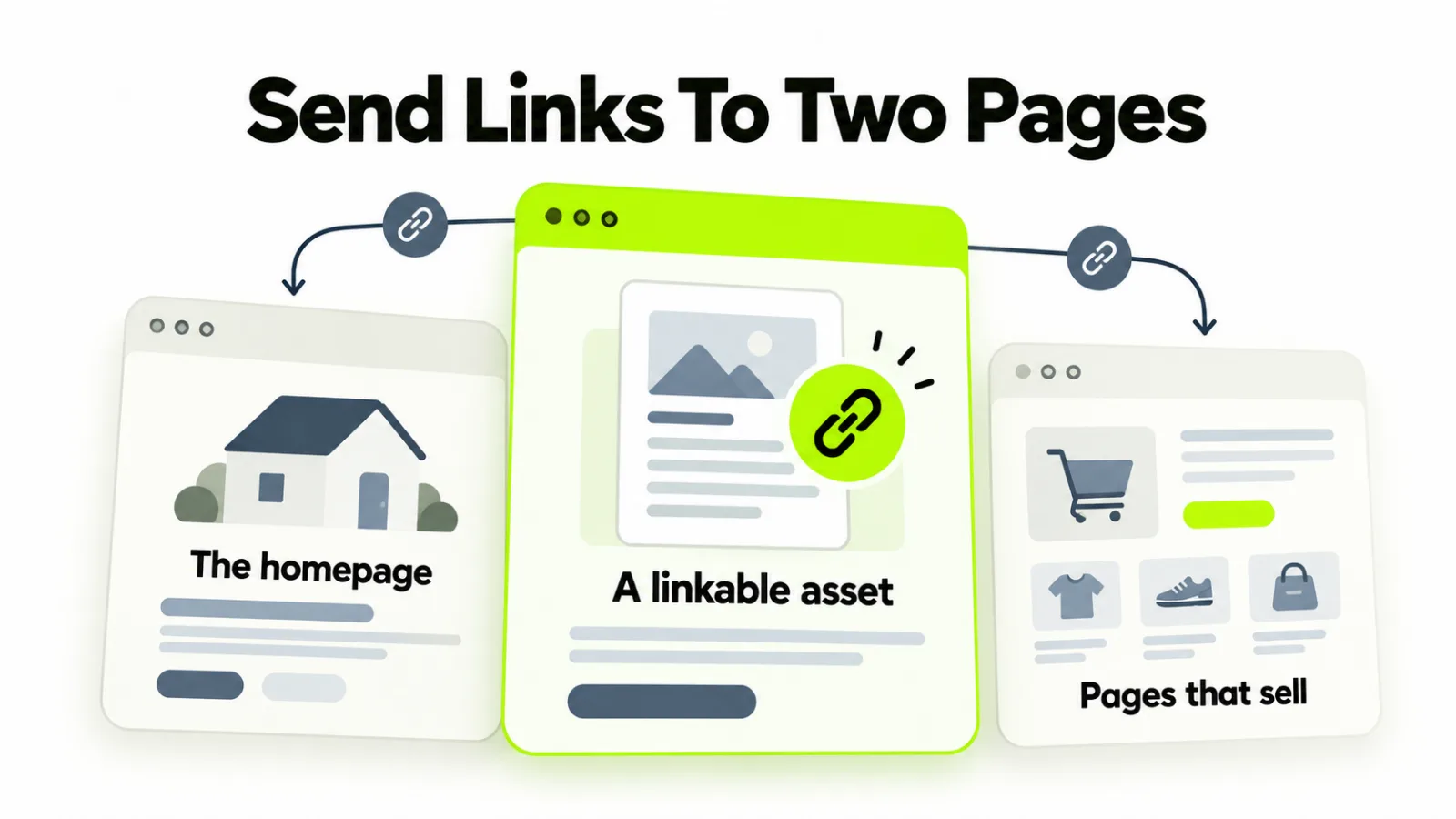
The homepage and one linkable asset. Then use internal links to send that authority to the pages that sell.
- The homepage collects most early links naturally: profiles, launch coverage, funding news, founder bios.
- A linkable asset earns the links that need a reason: the tool, the dataset, the teardown.
- Comparison and use-case pages rarely earn links directly. They rank because the homepage and the asset pass authority to them.
The common mistake is trying to build links straight to a features page. Nobody links to a features page. Our guide to SaaS backlink strategy covers how to route authority instead.
What does a realistic first year look like?
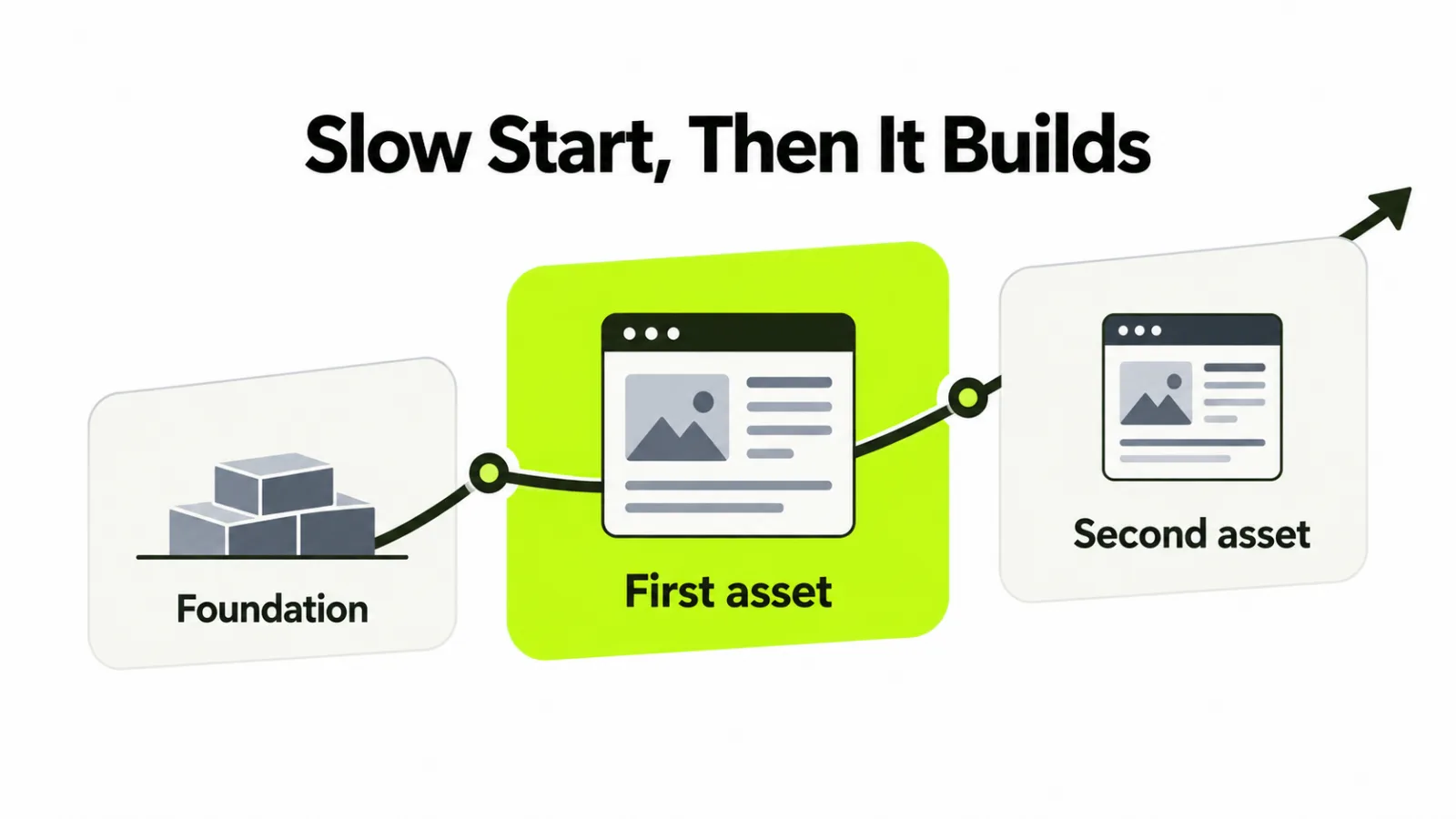
Slow at the start, and then it builds. Here’s a reasonable sequence for a startup doing this properly.
| Period | Work | What to expect |
|---|---|---|
| Months 1 to 3 | Foundation profiles, first launch, integration listings, unlinked mentions | Your brand name ranks. A base of relevant referring domains. |
| Months 4 to 6 | First linkable asset published and promoted. Founder commentary and podcasts. | First links that needed a reason. First long-tail rankings. |
| Months 7 to 12 | Second asset. Roundup inclusion. Partner co-marketing. A program, if the budget is there. | Rankings for narrow commercial terms. Mentions in AI answers for specific questions. |
Rankings lag links by weeks or months, because Google has to recrawl the linking pages. A startup that judges the work after six weeks is judging crawl timing.
How do you measure link building at startup scale?
With measures that still mean something when the numbers are small.
- Relevant referring domains: Count the ones from your category and from sites your buyers use. Ignore the rest.
- Branded search. More people searching your company name is the earliest sign that coverage is reaching anyone.
- Long-tail rankings: Track twenty specific terms and not the category head term.
- Referral visits: A good link sends people. If a link sends nobody, ask who reads that page.
- AI mentions: Ask three assistants the questions your buyers ask, once a month, and note whether you’re named.
Skip third-party authority scores as a target. They’re estimates, they move for reasons unrelated to you, and they’re the metric cheap link sellers optimise for. Our entry on domain rating explains what the score measures.
How does a new startup get named by AI assistants?
By becoming a company the assistant can find in more than one place. A new brand is an unknown entity, and assistants are cautious about naming things they can’t corroborate.
Google’s documentation on AI features and your website says there are “no additional requirements to appear in AI Overviews or AI Mode”. A page has to be indexed and eligible to show with a snippet.
The same page describes “query fan-out”: one question becomes several related searches, and the answer is built from the combined results. A startup that appears only on its own site rarely makes it into that combined set.
Three things help most at this stage.
- Consistent profiles: The foundation work above is what makes you a recognisable entity.
- Specific positioning: “Invoicing software for freelance translators” is easier to match to a question than “the modern invoicing platform”.
- Presence in comparisons: Roundups and review platforms are what assistants retrieve when asked for options. Our guide to listicle link building covers earning a place.
Check that you aren’t blocking the wrong crawlers. OpenAI’s crawler documentation lists separate bots for search and for training, and a startup that blocks the search bot is invisible in ChatGPT’s search answers.
Our guide on getting cited by AI covers the full method.
When should a startup hire a link building agency?
When three things are true at once. The message has stopped changing, there’s at least one asset worth promoting, and the budget is high enough for the work to pay off.
If any of the three is missing, the money does more elsewhere. That’s our honest view, and it’s why we tell some founders on the first call to come back later.
When you do hire, ask these before you sign.
- Can I see every site before a link goes live?
- Does money reach the publisher, in any form?
- Who approves the link on the publisher’s side?
- What will you refuse to do?
- Do you guarantee a number of links?
A guaranteed number means the placements are bought, because nobody can promise an editor’s decision. Our comparison of SaaS link building agencies covers who suits which stage.
If you’re at the point where it makes sense, book a strategy call. If you aren’t, we’ll say so.
Frequently asked questions
Is link building worth it for an early-stage SaaS startup?
The free kind is, from day one. Profiles, integrations, launch coverage and founder commentary cost time and build a real foundation. Paid link building is usually worth it only after the product and message are stable, which for most startups means seed stage with traction or later.
How much should a startup spend on link building?
Nothing before product-market fit. After that, the ranges we publish are $1,500 to $4,000 a month at seed and $5,000 to $10,000 at Series A. Below about $3,000 a month, an outsourced program rarely pays off, and founder-led work is the better use of the money.
Are cheap backlink packages safe for a new domain?
No. They’re links from networks built to sell them, which Google’s spam policies treat as link spam. A new domain has no earned links to dilute them, so they make up most of its profile. The saving is small and the asset at risk can’t be replaced.
Do nofollow links from directories and profiles help?
They help in a different way. A nofollow link isn’t meant to pass ranking credit, but these profiles establish your company as a consistent entity that search engines and AI assistants can recognise. They also rank for your brand name, which protects your first page of results.
How long until link building shows results for a startup?
Brand-name rankings can settle in weeks. Long-tail commercial terms usually take three to six months of consistent work. Competitive category terms take longer, and for a new domain they’re often out of reach in the first year.
Should a founder do link building personally?
At the start, yes. Reporters, podcast hosts and newsletter writers want a founder, and nobody else can speak for the company with the same credibility. As the company grows, the founder stays the spokesperson and someone else runs the process.
What’s the best first linkable asset for a startup?
A free tool that does one job your buyers currently do by hand, or a small original dataset with a clear method. Both give other sites a reason to cite you, and both keep earning links without further promotion.
Can a startup rank without backlinks?
For its own brand name and for very specific long-tail questions, sometimes. For anything a competitor is also targeting, no. Links are how a search engine tells that other sites consider yours worth referencing.