SaaS Link Building
Manual Link Building for SaaS: How It Works and When to Use It
Manual link building is the practice of earning each backlink through a person's research, outreach and judgment, rather than through software that places links at scale. For SaaS companies, it fits when relevance matters more than volume and each link must come from a site a real buyer reads.
What does manual link building mean for a SaaS company?
Manual link building means a human selects every target site, writes every pitch and checks every result. Software can help with research, but a person decides whether a link is worth pursuing. The opposite is automation: mass emails, directory submissions, comment drops and bulk placement.
For a SaaS company, the distinction matters because your buyers are specific. A project management tool wants links from operations and agency publications, not a general lifestyle blog. A person can judge that fit. A script can't.
Manual does not mean paid. Google's spam policies treat links bought to pass ranking credit as link spam, and its guidance says paid links should be qualified with rel="sponsored". Read Google's link spam policy before any deal involving money. Manual work earns links through value, so no payment for the link is involved.
How does manual link building work step by step?
Manual link building runs as five repeating steps: qualify a site, find an angle, pitch a named person, follow the reply, and verify the live link. Each step has a human decision in it, which is what keeps volume low and quality high.
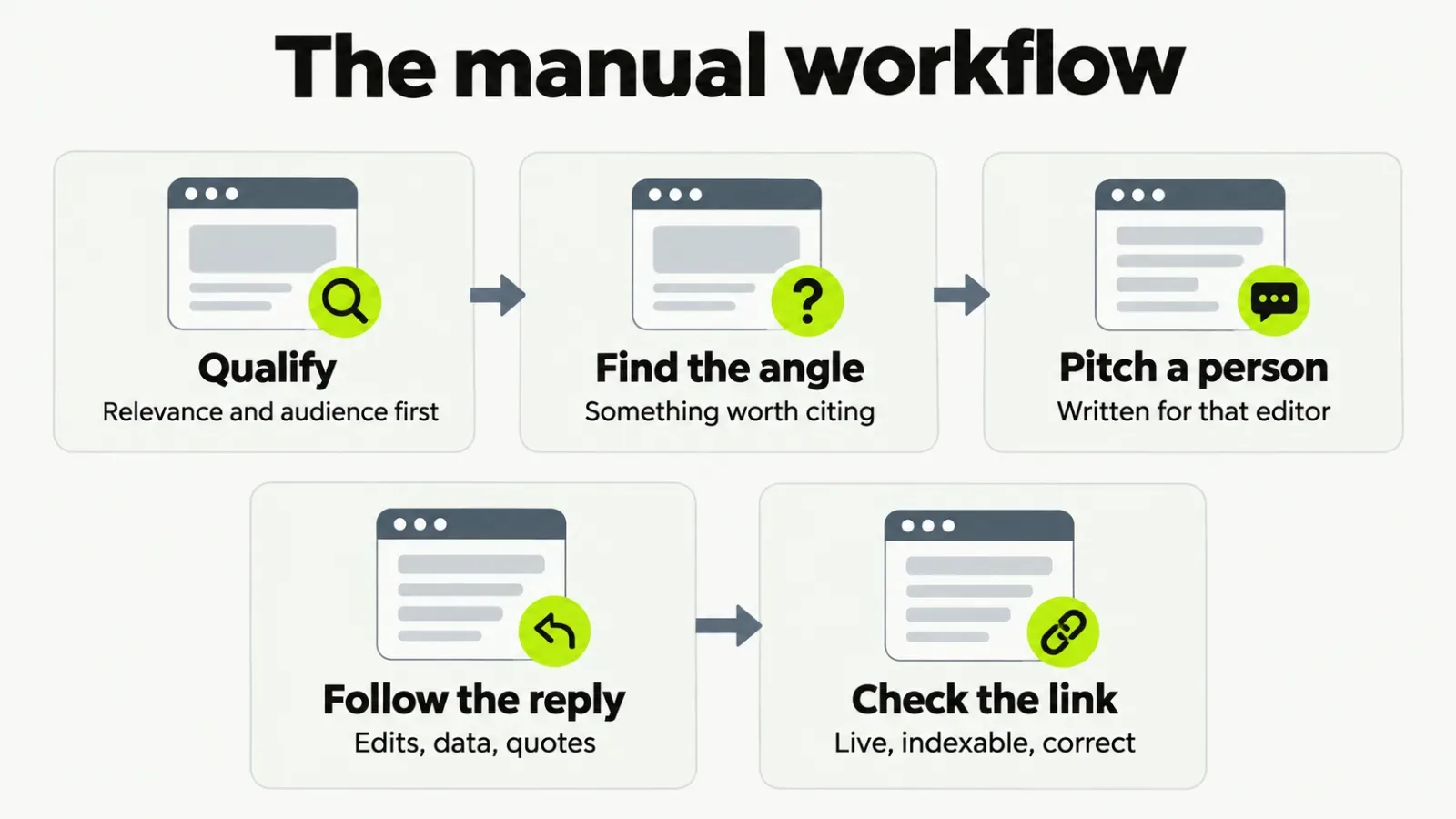
- Qualify. Check that the site covers your topic, reaches your buyers and publishes real editorial content. Skip sites that sell links openly.
- Find the angle. Decide what you offer: original data, an expert quote, a tool, a correction, a better resource. No angle means no pitch.
- Pitch a person. Write to one editor or author, referencing something they published. Our guide to outreach link building for SaaS covers what to do once the reply arrives.
- Follow the reply. Edits, questions and requests for data are normal. Answer fast.
- Check the link. Confirm it is live, indexable and points to the right page. Note whether it is nofollow; our nofollow link definition explains what that changes.
Which manual tactics suit SaaS best?
The manual tactics that suit SaaS best are the ones that give an editor a reason to cite you: original data, expert commentary, integration partnerships, podcast appearances and recovering lost links. Each starts with something you already have, so the pitch is an offer rather than a request.
- Original research from your product data, published with a clear method.
- Expert quotes for journalists writing on your category.
- Integration and marketplace pages with partners, covered in link building through SaaS integrations.
- Guest appearances on industry shows, covered in podcast guest appearances for links.
- Reclaiming unlinked brand mentions and broken links.
Skip generic guest posts on sites that accept anything. They are cheap to land and tend to be worthless to buyers.
Manual vs automated link building: which should you use?
Use manual link building when a link's value depends on the site's relevance and audience, which is the case for almost every B2B SaaS. Automation suits only low-stakes tasks such as finding prospects or tracking replies. The link itself should never be placed by a script.
| Situation | Choose |
|---|---|
| New SaaS with few links and a clear niche | Manual |
| Regulated or trust-sensitive category | Manual |
| Researching prospects, tracking replies | Automate the admin |
| Bulk directory or comment submissions | Neither. Skip them |
Rule of thumb: automate the spreadsheet, never the relationship. The bulk tactics also overlap with what we describe under black hat link building, so they carry real penalty risk.
What does manual link building cost?
Manual link building costs mostly time and skill: research hours, writing, design or data work for the asset, and follow-up. Cost per link varies widely with site quality and the effort the angle needs, so any fixed number you read is a guess.
There are two ways to pay. You can build an in-house routine, which costs salary time and tools. Or you can hire a team, where the cost follows placement quality, relevance and volume. On this site, SaaS link building services are billed per delivered placement, month to month, and placements are earned, never guaranteed.
When is manual link building the wrong choice?
Manual link building is the wrong choice when you need results you can't wait for, when you have no asset worth citing, or when your site has deeper problems. A weak product page with a perfect link still converts poorly.
- You need predictable traffic next month. Links take weeks to earn and longer to show effects.
- You have nothing to offer. Build the data, tool or resource first.
- Your site has indexing or content gaps. Fix those, since links won't cover them.
For the broader question of whether links still pay off, see does link building still work.
Run a four-week manual pilot
A four-week pilot tests whether manual link building works for your product before you commit. Keep it small.
- Week 1: pick one asset and list 30 qualified sites.
- Week 2: send personalized pitches to the best 15.
- Week 3: answer replies and supply what editors ask for.
- Week 4: verify live links and record which angle drew replies.
Repeat the angle that worked. Drop the one that didn't.
Frequently asked questions
Yes, when links are earned editorially and never bought to pass ranking credit. Google's spam policies target manipulative link schemes, not real citations. Disclose and qualify any paid placement.
It depends on the angle, the niche and the quality bar. A small number of strong links per month is a normal output. Volume is not the goal.
Mostly, but not automatically. A person can still do manual work that breaks the rules, such as arranging link swaps. Use the test in our white hat link building guide.
Tools help with prospecting, email tracking and link monitoring. They don't replace the decision about which sites deserve a pitch.