SaaS Link Building
Does Link Building Still Work in 2026? What the Evidence Says
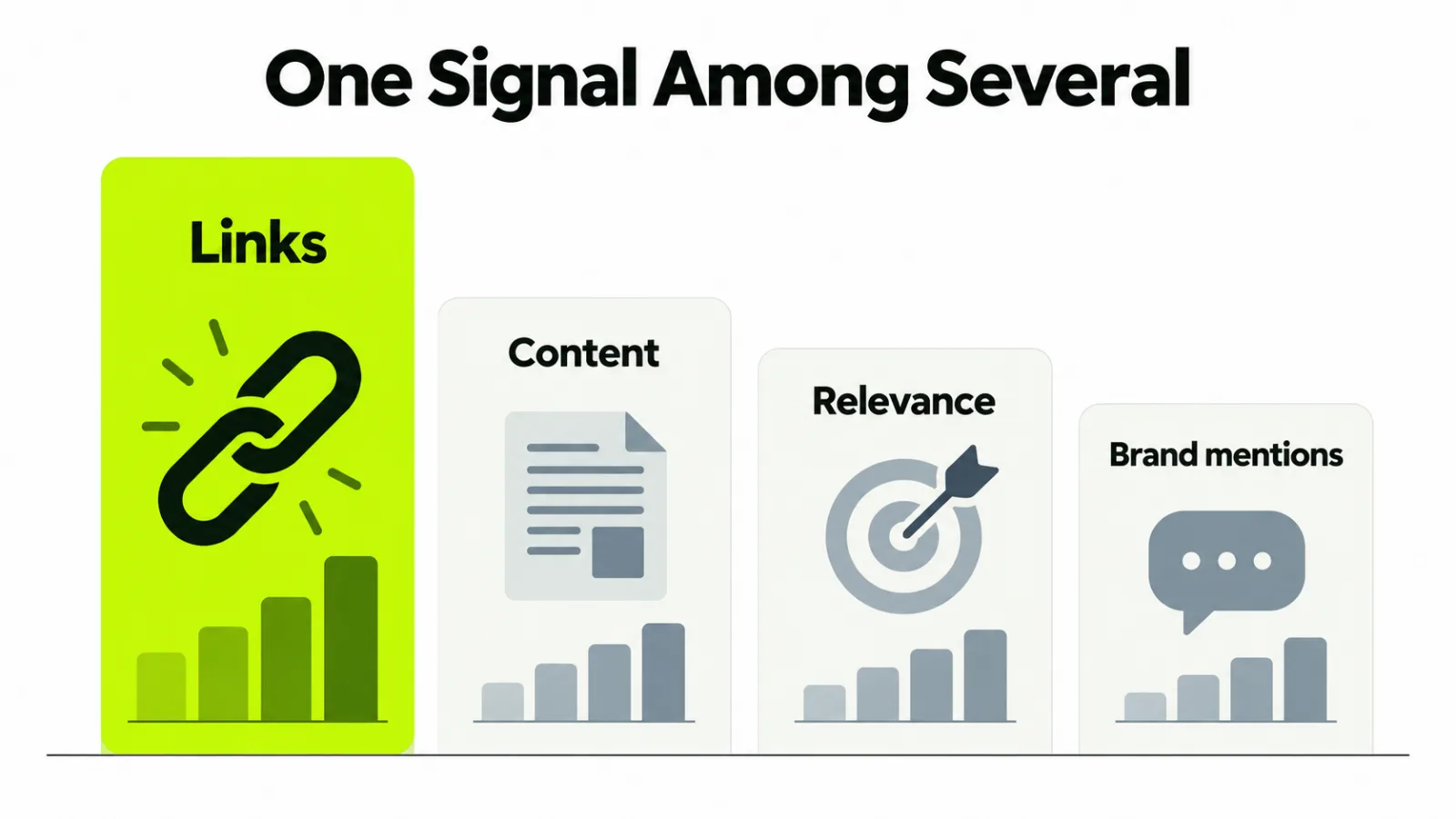
Yes, link building still works in 2026, but it is no longer the whole game. Google still uses links as a ranking signal, and the best public studies still find that pages with more links from more sites tend to rank higher. What has changed is how much a single link can do, how risky the cheap versions have become, and how much AI assistants now depend on being mentioned, not only linked.
This guide gives the evidence on both sides, including the statements from Google that sound like “links don’t matter” and what they mean. It then covers what has stopped working, what still does, how long it takes, and how to decide whether it is worth it for a SaaS company right now.
We sell link building to B2B SaaS companies, so you should read this with that in mind. We have tried to cite sources for every factual claim, say where the evidence is only correlation, and name the cases where we would tell you not to buy links yet.
What is the short answer?
Links still work as one of several signals, and they work best for competitive terms where your content is already good. They don’t work as a shortcut, as a volume game, or as a substitute for a product people want to talk about.
Three statements are all true at once:
- Google says it uses links. Its documentation states that Google “uses links as a signal when determining the relevancy of pages and to find new pages to crawl.”
- Google also says links are overrated. A Google analyst said in 2023 that people overestimate their importance, and that they are not a top-three factor.
- Independent studies still find a link effect. Large correlation studies keep finding that pages with more referring domains rank higher and earn more traffic.
The rest of this guide explains why those don’t conflict.
What does Google actually say about links?
It says links are a signal, and that you should not expect them to do all the work. Two public statements are worth reading carefully.
The first is in Google’s own documentation on links. Google uses links to judge how relevant a page is and to discover new pages. That is a plain statement that links are part of ranking.
The second is the comment that gets quoted as “links are dead.” At Pubcon Pro in Austin in 2023, Gary Illyes of Google was asked whether links are still among the top three ranking factors. As Search Engine Land reported, he said he thinks links are important, but that people overestimate their importance and that they have not been in the top three for some time.
Read that again. It does not say links don’t matter. It says they matter less than people assume, and that other signals have grown in weight. In the same report, he added that it is possible to rank without links.
The sensible reading is this: a page with no links can rank when the topic is uncompetitive and the content is the best answer. A page in a crowded category usually can’t, because everyone else’s content is good too, and links are one of the few things that separate them.
What do the independent studies show?
They show a consistent association between links and visibility, with the usual caution that association is not proof of cause. Three large studies are worth knowing.
| Study | Sample | What it found | What it can’t tell you |
|---|---|---|---|
| Backlinko ranking factors study | 11.8 million Google results | The number one result has about 3.8 times more backlinks than results in positions 2 to 10 | Whether links caused the rank, or good pages attract links |
| Ahrefs search traffic study | About 14 billion pages | 96.55% of pages get no traffic from Google. Pages with more referring domains rank for more keywords and get more visits | That a given number of links will produce a given amount of traffic |
| Ahrefs time-to-rank study | 1 million random URLs, updated May 2025 | Only 1.74% of newly published pages reach the top 10 within a year. 72.9% of top-10 pages are over three years old | The role of links specifically, because it does not isolate them |
Backlinko states that its own study is correlational. Ahrefs makes the same point about its work. A page that deserves to rank tends to collect links on its own, so the two move together even if links were not doing the lifting.
That caveat is real, and we won’t pretend otherwise. The practical point is narrower: in studies that look across millions of results, pages at the top of competitive searches almost always have a strong link profile, and pages with none are rarely there.
What did the 2024 Google leak add?
It added a look at what Google records about links, with a warning not to over-read it. In May 2024, thousands of pages of internal Content Warehouse API documentation became public. Google confirmed on May 29, 2024 that the documents were authentic, and a spokesperson cautioned against “making inaccurate assumptions about Search based on out-of-context, outdated, or incomplete information.”
With that caution in place, iPullRank’s analysis of the leak points to several things relevant here:
- The documentation describes anchors being tagged by the quality of the document they come from, with separate labels for high, medium and low quality sources.
- It lists an attribute called
siteAuthority, which iPullRank reads as at odds with Google’s public line that it has no domain-level authority metric. - It describes signals that track how quickly spammy anchor text appears across many domains, which is how coordinated link campaigns can be spotted.
The leak doesn’t tell you how much weight any of these carry, or whether they are used in live ranking. Treat it as confirmation that Google stores detailed information about links and judges them by source rather than as a recipe.
What has stopped working?
Anything that creates links in bulk, cheaply or artificially. Google’s spam policies define link spam as creating links to or from a site primarily to manipulate rankings, and the examples read like a list of old tactics.
| Tactic | Where Google’s policies stand | What happens in practice |
|---|---|---|
| Buying links that pass ranking credit | Named as link spam | Links are discounted at best, and the site risks a manual action |
| Link exchanges and reciprocal swaps at scale | Named as link spam when excessive | Patterns are easy to detect across a network |
| Automated link creation | Named as link spam | Low value and a clear footprint |
| Paid articles with unqualified links | Named as link spam unless the link is marked sponsored or nofollow | The placement can still help readers, but not rankings |
| Forum comments with keyword anchors | Named as link spam | No value, and a signal of a low-effort campaign |
| Low-quality directories | Named as link spam | Mass submission produces links that look alike |
The same policies cover two newer problems that affect link builders. Scaled content abuse is generating many pages mainly to manipulate rankings. Site reputation abuse is publishing third-party content on a host site mainly to exploit that host’s established ranking signals. A guest post farm sits uncomfortably close to both.
Two further things have become less effective, even though they are not forbidden: chasing a high Domain Rating number from sites that have no real audience, and pushing exact-match anchor text. Neither earns the trust that a link from a source readers respect does. Our guide on how to evaluate backlink quality goes through what to check instead.
What still works?
Links that exist because a real publisher decided your work was worth citing. That sounds obvious, and it is also the reason it is slow and costs money.
| Method | Why it holds up | The catch |
|---|---|---|
| Original research and data | Writers cite numbers they can’t get elsewhere | It has to be a real study with a method, and it costs real effort |
| Expert commentary for journalists | Reporters need sources, and a named expert can earn a citation | Fast turnaround and a genuine point of view are required |
| Digital PR on a real story | Coverage comes with a link because the story needs a source | Most pitches fail, so volume of outreach matters |
| Guest contributions on relevant publications | Reaches the buyer’s reading list and earns a contextual link | Only worth it on sites that have an audience and an editor |
| Useful free tools and calculators | People link to a tool they use | It has to be maintained, and it has to solve a real problem |
| Inclusion in category roundups | Buyers read these lists, and the links are relevant | You have to be worth including, and fees for inclusion are a red flag |
| Unlinked mention recovery | The mention already exists, so a polite request often works | A small number of opportunities |
What these have in common is that the link is a by-product. A publisher links because it helps the reader. Google’s guidance says the same thing in its section on link practices: linking to other sites can help establish trustworthiness, for example by citing sources. You are asking publishers to do what Google already tells them to do.
If your site has nothing a writer would want to cite, no outreach method fixes that. Our guide to linkable assets covers how to build something worth citing first.
Do links matter for AI search?
Less directly than mentions do, as far as the available evidence shows. Google says there are no additional requirements to appear in AI Overviews or AI Mode, and that the same foundational SEO practices apply, as set out in its page on AI features. A page must be indexed and eligible to appear with a snippet.
That means the usual route to ranking, which includes links, is also the route into Google’s AI features. But the most useful recent study of AI visibility looked at something different.
In December 2025, Ahrefs published a study of 75,000 brands comparing a range of web signals against how often each brand appeared in AI answers. Branded web mentions were strongly related to AI visibility, with correlations of about 0.66 for ChatGPT, 0.71 for Google’s AI Mode and 0.66 for AI Overviews. Link metrics showed weaker relationships.
Ahrefs states plainly that correlation isn’t causation, and that improving a metric does not guarantee more AI visibility. The study also filtered to domains with a Domain Rating above 40, so it says little about very new sites.
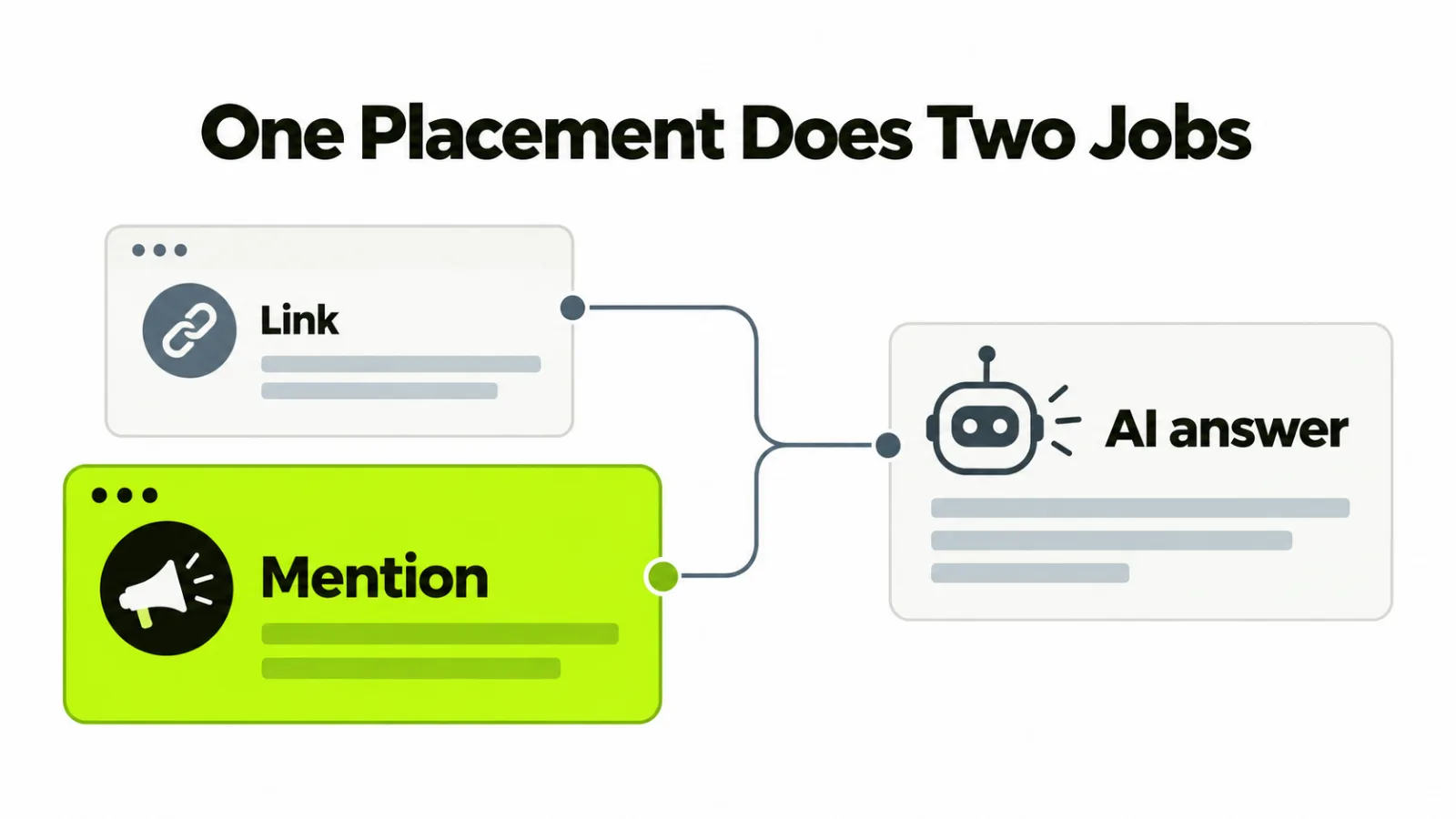
What we take from it, carefully: being talked about across the web appears to matter at least as much as being linked from it. A good placement gives you both, a link and a mention, which is one reason editorial links have held their value. A bought link on a page nobody reads gives you neither.
We cover the practical side in how to get cited by AI and AI search for SaaS.
How long does link building take to work?
Usually several months, and often longer for competitive terms. Nobody can promise a date, and Google says as much about SEO in general: no one can guarantee a number one ranking.
The data on how slowly new pages rise is sobering. In the Ahrefs time-to-rank study, only 1.74% of newly published pages reached the top 10 within a year, and the average page in first position was about five years old. Links accelerate that, but they do not bypass it.
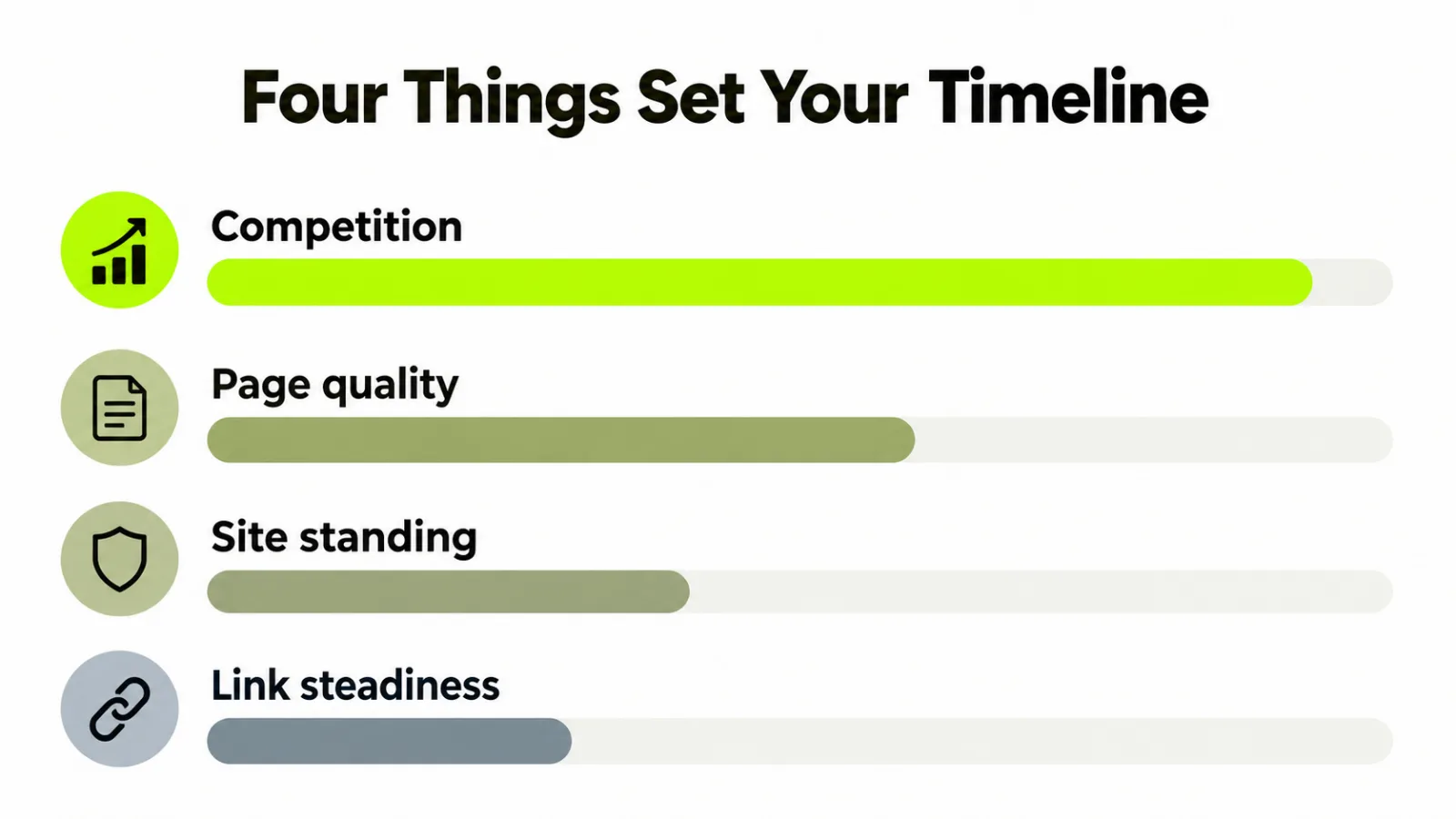
Four factors decide your own timeline.
- How competitive the term is. A narrow, specific query can move in weeks. A head term held by large sites can take a year or more.
- How good the page already is. A link to a thin page has less to work with than a link to the best page on the topic.
- The age and standing of your site. A new domain starts with less trust and more to prove.
- How steady the link flow is. A handful of strong placements a month over a half year behaves differently from forty in one week.
A reasonable expectation for a SaaS company starting from a modest base is to see early movement on specific, lower-competition pages within a few months, and a change in competitive terms only after sustained work. Our guide on link building budgets by stage sets out what a realistic program looks like at each point.
Is link building worth it for a SaaS company?
It depends on three things: the market you’re in, the state of your site, and whether you can sustain it. Before you decide, run through this checklist.
| Question | If yes | If no |
|---|---|---|
| Do your buyers search for what you sell? | Links can capture demand that already exists | Fix demand and positioning first |
| Is your best page already the best answer? | Links will help it climb | Improve the page before building links to it |
| Are your competitors’ pages clearly stronger on links? | The gap is probably part of your problem | Check whether the gap is content or intent instead |
| Can you fund it for six months or more? | The work can pay off | A short burst rarely shows results |
| Is the product ready for customers to find? | Traffic will convert | Wait until the product can retain what it wins |
If you answered no to the first, second and fifth questions, don’t buy links yet. Earlier-stage companies often get more from a handful of strong assets than from an agency retainer. We say more in link building for SaaS startups.
For a rough guide to spend, see how much SaaS companies should spend on link building. The short version is that below a certain monthly budget the work doesn’t build up enough to matter.
What are the most common mistakes?
- Optimising for a metric: Chasing Domain Rating or similar scores without checking whether the site has real readers.
- Buying volume: A large number of links in a short time looks unnatural and is exactly what Google’s spam systems look for.
- Linking everything to the homepage: Deep pages that answer buyer questions tend to benefit more and give the link a reason to exist.
- Ignoring relevance: One link from a respected publication in your field is worth more than ten from unrelated sites.
- Treating it as a one-off: Authority builds over time, and a stop-start program resets the clock.
- Skipping measurement: Without a baseline for rankings and referring domains, you can’t tell whether it worked.
How do you measure whether it is working?
Measure outcomes you can attribute, and set the baseline before you start. Four measures matter.
- Rankings for the pages you targeted. Track a fixed list of queries rather than site-wide averages.
- Impressions and clicks in Google Search Console. Compare the same pages over equal periods before and after.
- Referring domains gained, by quality. Count relevant editorial placements and not raw totals.
- Mentions in AI answers: Test a fixed set of prompts monthly and note whether you are named and linked.
Be careful with attribution. Rankings move for many reasons at once, including content changes and algorithm updates. A fair judgement looks at several months of data across several pages instead of one good week.
How should you choose a link building agency?
Choose on method and honesty rather than promises. Google’s guidance on hiring an SEO warns against firms that won’t explain what they do and against link popularity schemes. Ask these questions.
- How do you find and pitch publishers, and can I see example placements?
- Do any links involve payment to the publisher, and how are they labelled?
- What do you do if a placement doesn’t happen?
- Do you guarantee a ranking or a link count? The right answer is no.
- How will you report progress, and against what baseline?
Our list of SaaS link building agencies compares the options, including ours.
What would we do first if we were you?
- Pick the five pages that matter most to revenue and check whether each is the best answer to its query.
- Look at who ranks above you and compare their referring domains with yours.
- Build or improve one asset worth citing, such as original data or a calculator.
- Earn a small number of relevant placements and watch the pages they point to.
- Re-measure after a quarter and decide whether to scale.
If you want help deciding whether a program makes sense for your company, book a strategy call. If the honest answer is “not yet”, we will say so.
Frequently asked questions
Does link building still work in 2026?
Yes. Google’s documentation says it uses links as a signal, and large studies still find that pages with stronger link profiles tend to rank higher. It is one signal among many, and it works best for competitive terms where the content is already strong.
Is link building dead?
No, but cheap and bulk versions of it are. Google’s spam policies name purchased links, excessive link exchanges, automated link creation and low-quality directories as link spam. Earning links through research, press and useful content continues to work.
Are backlinks still a ranking factor?
Yes. A Google analyst said in 2023 that links are important but overestimated, and no longer a top-three factor. That describes their weight relative to other signals, not their removal.
Can a site rank without backlinks?
Sometimes. Uncompetitive topics can rank on content alone, and Google has said it is possible to rank without links. In a competitive category, a page with no links usually struggles against pages that have them.
How many backlinks do I need?
There is no fixed number. The useful comparison is with the pages already ranking for your target query. Look at how many referring domains they have and how relevant those domains are, then judge the gap.
How long does it take for link building to work?
Typically several months, and longer for competitive terms. Ahrefs found that only 1.74% of new pages reach the top 10 within a year. Nobody can guarantee a timeline, and anyone who does should be treated with caution.
Do nofollow links help?
They are treated as hints rather than ranking endorsements, and they can still send readers and earn mentions. Google asks that paid links be marked sponsored or nofollow. A mix of link types is normal and looks natural.
Are links or mentions more important for AI search?
In Ahrefs’s 2025 study of 75,000 brands, branded web mentions correlated more strongly with AI visibility than link metrics did. It is a correlation, not proof. Earning coverage that includes both a mention and a link covers both.
Is buying backlinks ever safe?
Buying links that pass ranking credit is listed as link spam in Google’s policies. Paid placements are acceptable when the link is qualified with sponsored or nofollow, though they then don’t pass ranking credit. We don’t guarantee outcomes, and neither should anyone you hire.
Should an early-stage SaaS company build links?
Often not yet. If the product, positioning and best pages are still changing, effort is better spent there. A few strong assets that people want to cite can do more than a monthly retainer at that stage.