SaaS Link Building
Link Building Through SaaS Integrations: Marketplaces, API Partners, and App Stores
SaaS integrations earn backlinks from three places: a partner's own integration page, a marketplace listing, and an app store profile. Partner pages usually carry the strongest links because a person at the partner writes or approves them. Marketplace and store links vary, so check each one before you count on it.
Do integrations earn backlinks for SaaS companies?
Yes, integrations create link opportunities, but the links come from a relationship, not a submission form. When your product connects to a partner's platform, the partner often needs a page describing the connection, and that page can link to you. That makes the link relevant by default: two software companies, one shared customer workflow.
The catch is control. You decide your own side of the integration. The partner decides whether the link is followed, where it sits and whether it exists at all.
Which integration link sources are worth pursuing?
Three sources matter: partner integration pages, marketplace listings, and app store profiles. They differ in link quality, effort and what else they deliver, so treat them as separate bets.
Partner integration pages
A partner integration page lives on the other company's domain and describes how the two products work together. It often includes a link to your site. Where the partner is an established platform in your category, this is the closest thing integrations offer to an editorial link.
Marketplace listings
A marketplace such as a CRM's app directory lists third-party tools. Profiles are usually quick to get once you pass review. Many marketplaces mark outbound links nofollow or route them through a redirect, so the SEO value is often small. The referral traffic and the buyer trust can still justify the work. Check the page source of a live listing on each marketplace you target to see which link attributes it uses.
App store profiles
Browser extension stores, mobile stores and platform stores give your product a branded profile. These pages rank for your product name and confirm your entity. Treat them as brand signals first and link sources second.
How do you choose between marketplaces, partner pages and app stores?
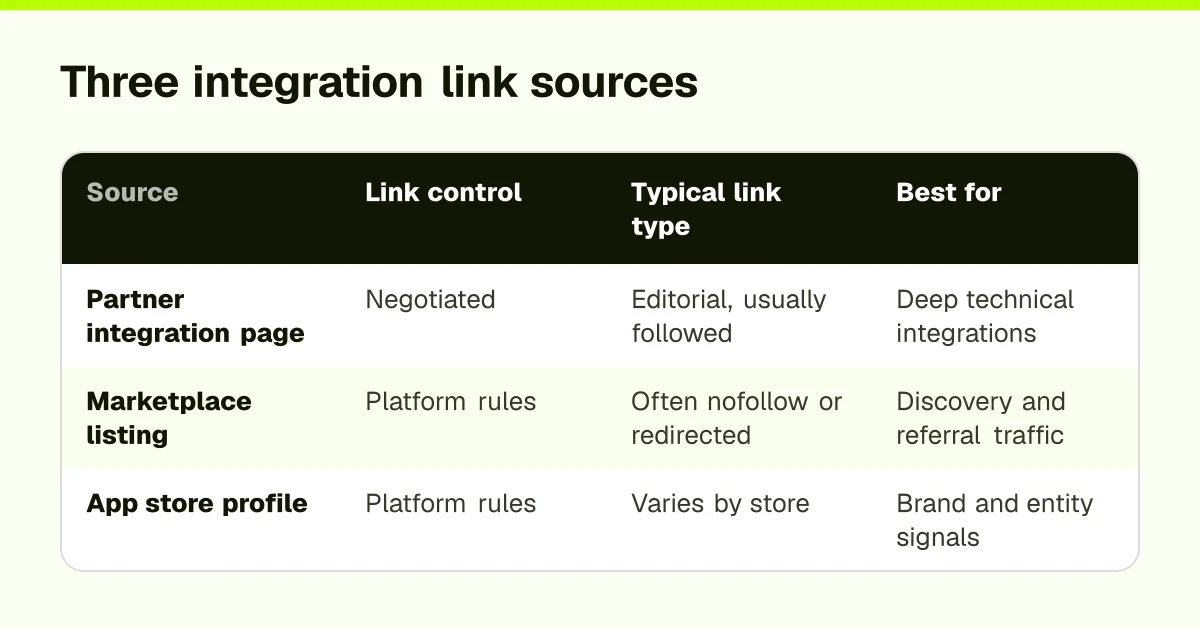
Choose by what you need from the link. If you need ranking authority, pursue partner pages. If you need discovery among active buyers, pursue marketplaces. If you need entity confirmation and branded search coverage, claim the store profiles.
| Source | Link control | Typical link type | Best for |
|---|---|---|---|
| Partner integration page | Negotiated | Editorial, usually followed | Deep technical integrations |
| Marketplace listing | Platform rules | Often nofollow or redirected | Discovery and referral traffic |
| App store profile | Platform rules | Varies by store | Brand and entity signals |
A simple decision rule: if a platform lets anyone list for a fee or a form, expect a low-value link. If the partner has to pick you, expect a better one. Skip any directory that sells placement for links alone. Google's spam policies treat paid links that pass ranking credit as link spam, and paid placements should carry rel="sponsored".
What makes an integration page linkable?
An integration page earns a link when it helps the partner's customers. A page with a setup guide, a clear use case and a real screenshot gives the partner a reason to feature and link it. A thin page with a logo and one sentence gives them nothing to point to.
Build the page on your own site first:
- A plain explanation of what the integration does
- The workflow it improves, with one example
- Setup steps or a link to documentation
- The partner's name used consistently
This is also on-page work, so our guide to on-page SEO for SaaS product and landing pages applies. And a strong integration page is a linkable asset you can pitch in its own right.
How do you build integration links step by step?
Work through the steps in order. Each one makes the next easier.
- List every integration you already have live. Many teams find partners who have never linked to them.
- Check each partner's site for an integrations directory, a partners page or a marketplace.
- Publish your own integration page for each partner, with setup detail.
- Ask the partner's partnerships or marketing contact to list the integration, and offer them copy and assets to make it easy.
- Offer something back: a joint webinar, a co-written guide or a customer story.
- Record each link, its attribute and its status, then revisit it when either product changes.
Step 5 matters. A request with nothing offered gets a polite delay. A co-marketing offer gets a reply.
What are the risks with integration links?
Three risks come up repeatedly. Reciprocal links can look like a swap if every partner links back and forth in bulk, so read our piece on when a partner link is fine and when it isn't before agreeing to anything mutual. Integrations built only to get a listing produce shallow pages that earn little. And marketplace links can disappear when a partner redesigns or retires its directory.
Also keep expectations honest. Placements are earned, never guaranteed, and no integration listing can promise rankings or traffic.
Where should you start this week?
Open a spreadsheet and list your live integrations. Mark which partners already link to you and which have a directory you could join. Pick the two partners with the strongest domains in your category and send each a short, specific listing request with an offer attached.
If you want help sequencing integration links with the rest of an authority program, our SaaS link building services page explains how we work, and you can Book a Strategy Call from there.
Frequently asked questions
It depends on the marketplace. Many mark outbound links nofollow or use redirects, while some leave them followed. Check the page source of a live listing rather than assuming, since each platform sets its own attributes.
Indirectly. They give your product a ranking branded page and confirm your entity, which helps search engines and AI assistants understand who you are. Treat any direct link value as a bonus.
No. An integration should solve a customer problem first. A build made only for a listing tends to be shallow, and partners can tell.
A single, relevant link on each side that helps customers is normal. Bulk mutual linking arranged to pass ranking credit falls under Google's link spam policy. Keep each link tied to a real integration page.
Marketplace approvals can take days to weeks. Partner pages depend on the partner's team, so plan on weeks to months. Check each platform's official partner or developer documentation for its current review times.