SaaS Link Building
EDU Backlinks for SaaS: Are They Worth Pursuing?
An EDU backlink is a link from a .edu domain, which US colleges and universities use. For a SaaS company, one is worth having when it sits on a relevant, maintained page and was earned on merit. As a shortcut to rankings, the .edu domain ending does nothing on its own.
Are EDU backlinks worth it for a SaaS company?
EDU backlinks are worth pursuing for a SaaS company only when the linking page is relevant to your product and the link is earned. A relevant link from a university research page or course resource is a good link. A random .edu link bought for a fee is a liability.
Most B2B SaaS buyers are not students. That limits the fit. An HR software company, a data tool or a developer platform can find real academic overlap. A niche sales-ops tool may find almost none, and that is fine.
Treat EDU links as one source among many. Our guide on how to evaluate backlink quality applies to them exactly as it applies to any other link.
Does Google treat .edu links as special?
Google does not give .edu links special weight because of the domain ending. Google's public statements say top-level domains such as .edu are not ranked differently by default. The idea that .edu is a ranking shortcut is a myth.
Why does the myth persist? Universities tend to have strong, old, well-linked sites. A link from one often comes with real authority because of the site's history and the editorial care behind the page, not the suffix.
That also explains why many .edu subdomains are weak. Student blogs, forgotten course pages and open profile pages carry the .edu name and little else.
Which EDU links can a SaaS company earn?
A SaaS company can earn EDU links through original research, free tools or data that faculty and students cite, and through expert contributions. Each works because someone at the university has a reason to reference you. None involves asking for a link as a favor.
- Original data or a benchmark that a researcher cites in a paper or course page
- A free tool or template a professor adds to a syllabus or lab resource list
- A founder or product expert quoted by a university news office or department blog
- A partnership, such as a class project or a guest lecture, that produces a mention
- A product-for-education program that a campus technology page documents
Expect slow, small volume. Five relevant EDU links over a year beat fifty from pages nobody visits.
If a university publishes a list of tools or resources in your category, see listicle link building for how to judge whether a list is worth appearing on.
Which EDU tactics should you skip?
Skip any EDU tactic where the link is the payment: bought links on .edu pages, scholarship link schemes and hacked or abandoned subdomain placements. Google's spam policies treat links that exist to pass ranking credit as link spam, and paid links must carry a rel="sponsored" or rel="nofollow" qualifier (Google Search Central, link spam policies).
The common offenders:
- Scholarship pages. Offering a small scholarship so a financial aid office links to you is a pattern that Google's spam policies on link schemes cover. It also rarely suits a SaaS brand.
- Paid .edu placements. Sellers advertise "guaranteed .edu links". Skip them. A bought link that passes ranking credit is link spam.
- Student blog and profile comments. These are open to anyone, so the links carry no editorial signal.
- Compromised pages. Links injected into hacked university sites can bring a manual action.
Our coverage of black hat link building tactics goes deeper on why these tactics fail.
How do you judge an EDU link before pursuing it?
Judge an EDU link by the page, not the domain. Ask five questions: is the page relevant, was the link earned, is the page live and maintained, do real people read it, and does the link sit in useful editorial text? A yes to all five makes it worth the effort.
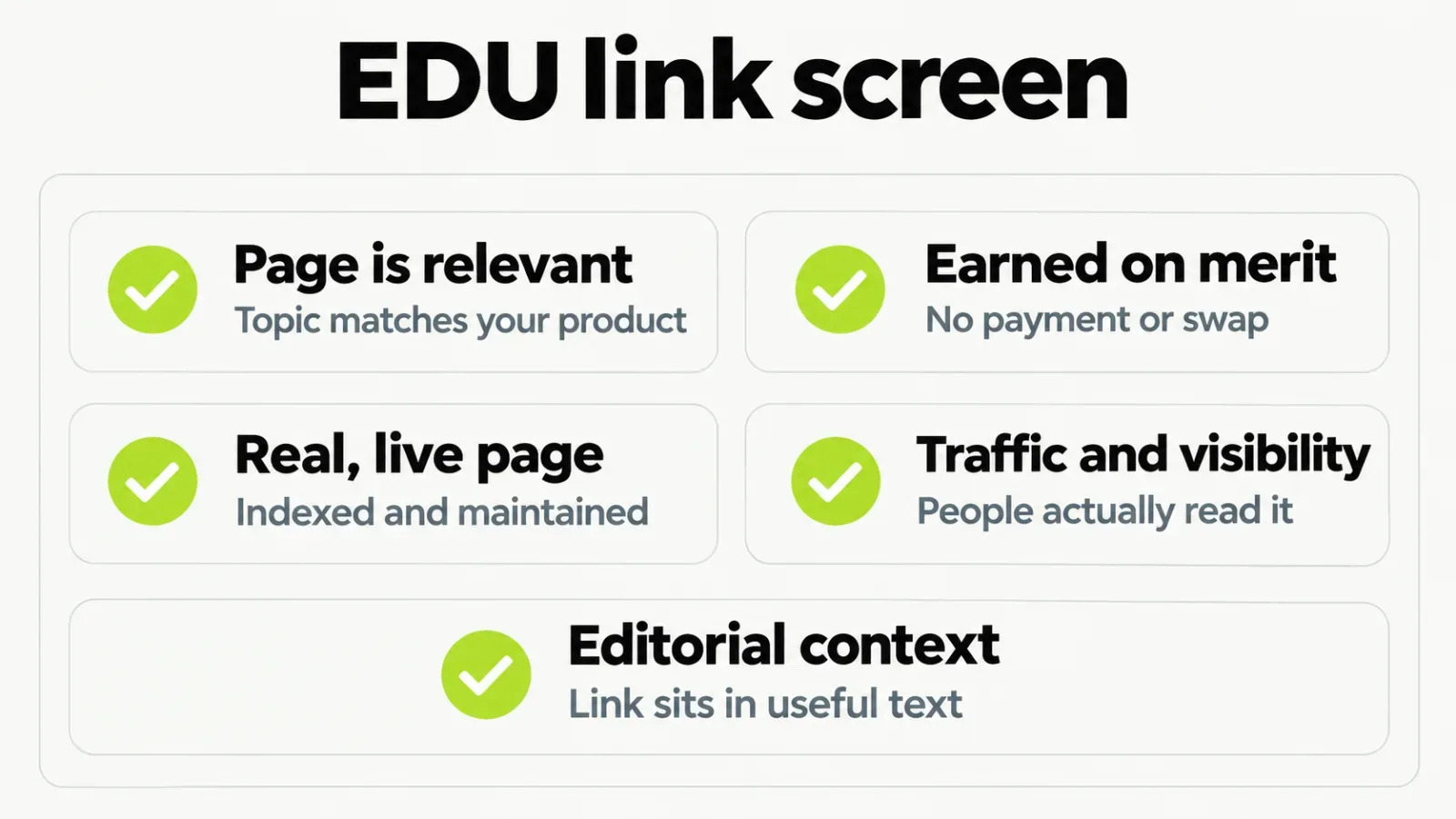
Any no is a reason to pause. A relevant page nobody reads is weak. A well-read page that would require payment is off the table.
Domain Rating is a poor stand-in here, because it is a domain-level metric and says little about the quality of one page. For the signals that matter more, look at the relevance of the linking page, whether it sends real visitors, and how editorial the placement is.
A one-week test for EDU outreach
Run a small test before building a program. It costs a week, not a budget.
- List 10 university pages that already link to tools, datasets or vendors in your category.
- Check each against the five questions above and drop any that fail.
- For the survivors, find the gap: a broken link, an outdated resource or a missing tool.
- Write one short, specific note to the page owner explaining what you have and why it fits.
- Track replies for a few weeks. If nothing lands, your product may not suit academic linking, and you can spend the effort elsewhere.
Broken resource pages are the easiest entry point. Our post on broken link building for SaaS shows how to spot them.
Earned placements are never guaranteed, and this test tells you early whether the channel is worth more time.
Frequently asked questions
They can, when they come from relevant, well-linked pages. The benefit comes from the page's quality and context. The .edu ending alone does not raise rankings, and no link guarantees a result.
It depends on the page and the site. Many university links are standard, followed links, but some are not, especially on user-generated areas. Check the link's rel attribute rather than assuming.
No. A paid link that passes ranking credit violates Google's link spam policy. If a placement is paid, it needs a rel="sponsored" qualifier, which removes the reason most sellers charge for it.
No, not by domain type. A relevant link on a respected .com publication can outweigh a stray .edu link. Compare pages on relevance and readership.
There is no target number. Many healthy SaaS profiles have only a handful, and some have none. Our guide on how many backlinks a SaaS company needs explains how to set a sensible range.