SaaS Link Building
Automated Link Building: Risks, Limits, and What Is Safe
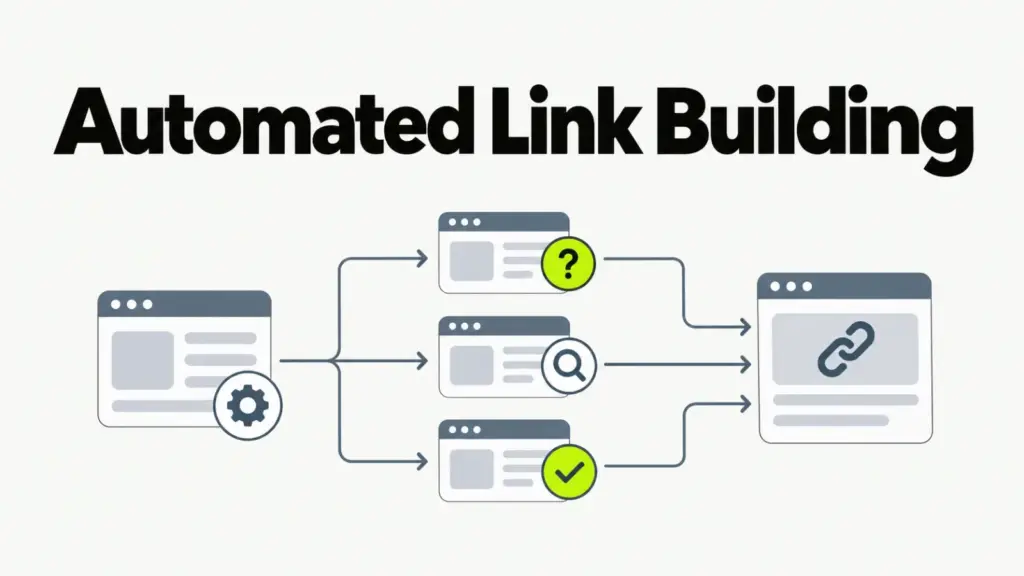
Automated link building is safe only when software handles the busywork around links and an editor on another site decides to place each one. Tools that create links for you, through comment bots, profile spam or auto-published posts, break Google’s link spam policy. Automate the finding, sorting and checking. Keep the pitch and the placement human.
What does automated link building mean?
Automated link building covers two different things, and the risk depends on which one a vendor sells. The first is software that creates links itself: posting comments, building forum profiles, spinning articles onto networks of sites. The second is software that speeds up the human work around earning links, such as prospecting, email scheduling and link monitoring.
The first kind is what Google’s policy targets. The second kind is how most legitimate campaigns run. One question sorts any tool: who decides the link exists? If a publisher’s editor decides, the tool helps you earn it. If the tool decides, you’re manufacturing it.
Does Google penalize automated link building?
Google’s spam policies name “using automated programs or services to create links to your site” as link spam. Links built that way get discounted by Google’s spam detection. At scale, they can lead to a manual action for unnatural links, shown in the Manual actions report in Search Console.
The same policy names several practices that automation tools still sell, including:
- Optimized-anchor links in articles or press releases distributed across other sites.
- Forum comments with optimized links in the post or signature.
- Low-quality directory or bookmark site links.
A penalty is only part of the cost. Discounted links eat budget and return nothing, and a profile full of them hides real progress behind noise. If a tool’s output would need a rel=”sponsored” or rel=”nofollow” tag to be honest, it isn’t building authority. Google’s guide to qualifying outbound links sets out when each attribute applies.
Which link building tasks are safe to automate?
Link building tasks are safe to automate when the software finds, sorts, schedules or checks, and a person still writes and sends each pitch. Automation earns its keep on the repetitive research that eats a campaign’s hours. It has no place in the step where a link appears on someone else’s site.

Five tasks are safe to hand to software:
- Prospect discovery, such as pulling pages that rank for a topic or link to a competitor.
- Contact lookup for the editor or author of each target page.
- Follow-up scheduling, with an automatic stop the moment someone replies.
- Detection of broken or lost links on pages you already target.
- Reporting on live links, follow status and referral visits.
Each of these still needs a human pass. A prospect scraper returns thin, scraped sites mixed in with real publications, so someone has to cut the list before outreach starts. Detection shows the right split: software spots the dead link, and a person judges whether your page is a fair replacement, which is the core of broken link building for SaaS.
Where does automation stop working?
Automation stops working at the point where a publisher has to trust you. Editors at the B2B sites your buyers read get a steady stream of templated pitches. They spot a mail-merge first line within one sentence, and a bigger send count won’t fix that.
Four jobs still need a person:
- Choosing which pages deserve a pitch at all.
- Writing the first line and the reason the link helps that page’s readers.
- Answering replies, from edit requests to fee demands.
- Walking away from a site that asks for payment.
The reply stage is where automated campaigns fall apart, because a sequencer can’t negotiate or notice a red flag. The guide on what to do with an outreach reply covers that step. Sending volume has its own ceiling: mailbox providers set bulk-sender rules on authentication and spam complaints, and cold email at scale puts your sending domain’s reputation at risk.
How do you spot a vendor selling automated links?
A vendor selling automated links usually gives itself away in the offer: a fixed bundle of links at a flat low price, delivered in days, with metric gains promised in advance. Editorial links don’t arrive on a schedule, because each one depends on an editor saying yes.
Ask the vendor to show live placements and explain who on the publisher’s side approved them. If the answer is a network the vendor controls, the links are manufactured. Watch for these red flags:
- A set number of links per month at a fixed package price.
- Promised DR, ranking or traffic gains.
- Exact-match keyword anchors you choose for every link.
- Sites with thin articles and outbound links on every page.
- A refusal to name the sites until after you pay.
Which steps should a tool handle and which need a human?
A tool should handle any step where speed matters and a mistake costs little, and a human should own any step a publisher sees. Hold your in-house workflow, or any vendor’s, to the split below.
| Task | Who does it |
|---|---|
| Building a prospect list | Tool, then a human cuts it |
| Writing and sending the pitch | Human, with templates for structure only |
| Handling replies and fee requests | Human |
| Checking that links stay live | Tool, with alerts to a person |
An agency should be able to show you this split for its own process. Our SaaS link building services are done-for-you editorial outreach, billed per delivered placement, and every placement is earned, never guaranteed.
What does a safe automated workflow look like?
A safe automated workflow uses software at the start and the end, and keeps people in the middle, where pitches are written and links are agreed. Here is a setup a small SaaS marketing team can run:
- Pull prospects with a backlink or SERP tool for one topic your product owns.
- Cut the list by hand, removing sites with no real audience or a paid-post menu.
- Find the editor for each remaining page with a contact lookup tool.
- Write each first line yourself, tied to that page, and send in small daily batches.
- Let the sequencer send one follow-up and stop the moment anyone replies.
- Answer every reply by hand, and decline any fee for a followed link.
- Log each live link and let a monitoring tool flag drops or attribute changes.
The link building checklist that runs a campaign turns these steps into a weekly routine. And before you scale any new tactic, run it past the white hat test for any tactic.
Audit one link building tool in your stack this week
Pick the link building tool or vendor you use most and list every step it performs. Mark each step as finds, sorts, schedules, checks or creates. Anything marked “creates” should stop today, and any email sent without a human-written first line should pause until it has one.
If the audit turns up links you never approved, open the Manual actions report in Search Console first. It tells you whether you face a penalty or only wasted budget.
Frequently asked questions
AI can help with a draft, but mass-produced guest posts placed for links break two policies at once. Google’s spam policies treat large-scale guest posting with keyword-rich anchors as link spam, and pages generated at scale to manipulate rankings as scaled content abuse. A post an editor would publish on its own merits is a different case.
Check the Manual actions report in Search Console first. If it shows an unnatural links action, remove what you can, disavow the rest and file a reconsideration request. With no action in place, document the links and end the vendor contract; a reflexive mass disavow is rarely needed.
Automation lowers the cost per email sent, but the cost per earned link barely moves. The expensive parts of a campaign are judgment, content worth linking to and handling replies, and software scales none of them.
Many are. Platforms that match sites to swap links fit Google’s descriptions of excessive link exchanges and automated link creation. Two related sites linking to each other because it helps their readers is normal; a system built to trade links breaks the policy.
No. Google’s link spam policy targets links created to manipulate rankings, and an email sequencer creates no links. What you send with it still counts: a pitch offering payment for a followed link is a link scheme, whatever tool sent it.