SaaS Link Building
International Link Building: Earning Links Across Language Markets
International link building means earning links from the publications, partners and communities buyers trust in each market you sell into, written in their language. For a B2B SaaS company expanding abroad, a few relevant local links to your localized pages do more than a stack of English links to the homepage.
This guide is for SaaS teams with an established English site that are opening a second or third language market. URL structure and hreflang setup belong to your technical SEO team. They come up here only where they change where links should point.
The short version:
- Links count most from sources your buyers in that market read.
- Your URL structure decides whether local links help one site or the whole domain.
- Localized data and local angles earn links, and translated assets earn little.
- Native speakers write, send and answer the outreach.
- Disclosure law differs by country, and Google’s rel=”sponsored” rule applies everywhere.
What changes when you build links in a new language market?
Link building in a new language market changes in four ways: which sources count, how you pitch, how publishers handle paid content, and who already holds the search results. The tactics stay recognizable. The inputs all become local.
Relevance resets. A buyer in Munich reads German-language trade press, checks German review sites and asks peers at German companies. Links from US publications show that American readers trust you. They show nothing about German buyers.
Pitching resets too. An English pitch to a French editor reads as mass outreach, because it usually is. Local editors expect their own language, a local angle and, often, a spokesperson they can quote in it.
Paid content follows local rules. Many European publishers sell sponsored articles openly and label them under national advertising law. Those placements are legitimate advertising, and they still need rel=”sponsored” on every link.
Local incumbents hold the head terms. In most markets, a domestic competitor has years of local coverage behind it. A new entrant wins first on specific use cases, local regulation topics and integrations with platforms that market already uses.
The practical result: plan each market as its own small campaign, with its own sources, assets and reporting.
How does your URL structure change where links help?
Your URL structure decides whether a link earned in one market strengthens only that market’s site or your whole domain. Google’s documentation on managing multi-regional and multilingual sites describes the main options: country-code domains, subdomains, subdirectories and URL parameters.
| Structure | Example | How earned authority behaves | What it means for links |
|---|---|---|---|
| Country-code domain | example.de | A separate domain with its own link profile from day one | Each market needs its own links from the start |
| Subdirectory | example.com/de/ | Shares the root domain, so links anywhere on example.com support it | English authority carries over; local links target the /de/ pages |
| Subdomain | de.example.com | Practitioners disagree on how much it shares with the root domain | Earn some links to the subdomain directly |
| URL parameter | example.com?lang=de | Google’s documentation advises against this setup | Fix the structure before spending on links |
On subdirectories, your English links already lift the localized sections, and local links add market relevance. On country-code domains, each site is a new site for link purposes, so budget for every market as a separate launch.
Hreflang annotations tell Google which language version to show a searcher, and they move no link authority between versions. A German link to your English homepage helps the domain but sends a German reader to the wrong page. When a local publication offers a link, ask for the localized URL.
Which sources carry authority in a local market?
Local authority comes from sources that buyers in that market already read, join or buy through: national trade press, industry associations, local partners and local communities. The categories match what works in the US. The names, languages and norms differ in every market.
| Source type | Examples | Why it carries weight | How a link is earned |
|---|---|---|---|
| National trade and business press | IT and business titles in the local language, regional startup press | Read by local buyers and watched by local competitors | Local data, local customers, a spokesperson who speaks the language |
| Industry associations | Digital industry bodies such as Bitkom in Germany, sector associations, chambers of commerce | Signals that you take the market seriously | Contributing research or expertise to their publications |
| Local partners and resellers | Implementation partners, resellers, local system integrators | Shows the product is sold and supported in the market | Co-written case studies and partner pages that describe real work |
| Local software marketplaces | Regional app stores and the local editions of platforms you integrate with | Buyers shop there, and listings rank for product queries | Building and maintaining a localized integration |
| Local-language review and comparison sites | Country-specific software review portals, local comparison articles | Where local shortlists form | Real local customers and a complete localized profile |
| Podcasts, newsletters and events | Local-language shows, meetups and conferences | Small audiences with high trust | A speaker who presents in the local language |
| Universities and research groups | Local university departments and applied research institutes | They rarely link to vendors, so their links stand out | Joint research, or data shared for a study |
| “International link packages” | Bundles of foreign-language sites sold by the batch | Very little | Paying, which makes them link spam unless marked sponsored |
The examples show the kinds of sources that matter in a market. They are not placements anyone can promise: in every country, coverage is earned, never guaranteed.
The domain extension on the linking site matters less than most teams expect. Plenty of respected French and German publications sit on .com domains. Judge the audience and the topic, and ignore the extension.
Should you translate your English link assets?
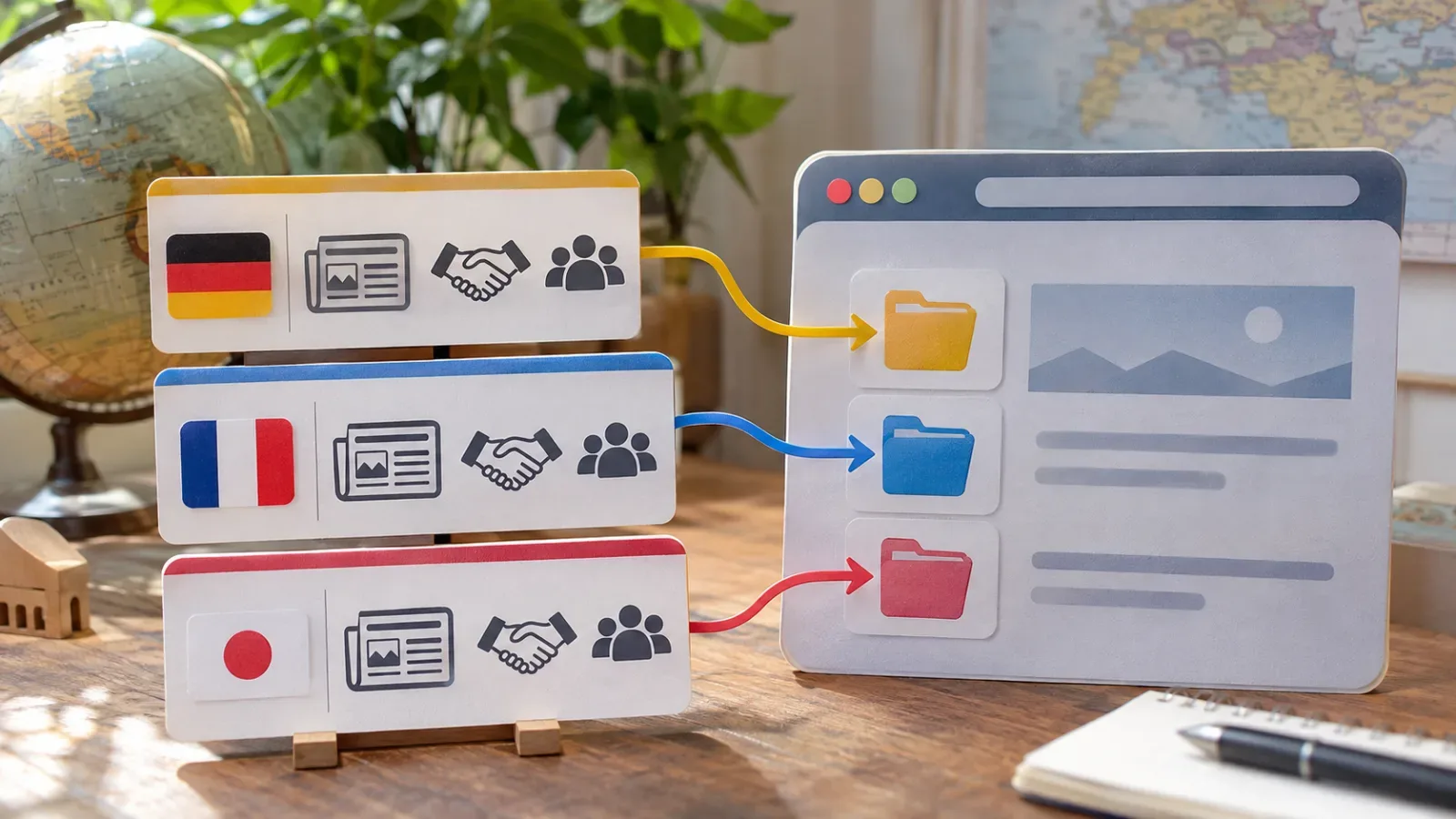
Translating an English linkable asset rarely earns links in another market, because local writers need local proof. A US salary survey translated into German is still about US salaries. The assets that earn links abroad use the market’s own data, rules and examples.
Four kinds of localized asset do most of the work.
Local data studies come first. A survey or anonymized usage analysis with a sample from that country hands reporters a number about their own market.
Regulation explainers come next. An HR platform entering Germany meets works councils, which hold co-determination rights over systems that can monitor employee behavior or performance under the Works Constitution Act. A clear German explainer on that topic, reviewed by local counsel, gives HR writers something to cite.
Localized tools and templates earn steady links when they fit local practice: a calculator that uses local holiday calendars, or a template built around local requirements. A US template with translated labels earns nothing.
Local customer stories round out the set. One named customer from that country carries more weight with local press than a page of American logos.
A translated page gives a local writer nothing new to cite, and a localized one gives them a reason. Translation is the delivery format. The substance has to be built for the market first.
Before you localize any asset, run three checks.
- Confirm the asset answers a question people in that market ask, using local search results and local press.
- Replace US data, examples and rules with local ones, or drop the asset for that market.
- Have a native speaker who knows the industry review it before it goes live.
Machine translation is fine as a first draft for internal review. Publishing large volumes of machine-translated pages to rank is what Google’s spam policies call scaled content abuse: many pages made mainly to manipulate rankings, however they’re produced.
Who should run outreach in each language?
Outreach in a new market works when a native speaker who knows the local industry writes and sends it. Editors spot a translated pitch in the first line, and a pitch that ignores local norms gets filed with the spam.
Five rules keep local outreach credible.
- Write in the editor’s language, at the register the market expects, such as the formal Sie in German business email.
- Pitch with a local angle: a local number, a local customer or a local rule.
- Offer a spokesperson who can give an interview in that language, or say plainly that you can’t.
- Send during local working hours, and plan around national holidays and summer breaks.
- Disclose any paid element up front, and follow that country’s labeling rules.
Replies need the same native speaker. A warm reply in Dutch answered in English often goes cold. Our guide on what to do with an outreach reply covers the follow-up, and every step of it applies in any language.
Which link building methods work in a new language market?
The methods that work abroad give a local audience proof they can check from inside their own market. Eight carry most international programs.
Expert commentary for local press comes first. When a national regulator or a large domestic competitor changes something, local reporters need an informed reaction in their language, fast. An expert on call who speaks it becomes a regular source.
Data stories are next. Pitch the local study to the reporters who cover your buyers, and send the full method with it.
Localized documentation and help content earn links from forums and community Q&A sites, where admins and developers answer each other in their own language.
Integrations with local platforms open three doors at once. Each market has its own accounting, payroll, ecommerce and messaging tools, and one integration can produce a marketplace listing, a partner announcement and a joint tutorial. Our guide to link building through SaaS integrations covers the mechanics.
Partner and reseller content works because the partner is already trusted. A local implementation partner’s case study about your product is an editorial link from a business buyers in that market know.
Local podcasts and events reward a founder or country manager who speaks the language well, with show-notes links and speaker pages. The guide to podcast guest appearances for SaaS covers how to pitch hosts.
Local review and comparison sites matter where buyers shortlist through country-specific portals. Earn inclusion with real local customers and a complete localized profile, and skip the paid top spots.
Local customer stories give trade press a reason to cover a foreign vendor. A named domestic customer with a measured outcome is the strongest of them.
Guest posting has a narrow role abroad. A contributed article in a local trade title works when a native-speaking expert writes it to teach something. A translated post from your English blog gets declined, or lands on a site that accepts anything.
How do paid-content rules differ by country?
Paid-content rules have two layers in every market: Google’s link rules, which are the same everywhere, and local advertising law, which changes by country. Google asks for paid links to be qualified with rel=”sponsored”, whatever language the page is in.
The local layer is where SaaS teams entering Europe get caught. Five points come up most.
- The EU’s Unfair Commercial Practices Directive lists paid editorial content that isn’t clearly identified as unfair in all circumstances.
- German publishers label paid articles, commonly as “Anzeige” or “Werbung”, under competition and press law. Check the current labeling requirements in the relevant competition law and state press laws.
- In the UK, the ASA and the CMA expect sponsored articles and paid posts to be obviously identifiable as ads. Check the current CAP Code and CMA guidance on advertorials for the exact requirements.
- In the US, the FTC’s Endorsement Guides cover sponsored articles and paid reviews.
- A publisher’s own label, such as “partner content”, doesn’t replace the link attribute. Check both.
This section is general information, and none of it is legal advice. Ask counsel in the target market before you run paid content there.
A paid placement that passes ranking credit is link spam in any language. A labeled placement with rel=”sponsored” is advertising, and buying it for reach is fine.
How does the plan change by type of market?
International link building plans differ by how far a new market sits from your home market in language, buyers and sales model. The plan follows those three gaps more than the country name.
| Situation | Example | Strongest link asset | Watch out for |
|---|---|---|---|
| Same language, new country | US to UK or Australia | Local customer stories and local data | Assuming home-market links cover it |
| New language, mature SaaS buyers | Germany, the Nordics, the Netherlands | Regulation explainers and trade press commentary | Skipping data protection, which buyers raise early |
| Partner-led market | Markets where local integrators and resellers lead software sales | Partner case studies and partner pages | Keyword-anchor footer links across every partner site |
| Multilingual country | Switzerland, Belgium, Canada | Separate assets for each language community | One translated page serving every language |
| Region served in English | An English page for Asia-Pacific or the Middle East | Regional customer stories and regional events | Calling it international while every link comes from the US |
The second row is a common first step for US SaaS companies in Europe. German-speaking buyers ask about GDPR and data residency early, so a clear localized data-processing page supports every pitch, even though it rarely earns links itself.
What should you avoid in international link building?
The international link building shortcuts to avoid are the ones that look efficient from headquarters: bulk packages, machine translation and keyword anchors in every language. Local editors spot them at once, and Google’s spam policies cover most of them.
- Bought “international” link packages on foreign sites with no audience.
- Machine-translated guest posts placed in many countries at once.
- The same exact-match keyword anchor repeated in every language.
- Keyword-rich footer links swapped with every reseller, which Google’s spam policies treat as excessive link exchange.
- Sponsored articles with no label and no rel=”sponsored”.
- One press release translated into many languages and sent to bought lists.
- Links from countries you don’t sell in, chosen because sites there were cheap.
Each one trades local trust for volume. A small set of links from sources your buyers read beats all of them in every market.
Do local links help in AI assistant answers?
Local coverage gives AI assistants something to find when a buyer asks a question in their own language. If no publication in that market mentions you, an assistant answering in German has only your own pages and English sources to work with.
Keep the brand name identical in every language, and translate a consistent descriptor around it. “Acme, the payroll software” becomes “Acme, die Lohnabrechnungssoftware”, and the name itself never changes. That consistency helps search engines and assistants treat every mention as the same company.
Localized help content deserves the same care as marketing pages. Clear, current help articles in the buyer’s language are common sources for how-to answers.
Nobody can promise a citation in any language. Track a fixed set of local-language buyer prompts for each market and watch the trend.
Which localized pages should local links point to?
Local links should point to localized pages that give the reader something to use: studies, explainers, tools and integration pages. Localized product and pricing pages rarely earn links, and they gain authority through internal links from the pages that do.
| Page type | Earns local links? | Role in the plan |
|---|---|---|
| Local data studies | Yes, strongly | Main target for press links |
| Regulation and compliance explainers | Yes, steadily | Cited by trade writers and associations |
| Localized integration pages | Yes | Target for marketplace and partner links |
| Local customer stories | Sometimes | Proof for press and partner pitches |
| Localized security and data-processing pages | Rarely | Answers procurement; link to it internally |
| Localized homepage | Through brand mentions | Receives branded and partner links |
| Localized product and pricing pages | Almost never | Receive authority through internal links |
A frequent fault is a local press link pointing at the .com homepage, which lands a German reader on English copy. When a journalist offers a link, give them the exact localized URL. Ask your developers to check that language redirects don’t send local visitors somewhere else.
How do you start link building in a new market?
Start link building in a new market by checking what already exists there, then building local foundations, then running one focused campaign. Keep the three phases in that order, with a native speaker involved in each.
| Phase | Work | What you have at the end |
|---|---|---|
| Market check | Review your local link profile and close local competitors. Find existing mentions in that language. Map local search terms and publications. | A short list of local sources and gaps |
| Local foundations | Build localized pages for the strongest assets. Complete partner, marketplace and association listings. Reclaim unlinked local mentions. | Pages worth linking to, and the first local links |
| First local campaign | Pitch one local data story or regulation angle in the local language. Offer commentary on local industry news. | First coverage, with what worked logged |
Native-speaker review belongs in every phase. A pitch with a grammar slip or a wrong legal term tells a local editor you don’t understand their market.
Open one market at a time, and pick the one where sales already has pipeline. Links in a market your team can’t serve yet bring coverage you can’t convert.

How do you measure international links?
Measure international link building market by market: who links to you in each market, which localized pages they point to, then local rankings and pipeline. A single global total hides the market that isn’t moving.
- Relevant referring domains from the target country and language.
- How many local links land on localized URLs and how many on the English site.
- Rankings for a fixed set of local-language queries in that country’s Google results.
- Branded search in the market, as a sign that coverage reaches buyers.
- Signups, trials and pipeline from organic search in that country.
Report each market separately, and say which measures haven’t moved. A market that stays flat after a fair run is a signal to change the angle or pause.
When should you hire an agency for international link building?
Hire an agency for international link building once you have localized pages worth linking to, a market you’re committed to, and a native speaker inside the company who can review the work. Without those three, outside outreach has nothing local to point to.
Ask any provider these questions.
- Who writes and sends the outreach in each language?
- Can I see every site before a link goes live?
- Does money reach the publisher, in any form?
- How do you handle each country’s sponsored-content labeling?
- Which markets would you advise us to wait on?
- Do you guarantee a number of placements?
Good answers to the first and fifth questions are specific: named native speakers, and a market they’d push back on. The only acceptable answer to the last is no, since a guaranteed count means the placements are bought.
Google’s own guidance on hiring an SEO warns that no one can guarantee a top ranking. Our checklist on how to choose a link building agency has the full set of questions.
Our SaaS link building services are off-page only and billed per delivered placement, month to month, with no retainer. Localization and hreflang stay with your own team.
Frequently asked questions
Should anchor text be in the local language?
Yes, and mostly it should be your brand name. A German page linking to you with the German name of your category reads normally. The same exact-match keyword anchor repeated across sites in several languages looks engineered, because it is.
Can we republish a translated version of a guest post we already placed?
Only with the original publisher’s agreement and a real adaptation for the new audience. Most publications want exclusive content, and a piece built on US examples seldom suits a local trade title. Write new for the market and reuse the research behind it.
Do we need hreflang before starting international link building?
Yes, set it up first. Hreflang tells Google which language version fits a searcher, and it earns no links itself. With it in place, the local links you earn support pages Google already shows to the right market.
Can a local freelancer or local agency run outreach for us?
Yes, and their native language is the point. Give them the same rules you’d give any provider: disclosed payments only, no keyword anchors, and every site shared before a link goes live. Review a sample of their pitches in translation each month.
How long before links in a new market show results?
There’s no fixed timeline, and anyone quoting one is guessing. Local competition, the strength of your localized assets and how well the market already knows you all set the pace. Track referring domains and coverage first; rankings and pipeline follow later.
Should we build links in a market before the product is localized?
No, with one exception. A local editor who links to you sends readers to English pages, and that coverage converts poorly. Same-language markets such as the UK are the exception, where local customer stories and local data can start right away.