SaaS Link Building
Black Hat Link Building: What It Is and Why It Gets SaaS Sites Penalised
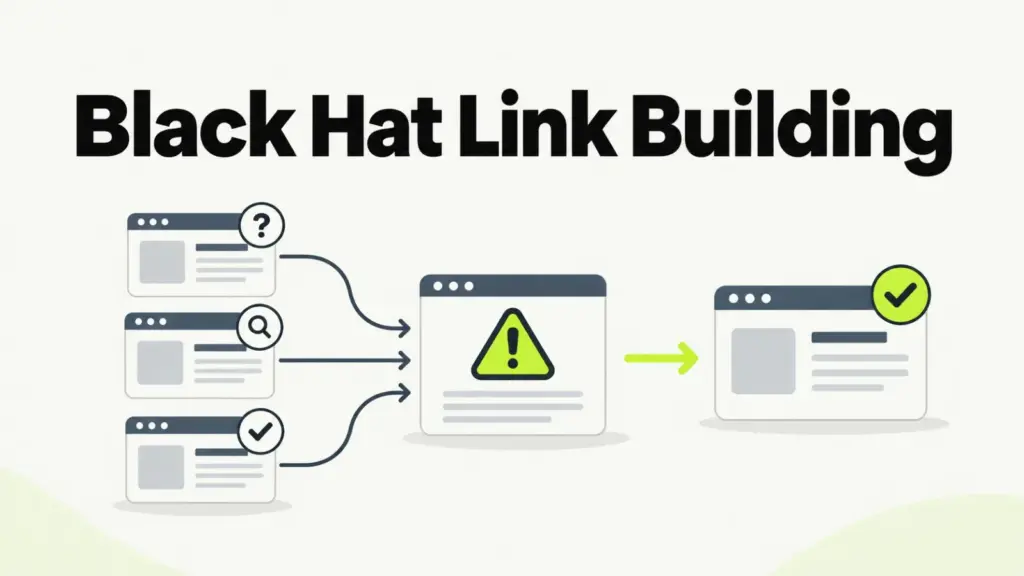
Black hat link building is any tactic that creates links to manipulate search rankings instead of earning them. Paid links that pass ranking credit, private blog networks and automated link spam all qualify. Google treats them as link spam, and a SaaS site caught using them can lose rankings through a manual action or algorithmic demotion.
What counts as black hat link building?
Black hat link building is the practice of acquiring links in ways that break Google's spam policies. Google's link spam policy describes links meant to manipulate rankings, including buying or selling links that pass ranking credit, excessive link exchanges, and automated link creation. The test is intent and method, not the type of site linking to you.
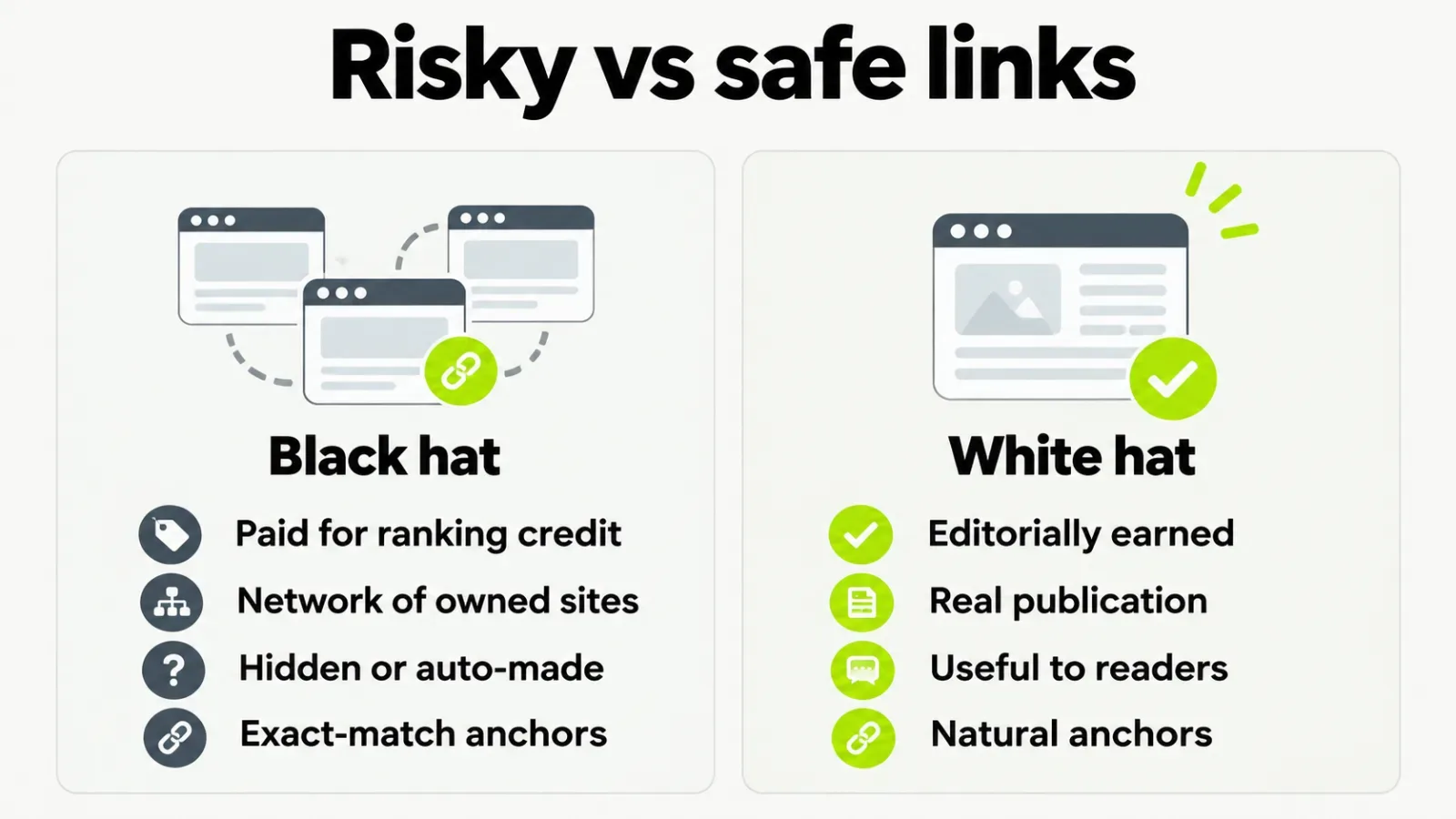
A useful rule: if the link exists only because you paid for ranking credit, built it yourself on a site you control, or generated it with software, it is black hat. If an editor placed it because your content helped their readers, it is not.
Paid placements are not banned outright. Google's documentation on qualifying outbound links says paid links should carry rel="sponsored". The violation is a paid link that passes ranking credit without that qualifier.
Which black hat tactics do SaaS companies run into?
SaaS companies most often meet six tactics: private blog networks, paid links without disclosure, link exchange schemes, automated or spun guest posts, hacked or expired-domain links, and comment or profile spam. Most reach a SaaS team through a vendor, not through a decision the team made on purpose.
Private blog networks
A private blog network (PBN) is a set of sites built to link to other sites and lift their rankings. The sites often run on expired domains with old authority. They exist for the links, not for readers, which is what makes them spam.
Paid links that pass ranking credit
A vendor sells "DR50+ placements" on sites that sell slots to anyone. The price list is the giveaway. Real editorial sites do not publish a rate card for dofollow links.
Link exchange schemes
Trading links at scale breaks the policy. A genuine partner link between two products is a different case, covered in when a partner link is fine and when it isn't.
Automated and low-quality content links
Spun articles, mass directory submissions and forum or comment spam create links in volume. Google's spam policies list automated link creation as link spam.
Hacked and expired-domain links
Links injected into compromised sites, or built by buying a lapsed domain and redirecting it, deceive both Google and readers. Skip them entirely.
How does Google catch and penalise black hat links?
Google handles link spam in two ways: algorithms that neutralise spammy links, and manual actions applied by human reviewers. Google's documentation on manual actions says a site can receive a penalty for unnatural links to or from it, which can lower rankings or remove pages from results.
The outcomes differ:
| Outcome | What happens | How you find out |
|---|---|---|
| Algorithmic discount | Spam links are ignored, so rankings that depended on them fall | No notice. You see traffic drop |
| Manual action | Rankings drop for pages or the whole site | Message in Search Console |
An algorithmic discount is the quieter risk. You pay for links, they are ignored, and the money is gone with nothing to appeal. A manual action is the louder one, and it requires cleanup and a reconsideration request.
Why are SaaS sites especially exposed?
SaaS sites are exposed because their commercial pages sit in a small set of high-value queries, and a link vendor will push exact-match anchors to those pages. A few pages carry most of the pipeline, so a drop there costs real revenue.
Two patterns show up repeatedly:
- Sudden bursts of links to a pricing or product page, with the same keyword-rich anchor repeated. See when anchor text triggers Google penalties for how this looks.
- Inherited damage. A founder hires an agency, the agency is replaced, and the next team finds a backlink profile full of links nobody remembers buying.
The second is more common than most teams expect, which is why an audit belongs at the start of any new engagement.
How do you tell a risky tactic from a safe one?
A tactic is safe when an independent editor chose to link because your content serves their readers. It is risky when you control the placement, pay for ranking credit, or hide the relationship. Apply three questions before approving any link source.
- Would this link exist if search engines did not?
- Does the site have real readers, real editors and topical fit with your product?
- Could you explain the arrangement publicly without embarrassment?
If any answer is no, walk away. The longer version of this test, applied to specific tactics, is in white hat link building for SaaS.
No safe tactic comes with a guaranteed link. Earned placements are earned, never guaranteed, and a vendor that promises a fixed count of high-rating links on a deadline is describing a purchase, not editorial work.
What should you do if you already have black hat links?
Start with an audit, then remove what you can, then disavow what you can't. Google's Disavow tool tells Google to ignore specific links, but Google's documentation says it is an advanced feature that can harm performance if used wrongly, so use it only for clearly manipulative links you can't get removed.
- Export links from Search Console and any backlink tool you use.
- Flag patterns: networks, paid footprints, exact-match anchors, unrelated sites.
- Ask site owners to remove or add rel="sponsored" or rel="nofollow".
- Disavow what remains, for real spam only.
- If you have a manual action, submit a reconsideration request describing what you removed.
- Stop the source. Cancel the vendor and get written details of what was built.
A full method is in backlink profile audit for an inherited SaaS domain. If you want a team to build links the editorial way instead, SaaS link building services explains how placements are earned and billed.
Frequently asked questions
No. It is not against the law, but it breaks Google's spam policies. The consequence is lost rankings, not a legal penalty. Undisclosed paid endorsements can raise separate advertising-disclosure issues, so ask counsel if that applies to you.
Yes, in most documented cases. A manual action can be lifted after you clean up links and submit a reconsideration request. Recovery takes time and Google does not guarantee a return to previous rankings.
No. Paid placements are acceptable when they are disclosed and carry rel="sponsored", because they then pass no ranking credit. The problem is paid links made to pass ranking credit.
Not by default. Guest posts on relevant publications, written for readers, are normal. Large-scale guest posting with keyword-rich anchors for links is what Google's link spam policy targets.
No. A disavow file only asks Google to ignore listed links. It does not remove the links or fix a vendor relationship, and it does not help if the real cause is ongoing link buying.