SaaS Link Building
What Is Keyword Stuffing? Examples and Why It Hurts Rankings
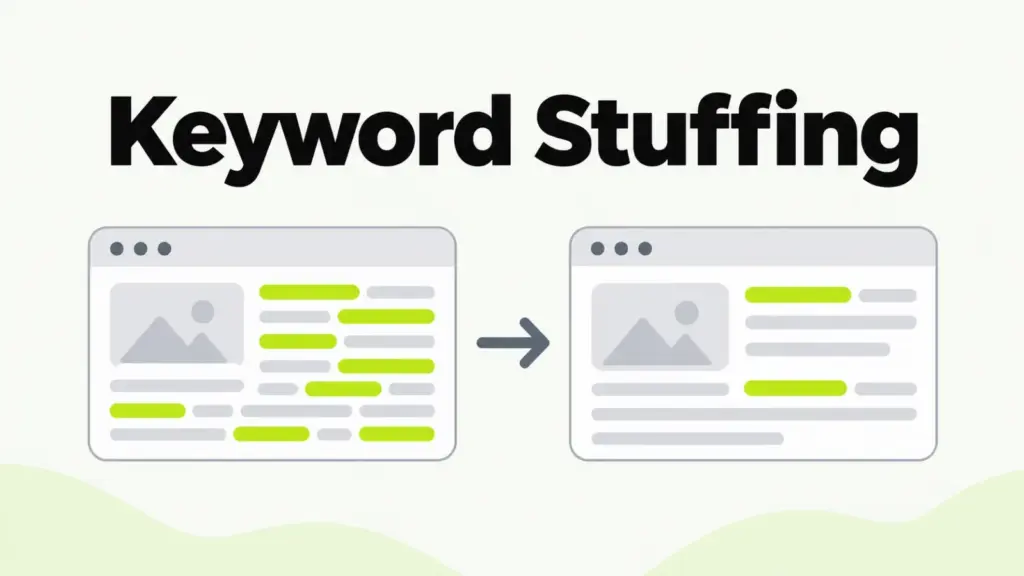
Keyword stuffing is the practice of loading a page with the same keywords, or lists of related terms, to manipulate search rankings. Google treats it as spam. The copy reads badly to people, and it can lead to lower rankings or a manual action.
What keyword stuffing looks like on a SaaS page
Keyword stuffing shows up as repetition that no writer would produce on purpose. A reader notices it within a sentence.
Common forms on SaaS sites:
- The same phrase repeated in every paragraph and heading
- Blocks of city, industry or "alternative to" terms dumped in a footer or a list
- Alt text, meta tags or image filenames crammed with keywords
- Exact-match anchor text repeated across many inbound links, which is link spam in the same spirit (see backlink)
What Google's spam policy says
Google's spam policies define keyword stuffing as filling a page with keywords or numbers in an attempt to manipulate rankings. The documentation gives examples: lists of phone numbers with no added value, blocks of text naming cities or regions a page wants to rank for, and repeating a phrase so often that it sounds unnatural. Read the Google Search Central spam policies for the exact wording.
Google does not publish a safe keyword density. Stop counting percentages. Write for the reader and check that the copy sounds normal read aloud.
Why stuffing hurts rankings and trust
Keyword stuffing hurts because it breaks two things at once: your standing with search systems and your credibility with buyers.
- Google's systems can demote pages that read as spam, and a manual action can follow for serious cases.
- A B2B buyer comparing three vendors leaves a page that sounds robotic.
- Stuffed pages rarely answer the question behind the query, so they lose to pages that do.
Skip the density tricks. They cost more than they return.
How to fix a stuffed page
To fix a stuffed page, rewrite it around the question the visitor came with and let the keyword appear only where it fits.
- Read the page aloud and mark every sentence that sounds forced.
- Cut repeated phrases down to one use in the title, one in the opening, and natural mentions after that.
- Replace repeated terms with synonyms, product names and specific details.
- Delete hidden or dumped keyword blocks, including cities, regions and stray number lists.
- Check alt text and meta tags for lists and rewrite them as plain descriptions.
- If Search Console shows a manual action, fix the page and file a reconsideration request.
Better targeting starts before writing. Pick terms with intent behind them, as covered in SaaS keyword research.
How keyword stuffing differs from related terms
Keyword stuffing is an on-page tactic, while keyword research and anchor text are separate subjects.
- Keyword research chooses what to target. Stuffing is overusing the result.
- Anchor text over-optimization is the same overuse applied to inbound link text.
- Keyword difficulty estimates how hard a term is to rank for; it says nothing about how to write for it. See keyword difficulty.
More definitions like these are in the SaaS link building and SEO glossary.