SaaS Link Building
Disavowing Backlinks: When SaaS Sites Should Use the Tool
Disavowing backlinks tells Google to ignore specific links pointing at your site. Most SaaS sites never need it. Use the disavow tool only when you hold a manual action for unnatural links, or when you built a large set of paid or manipulative links that you cannot get removed.
Do SaaS sites need to disavow backlinks?
Most SaaS sites do not need to disavow anything. Google's documentation on the disavow tool says it is an advanced feature and that most sites will not need it, because Google's systems already work to ignore spammy links without any action from you.
A SaaS site collects odd links naturally: scraper directories, auto-generated stat pages, forum profiles. A low Domain Rating (DR, a third-party authority score) on a linking site is not a reason to disavow. It is just a weak link, and weak links get ignored.
Skip the monthly "toxic link" cleanup that audit tools suggest. It costs time and can remove links that help you.
When is disavowing backlinks justified?
Disavowing is justified in two situations: you received a manual action for unnatural links, or you know you created links that violate Google's link spam policies and cannot remove them. Both involve links you are responsible for, not stray junk.
You have a manual action
Search Console's Manual Actions report shows a penalty for "unnatural links to your site." Here, remove what you can, disavow the rest, and file a reconsideration request.
You bought or swapped links in the past
Maybe a previous agency ran a paid link campaign, or you inherited a domain with a history of it. Google's spam policies treat links that pass ranking credit in exchange for payment as link spam. If you cannot get those links taken down, disavowing them is the cleanup. A backlink profile audit for an inherited SaaS domain is the best way to find them.
A hacked or injected link network
If a hack on your own site or a spam network created thousands of links with exact-match anchors, and the volume is high, disavowing at the domain level is reasonable. Fix the hack first.
What should you not disavow?
Do not disavow links just because they look low quality, come from low-DR sites, or are nofollow. Nofollow links already pass no ranking credit in the usual way, so filing them is wasted effort. See our definition of a nofollow link for how Google treats them.
Also skip these:
- Scraper and directory links you never asked for
- Links from sites in other languages
- Links you suspect a competitor placed as negative SEO, with no evidence of harm
- Links from sites you simply do not recognize
Each of these is noise. Disavowing a good link by mistake is a real cost, and you cannot see a clear benefit in return.
How do you disavow backlinks step by step?
You disavow by uploading a plain text file to Google's disavow tool in Search Console. The file lists URLs or whole domains, one per line, and applies to the property you select. Check Google's current documentation for where to find the tool.
- Export your links from Search Console's Links report, plus any third-party backlink tool you use.
- Mark each link you are responsible for and cannot get removed.
- Write a .txt file in UTF-8 or 7-bit ASCII. Start comment lines with a #.
- List a full page as
https://example.com/pageor a whole site asdomain:example.com. - Choose the right property in the disavow tool and upload the file.
- Keep a copy and a note of why each entry exists.
Prefer domain: entries when a whole site is spam, since the links tend to be spread across many URLs. Google's documentation lists limits on file size and number of lines, so check the current limits in Google's disavow documentation before uploading.
Processing takes time. Google does not recrawl instantly, so expect weeks before the effect is applied.
What should you try before disavowing?
Try removal first. Contact the site owner, ask for the link to come down, and document the attempt. For a manual action, Google expects to see this effort in your reconsideration request.
For paid placements you can reach, ask the publisher to remove the link or add rel="sponsored". Google's qualifying outbound links documentation explains these attributes. For links from your own old campaigns, check contracts and emails to find who placed them.
Also check whether the links hurt you at all. If rankings and traffic held steady, you have no evidence of a problem to solve. Backlink monitoring helps you work out which link changes deserve action.
How do you decide: a quick rule
Ask two questions. Did you or someone working for you create the link in a way that breaks Google's link spam policies? Can you not get it removed? If both answers are yes, disavow. If either is no, leave the link alone.
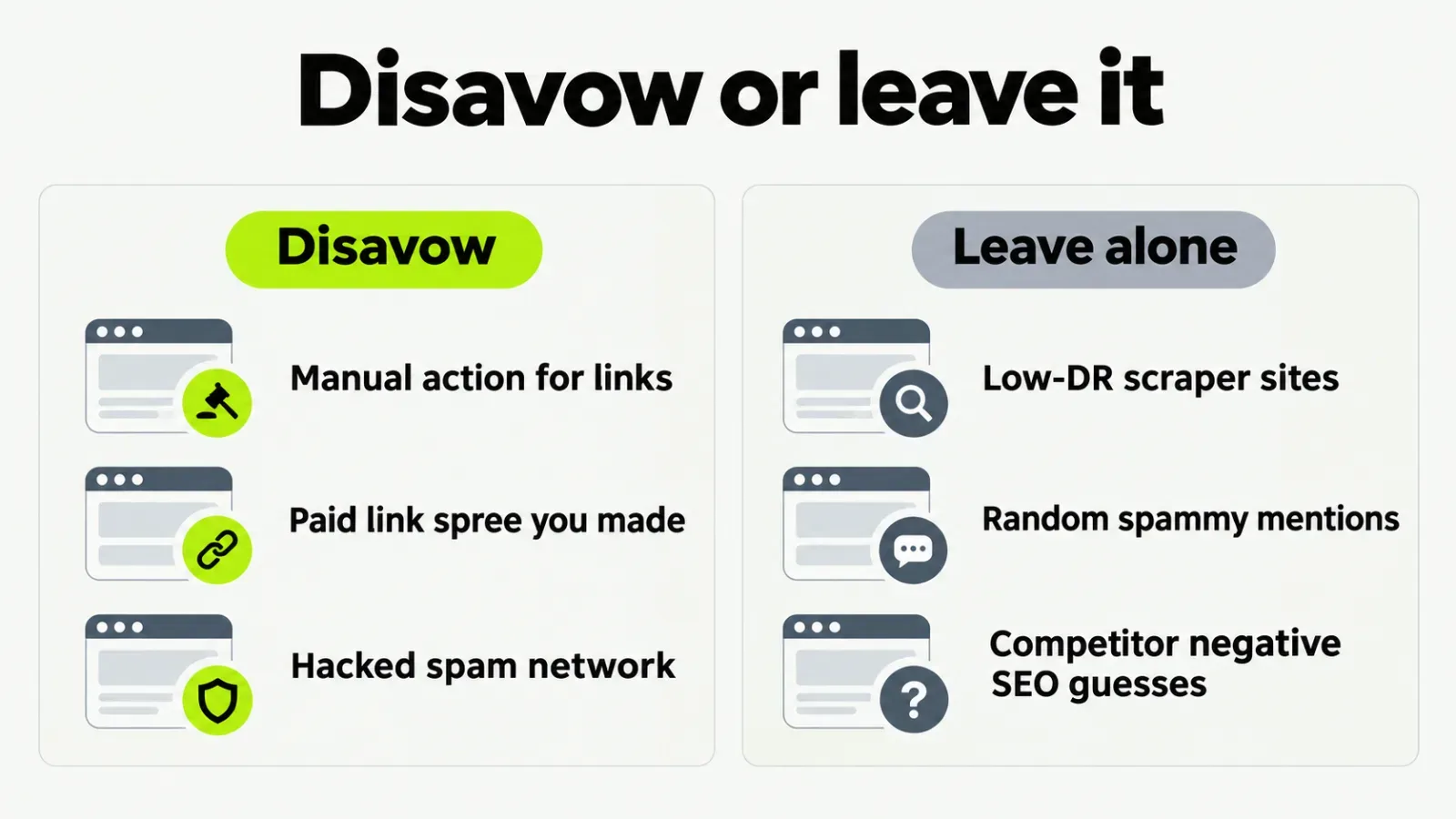
If you have a manual action, the answer is almost always to disavow what you cannot remove. If you have no manual action and no history of paid links, do nothing.
Review your profile before you touch the tool
Run a profile review this week: export your links, flag any you or a past vendor paid for, and check Search Console for manual actions. If the report is empty and you have no paid history, close the file. If you do find paid links, build the list, try removal, then upload. Our overview of how much SaaS should spend on link building helps you redirect that budget to earned links instead.
Frequently asked questions
Not on its own for most sites. The tool asks Google to ignore links, so it helps only where bad links were counted against you, such as under a manual action. Healthy sites rarely see any change.
Google says its systems are built to ignore most spammy links. Without a manual action or clear evidence of harm, a few strange links do not justify filing a disavow file.
Google processes it as it recrawls the linked pages, so effects can take weeks. Do not expect an instant change, and do not resubmit the file repeatedly.
No. Nofollow links are a hint to Google not to pass credit in the usual way, so including them adds nothing to the file.
Yes. Upload a new file without the entries, and Google will recount those links over time. This is why keeping notes on each entry matters.