SaaS Link Building
How SaaS Founders Should Think About SEO ROI
SaaS founders should treat SEO ROI as a cumulative, multi-month investment measured against sourced pipeline and customer lifetime value rather than as a short-term cost weighed against this month’s traffic. Paid acquisition spends and returns in the same breath. SEO and link building build an asset that keeps paying out long after the work ships. Judge it on 30 days and it looks expensive. Judge it on the lifetime of the rankings, citations, and authority it creates, and it’s often the highest-return channel a B2B SaaS company has. The mistake most founders make is grading an asset-building activity with a performance-marketing scorecard.
Why SaaS SEO ROI works differently from paid channels
SEO ROI is back-loaded and cumulative; paid ROI is immediate and linear. Pause Google Ads and the leads stop that afternoon. Stop investing in authority and the rankings and links you already earned keep sending qualified traffic for months, sometimes years. That gap changes how you should judge the spend.
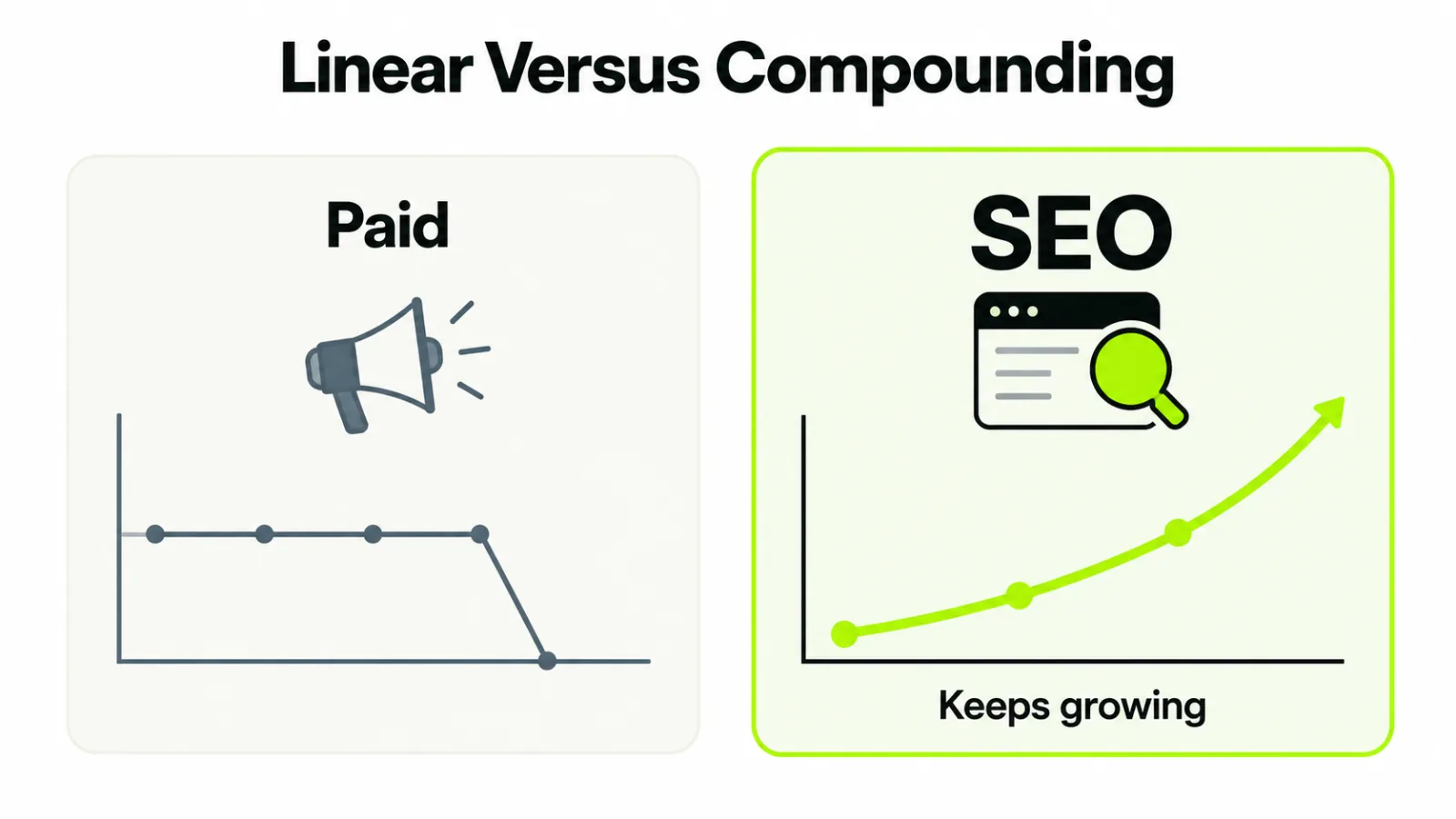
The economics tilt toward SEO the longer you run it. Paid cost-per-acquisition climbs as you scale and as competitors bid up the same keywords. Organic cost-per-acquisition falls as your authority grows, because each new page and each new link ranks more easily on a domain search engines already trust. A page you pay to produce once can return pipeline indefinitely. That’s why mature SaaS companies so often watch organic become their most efficient channel, even though it was the slowest to get going.
The metrics that actually measure SaaS SEO ROI
Measure SEO ROI through pipeline and revenue signals: organic-sourced demos, influenced pipeline, and the lifetime value of customers who arrive through search. Traffic and rankings are leading indicators. Pipeline is the number a founder and a board care about.
| Metric layer | What it tells you | Why it matters for ROI |
|---|---|---|
| Rankings & visibility | Whether your priority pages are climbing | The earliest sign the investment is taking hold |
| Qualified organic traffic | Visits from people who fit your ICP | Proves relevance |
| AI-answer citations | Whether AI engines name your brand | More buyer research starts here every quarter |
| Sourced & influenced pipeline | Demos and opportunities organic helped create | The direct line from SEO to revenue |
| Customer lifetime value | What organically acquired customers are worth over time | The denominator that makes SEO ROI add up |
Attribution is the connective tissue. Wire your analytics and CRM so organic visits and assisted conversions trace back to closed revenue, and SEO stops being a faith-based line item: it becomes a measurable channel you can hold up against paid on equal terms. Building authority around your highest-intent pages, through a deliberate link building program, is what turns rankings into the pipeline these metrics track.
How to think about payback period and timeframe
Expect a realistic payback period of several months to a few quarters, with returns accelerating as authority grows, and treat anyone promising faster guaranteed results as a red flag. The early months of an SEO and link-building program are the investment phase: you’re producing content, earning links, and stacking up the authority rankings depend on. Returns start modest and steepen later, the inverse of paid’s flat line.
The right mental model looks more like product development or a sales rep ramping than an ad campaign. You’re funding an asset that takes time to mature, then throws off durable demand at a falling cost. This is why consistency beats intensity. Stop-start programs reset the progress; sustained investment lets each quarter build on the last. Need to validate demand right now while SEO matures? Run paid alongside it and let organic take over the efficient, durable share of pipeline as it grows.
Why link building and authority are central to the ROI case
Links and authority are what turn content investment into rankings and pipeline, which is why they sit at the center of SEO ROI in competitive SaaS categories. Content alone rarely ranks in a crowded market. The domains that win are the ones credible sources vouch for. Earned authority is the multiplier that makes everything else you publish perform.
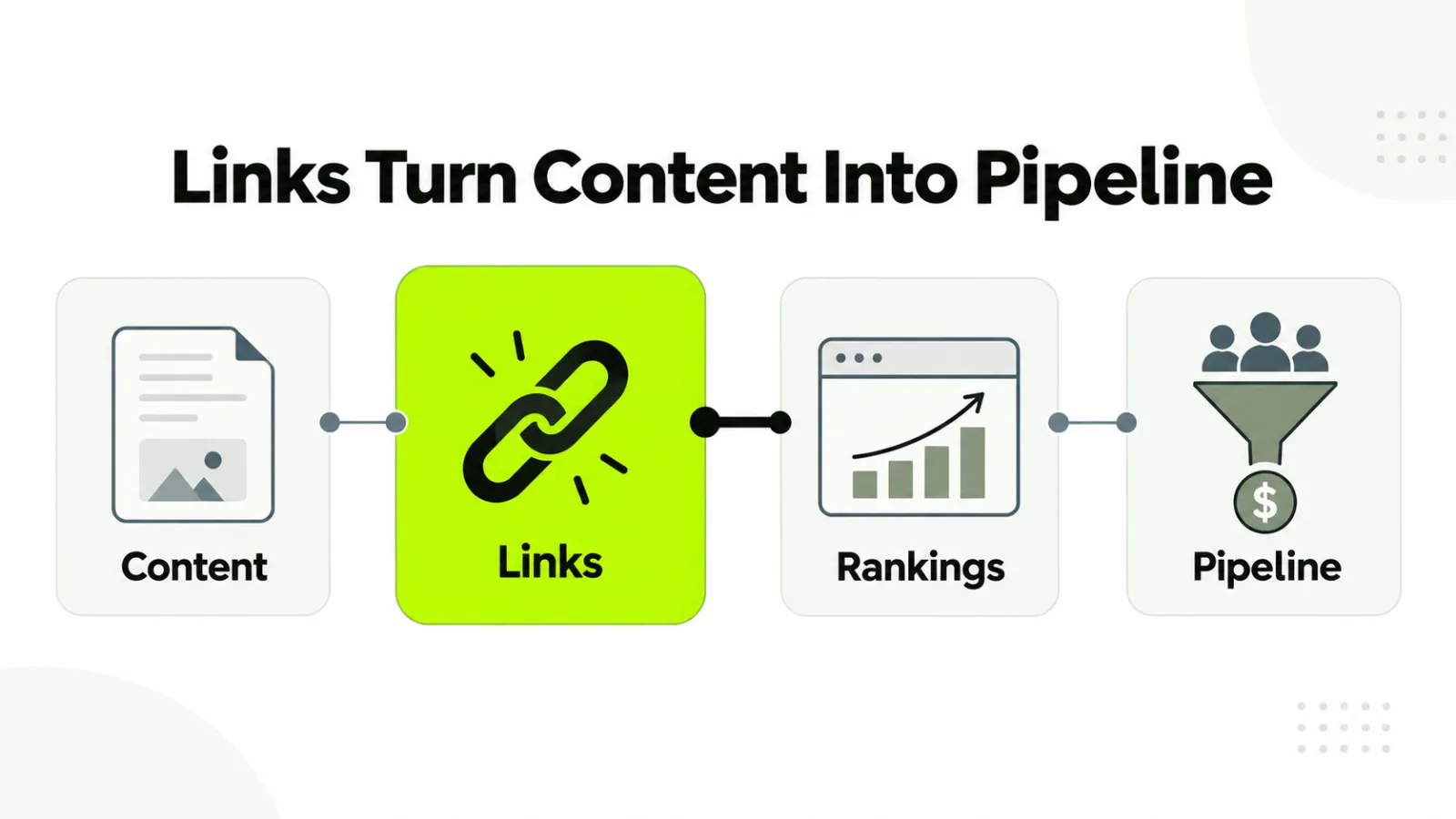
The asset framing earns its keep here. A relevant, editorially earned link keeps passing authority for years, lifting the page it points to and the whole topical cluster around it. That same earned coverage increasingly decides whether AI engines cite your brand, stretching the return into a channel that barely existed a few years ago. Founders who grasp how SaaS link building pays off tend to fund it as infrastructure rather than a campaign, and that framing is usually what separates the companies that win organic from the ones that quit before the curve bends. Want help modelling what an authority program could return for your category? You can talk to our team.
Frequently asked questions
How long until SaaS SEO pays for itself?
Most B2B SaaS companies see payback land somewhere between several months and a few quarters, with returns picking up speed as authority grows. The early months are an investment phase: you build content and earn links, and meaningful pipeline tends to follow once rankings and authority mature. Your exact timeframe comes down to how competitive your category is, how much authority you start with, and how consistently you keep investing.
How is SEO ROI different from paid ads ROI?
Paid ROI is immediate and linear: spend and return move in lockstep, and the leads stop the moment you stop paying. SEO ROI is back-loaded and cumulative: slower to build, but it keeps returning pipeline long after the work is done, usually at a falling cost per acquisition. Score SEO on a short paid-style window and you’ll almost always undersell its real return.
What metrics should founders track to measure SEO ROI?
Follow the chain from rankings and qualified organic traffic through to sourced and influenced pipeline and the lifetime value of organically acquired customers. Rankings are an early signal, but pipeline and revenue are what prove the ROI. AI-answer citations are increasingly worth watching too, as more buyer research moves to AI assistants.
Is SEO worth it for an early-stage SaaS startup?
SEO is worth it for early-stage SaaS when you can stomach a multi-month horizon and want a durable, long-term channel. If you need demand validated this quarter, paid is faster, but it doesn’t build an asset. Plenty of startups run paid for speed while investing in SEO and authority for the long-term, falling-cost pipeline it eventually produces.
Why is link building part of the SEO ROI conversation?
Because in competitive SaaS categories content rarely ranks without authority, and links are how that authority gets earned and confirmed. Relevant, earned links keep passing value for years and lift entire topic clusters, which makes them one of the most valuable parts of the whole investment. They also shape whether AI engines cite your brand, extending the return into a newer discovery channel.
Can SEO ROI be attributed accurately?
Yes, when your analytics and CRM connect organic visits and assisted conversions to closed revenue. With that attribution in place, you can compare SEO to paid on equal terms instead of treating it as a faith-based expense. Some influence, like brand lift and AI citations, is harder to pin down click-for-click, so the strongest measurement pairs direct attribution with leading indicators.