SaaS link building
Link Equity: Definition and How Authority Flows Through Internal Links
Link equity (sometimes called “link juice”) is the authority and ranking power transferred from one page to another through a hyperlink. Both external backlinks and internal links transfer equity. Strategic internal linking concentrates equity on the pages that need to rank.
What it means
Each page has a baseline amount of equity derived from external links and inbound internal links. When the page links out, internally or externally, it passes a share of its equity to the destination. Pages with many high-equity inbound links accumulate more equity to pass forward.
The amount of equity passed per link depends on the source page’s equity divided across the number of outbound links on the page. Pages with fewer outbound links transfer more equity per link.
How it works
When Google’s ranking systems evaluate a page, they consider both direct backlinks and the internal link structure. Pages with strong internal link support from authoritative pages on the same site rank better than orphan pages even with similar content quality.
Internal link equity flow is therefore a key SEO leverage point: by routing links strategically, you concentrate authority on commercial pages where rankings translate directly to pipeline.
Why it matters for SaaS
For SaaS sites, the highest-equity pages are typically the homepage and blog category pages. Strategic internal linking moves equity from these high-authority pages to commercial pages (product, pricing, comparison) that need ranking power.
Most SaaS sites under-route equity. Authority earned through external link building flows to the blog where it accumulates uselessly while commercial pages stay equity-starved. A quarterly internal linking audit fixes this.
How to evaluate or use it
Audit which pages have inbound internal links and which don’t. Identify commercial pages that need ranking power. Add contextual internal links from high-authority blog content to those commercial pages, with descriptive anchor text. Use Ahrefs Site Audit or Screaming Frog to map internal link distribution.
Related terms
Learn more
See the SaaS on-page SEO guide for the working internal linking patterns.
How equity flows through a typical SaaS site
The typical SaaS site has equity distribution that looks roughly like this: homepage holds ~30-40% of total site equity, blog index holds ~10-15%, top-traffic blog content holds ~15-20%, product pages hold ~10%, pricing holds ~3-5%, the rest distributed across long-tail content. Most of the equity sits on pages that don’t directly drive conversion.
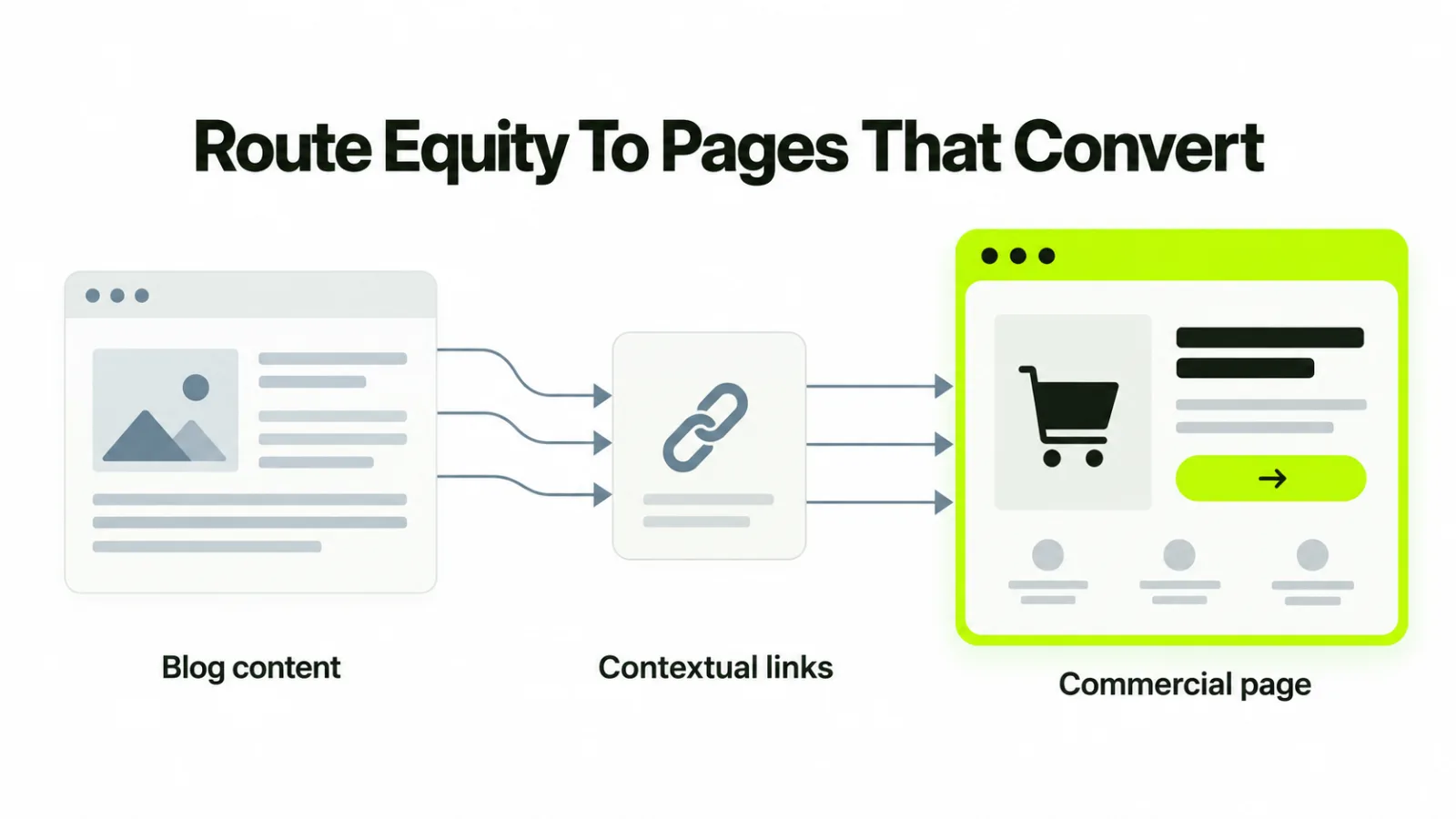
The redistribution opportunity: Strategic internal linking moves equity from high-authority blog content to commercial pages that need it. Adding 4-6 contextual links from your top 10 highest-equity blog pages to your priority commercial pages (product, comparison, pricing) typically moves commercial page rankings 2-5 positions within 30-60 days.
The audit pattern: Use Ahrefs Internal Backlinks or Screaming Frog to map current internal link distribution. Identify the 20-30 highest-authority pages on your site. Identify the 10-20 commercial pages that need ranking power. Add contextual cross-links with descriptive anchor text. Repeat quarterly.
Frequently asked questions
What’s the difference between link equity and PageRank?
Link equity is the general concept; PageRank is Google’s historical (now internal) implementation. The terms are used interchangeably though PageRank specifically refers to Google’s algorithm.