SaaS link building
AEO vs SEO for SaaS: When Each Wins and How to Combine Them
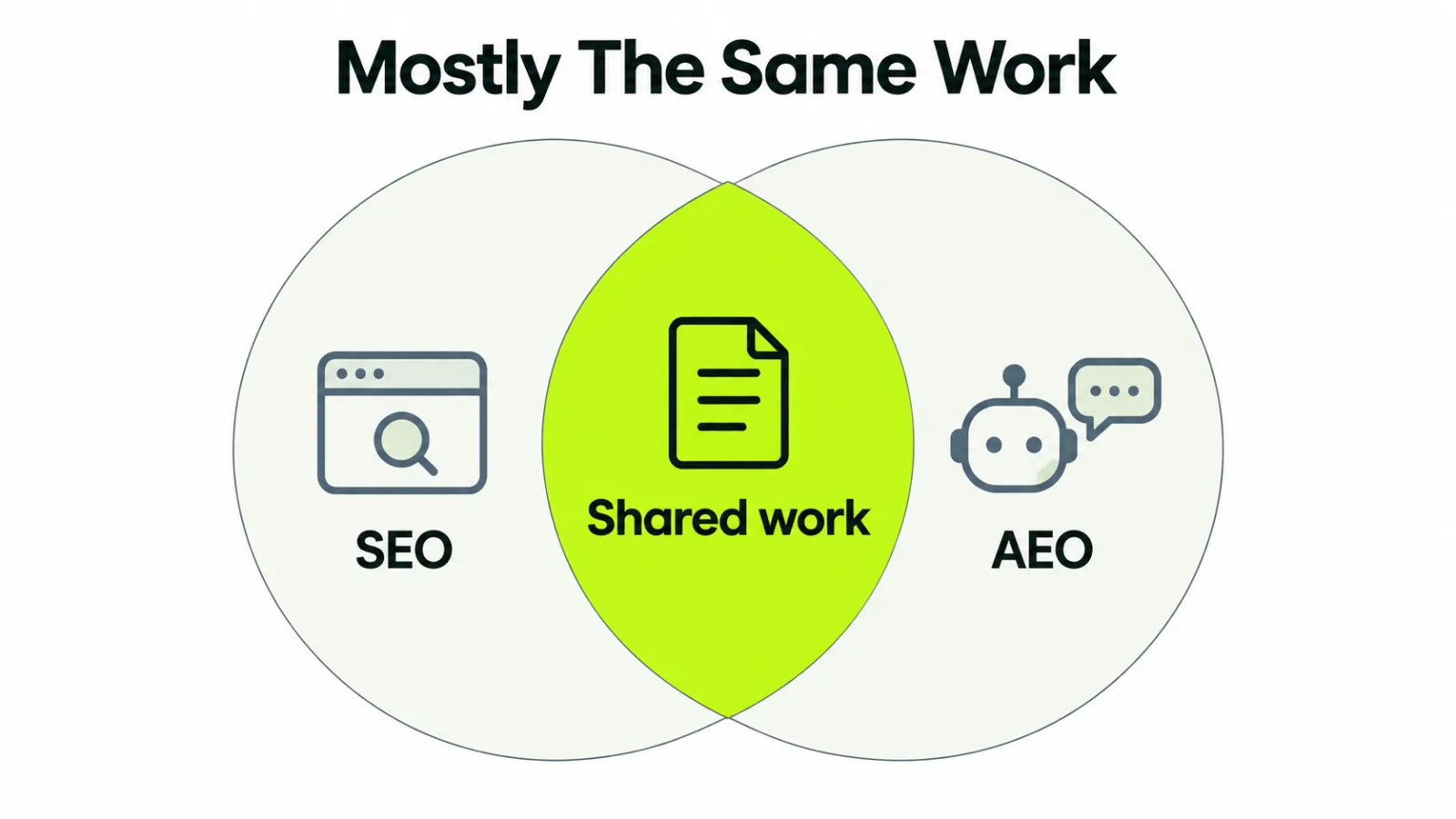
AEO and SEO are not the same discipline, but they overlap by roughly seventy percent. SEO optimizes web pages to rank in traditional search engine results. AEO optimizes content so AI answer engines like ChatGPT, Perplexity, Google AI Overviews, Claude, and Gemini select it as a cited source. B2B SaaS marketing teams that treat these as one discipline lose ground in both; teams that treat them as competing priorities double their costs unnecessarily. The right approach is to recognize the overlap, add the few net-new AEO inputs that SEO does not cover, and run both as a single workflow.
The thirty-second definition of each
SEO stands for Search Engine Optimization. It is the decades-old discipline of optimizing web pages to rank in the results of search engines like Google and Bing. The inputs are keywords, backlinks, on-page content quality, technical site health, and topical authority. The output is page position in the search results. The goal is to land in positions one to ten for queries that matter to your business.
AEO stands for Answer Engine Optimization. It is the much newer discipline of optimizing content so that AI answer engines pick it as the cited source when those engines generate an answer to a user’s question. The inputs are schema, direct-answer formatting, entity authority, source diversity across high-trust domains, and brand mention velocity. The output is a citation in an AI-generated response. The goal is to be the source the model points to when a buyer asks a question.
The two disciplines share their core inputs (quality content, structured data, authority signals) but diverge on tactical priorities, measurement, and a handful of net-new signals that only matter for one or the other.
Where AEO and SEO overlap (about seventy percent)
Content quality: Both disciplines reward expertise, accuracy, original research, depth, and clarity. A page that ranks well in Google generally has the qualities that get it cited in AI engines too.
Schema markup: Organization, Article, FAQ, HowTo, and Product schema all benefit both SEO (rich results) and AEO (parsability for AI extraction). The same schema implementation serves both disciplines.
Site authority: Domain authority still matters for AEO, particularly for Perplexity and Google AI Overviews, both of which heavily weight DA in source selection. The link building work that improves your SEO also improves your AEO.
Topical depth: Cluster architectures (pillar pages plus supporting children, bidirectionally linked) help both. Google reads them as topical authority signals; AI engines read them as evidence the site is a real authority on the topic.
Internal linking: Both signal topical relevance and improve crawlability. The same internal linking architecture serves both.
Where AEO and SEO diverge (the other thirty percent)
Answer format is much stricter in AEO. SEO is forgiving about how your content is structured. Google can extract the right paragraph from a long article. AEO requires direct-answer first paragraphs because AI engines lift the first clean answer they find. Bury the answer at the bottom and you are invisible to AEO even if the page ranks well in Google.
Third-party signals matter much more in AEO. SEO trusts your own domain heavily. Your page is a primary signal of authority on a topic. AEO weights third-party mentions of your brand (on Reddit, Quora, Wikipedia, news sites, high-DA blogs) much more than your own claims about yourself.
llms.txt is a pure AEO signal. SEO does not care whether you publish an llms.txt file. Several AI engines now read it as a content map. Full llms.txt guide.
Brand entity recognition is required for AEO. SEO ranks pages. Your URL can rank for a query whether or not Google “knows” who you are as a brand. AEO requires brand-as-entity recognition. The AI engine has to know what your brand is and what it does before it will confidently cite you as the source.
Recency weighting is sharper in AEO. SEO weights recency for some queries (news, trending topics) but is generally tolerant of older content if it remains accurate. AEO heavily favors recent content across the board, particularly Perplexity, which prioritizes content updated within the last twelve months.
Measurement is harder for AEO. SEO has Google Search Console, Ahrefs, Semrush, and a mature reporting ecosystem. AEO has manual prompt audits plus emerging tools like Profound, AthenaHQ, and Otterly. The measurement discipline is roughly where SEO was in 2008.
When AEO wins and when SEO wins
AEO wins when the query is definitional (“what is customer success platform”), comparison-driven (“ToolA vs ToolB”), multi-step (“best onboarding tool for fifty-person B2B SaaS”), or research-heavy. Buyers in research mode increasingly start with AI engines instead of Google because they get a synthesized answer instead of ten links to evaluate. For B2B SaaS, this is where most of your top-of-funnel buyer attention is migrating.
SEO wins when the query is transactional (“buy [specific product]”), navigational (“Slack login”), or pricing-specific (“[brand] pricing”). Buyers ready to convert still go to Google because they want direct access to a specific page and not a synthesized answer. Bottom-of-funnel queries that close deals remain SEO-dominated.
For a B2B SaaS company in 2026, the rough mix is that roughly sixty percent of new top-of-funnel value will flow through AEO surfaces within twenty-four months, but the bottom-funnel transactional queries that close deals will remain SEO-dominated for the foreseeable future. You need both.
How to invest in both without doubling cost
The good news is that most AEO tactics are SEO tactics with one or two additional steps. Examples:
Your existing SEO content briefs already include target keyword, headings, structure, and content length. To make them AEO-ready, add two requirements: the lead paragraph must answer the implied query in fifty to eighty words, and the page must include FAQ schema with at least five questions. That is the entire content brief upgrade.
Your existing comparison pages already serve SEO. They now also serve AEO disproportionately because AI engines cite comparison content heavily. The same pages, no new work, but you should build more of them.
Your existing digital PR program already earns backlinks for SEO. It now also seeds the brand mentions that AI engines use to recognize your entity. Same work, double benefit.
The five net-new AEO tactics that SEO teams need to add: publishing llms.txt, building genuine Reddit and Quora presence, working Wikipedia and Wikidata for entity recognition, tracking brand mention velocity as a metric, and running monthly AI prompt audits. None of these are expensive, combined, they add roughly five to ten hours per month to a competent SEO program.
What GEO adds to the picture
GEO stands for Generative Engine Optimization. It is the broader umbrella discipline that contains AEO plus entity authority work, model training-data influence, brand mention seeding across the open web, and the strategic coordination of all the above. Think of it as: SEO plus AEO plus entity work plus PR all running together. Read the full GEO playbook for the integrated framework.
Frequently asked questions
Will AEO replace SEO?
No. They are complementary. Even as AI engines absorb more top-of-funnel traffic, traditional search remains essential for navigational and transactional intent. The right mental model is “SEO + AEO” not “SEO or AEO.”
How much of my budget should shift from SEO to AEO?
For most B2B SaaS in 2026, allocate roughly seventy percent to combined work that serves both, twenty percent to net-new AEO-specific work (Reddit/Quora, entity, llms.txt), and ten percent to AEO measurement tooling and audits.
Do I need a different agency for AEO?
Not necessarily. A competent modern SEO partner should already be running AEO-aligned tactics. Ask your agency to articulate their AEO playbook and measurement approach, if they cannot, that is the warning sign.
Related reading
- ← Back to AI Search for SaaS: Complete Guide
- Generative Engine Optimization for SaaS
- Entity Authority for SaaS
Need help bridging SEO and AEO for your B2B SaaS in one integrated program? Our authority program runs both as a single workflow. Book a strategy call.